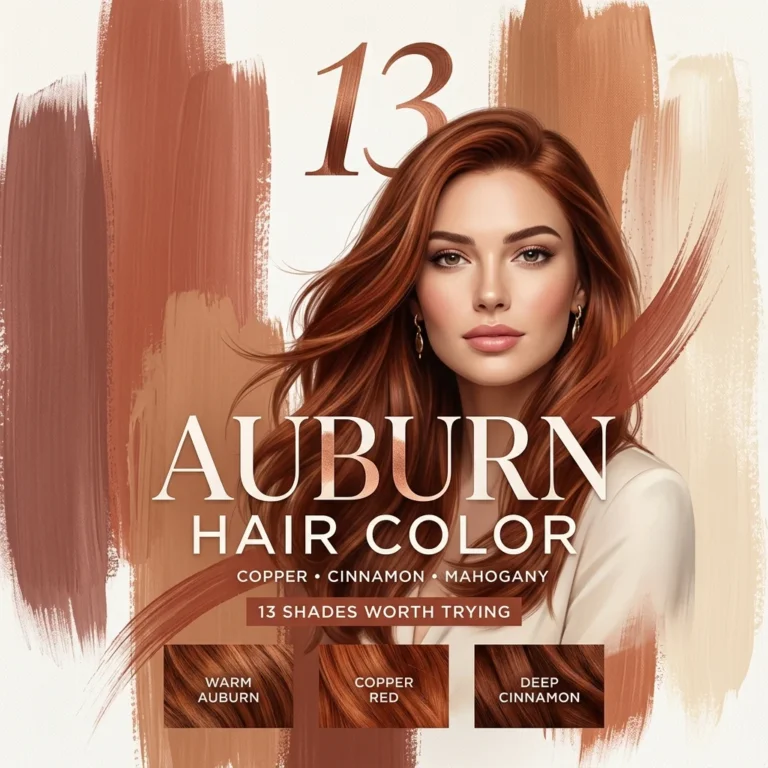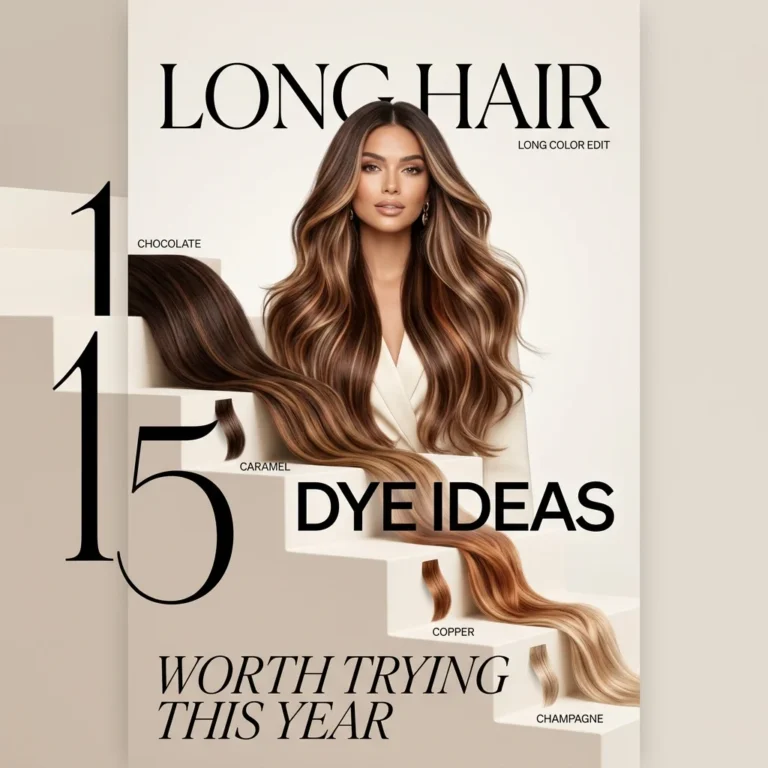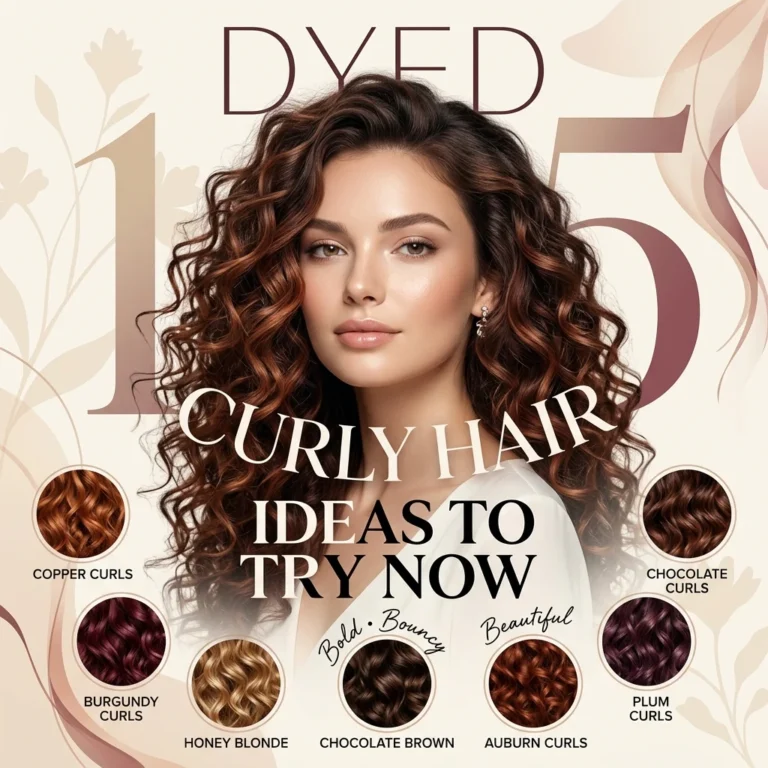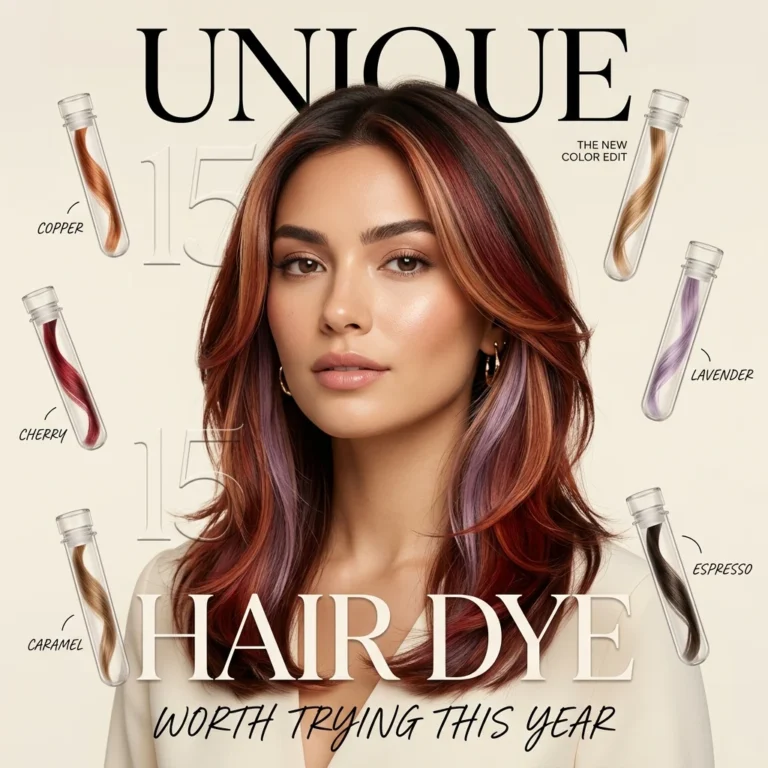
15 Maroon Hair Ideas Worth Saving (And Stealing)

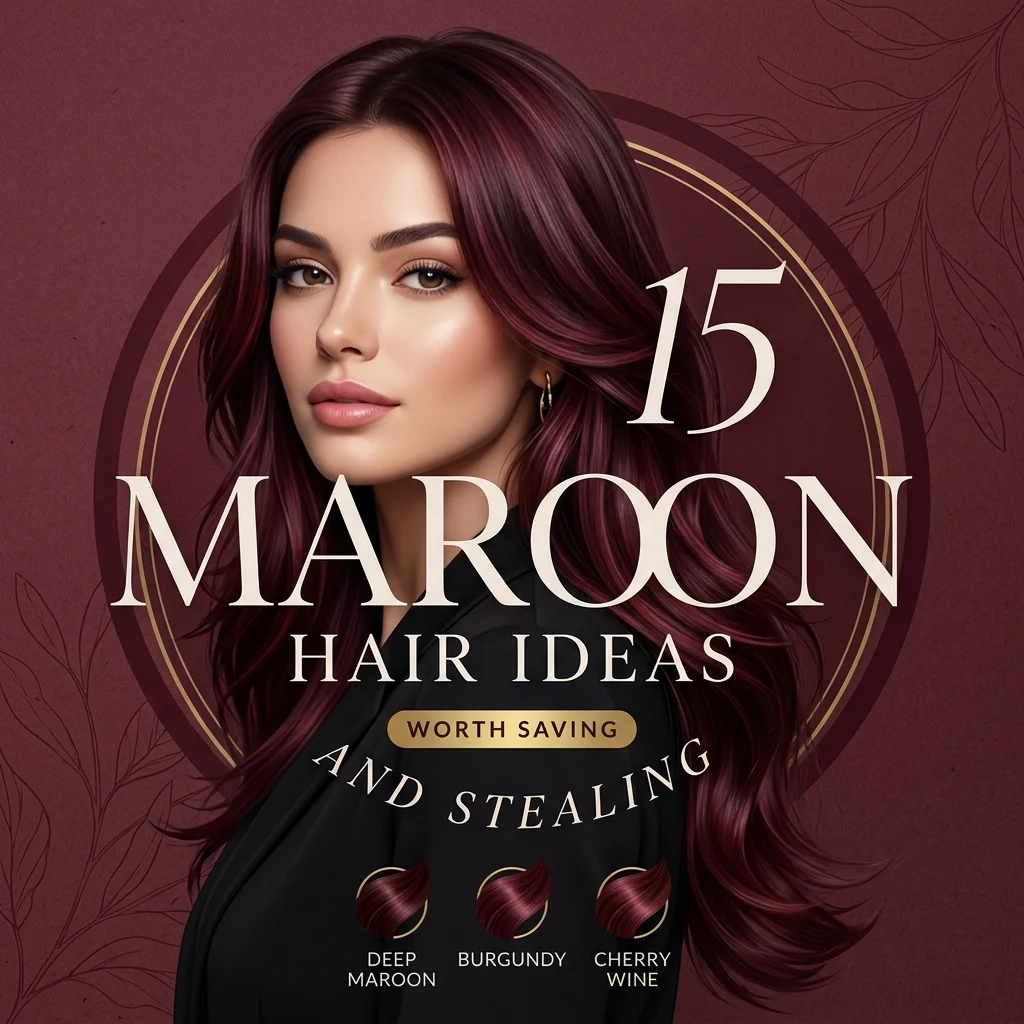
Maroon hair is a deep, brownish-red shade that sits between burgundy and chestnut, with just enough purple undertone to look rich instead of harsh. This article gives you 15 maroon hair ideas, from full-color transformations to low-commitment glosses, so you know exactly which shade, technique, and finish to ask your colorist for.
Maroon reads differently depending on the light it catches: flat and almost black indoors, then glowing garnet the second the sun hits it. It’s the color equivalent of velvet, dense and warm, a little dramatic without trying too hard. It suits people who want red hair that still feels grounded and wearable for everyday life. Here are 15 ideas worth saving, and stealing.
Why Maroon Hair Works So Well
Maroon sits at the intersection of red, brown, and violet on the color wheel, so it reads as more sophisticated than a straight copper or cherry red. The shade family includes blackberry maroon (cooler, purple), cherry cola maroon (warmer, red-brown), and wine maroon (deep, near eggplant), usually built at a 3–5 color level and finished with a gloss. On dark brown or black hair, true maroon often needs a gentle lift first, since dark strands hold pigment differently than pre-lightened hair.
Maroon is trending as part of a shift toward “your-hair-but-richer” color: low-maintenance, dimensional shades that don’t demand constant touch-ups, matching rising search interest in tonal fall and winter colors over high-maintenance vivids. It also pairs naturally with the muted, jewel-toned makeup trends on Pinterest lately.
It’s one of the more forgiving deep tones for first-timers, though not zero-commitment. As a deposit-only or low-lift color on most bases, it fades toward warm brown rather than brassy orange, so the in-between weeks still look intentional.
Style at a Glance
| Element | Cool-Toned Maroon | Warm-Toned Maroon |
| Philosophy | Moody, understated depth | Rich, sun-catching warmth |
| Key Formulas | Blackberry, plum-mahogany | Cherry cola, garnet |
| Best On | Cool or neutral undertones | Warm or olive undertones |
1. Deep Wine Maroon Base Color
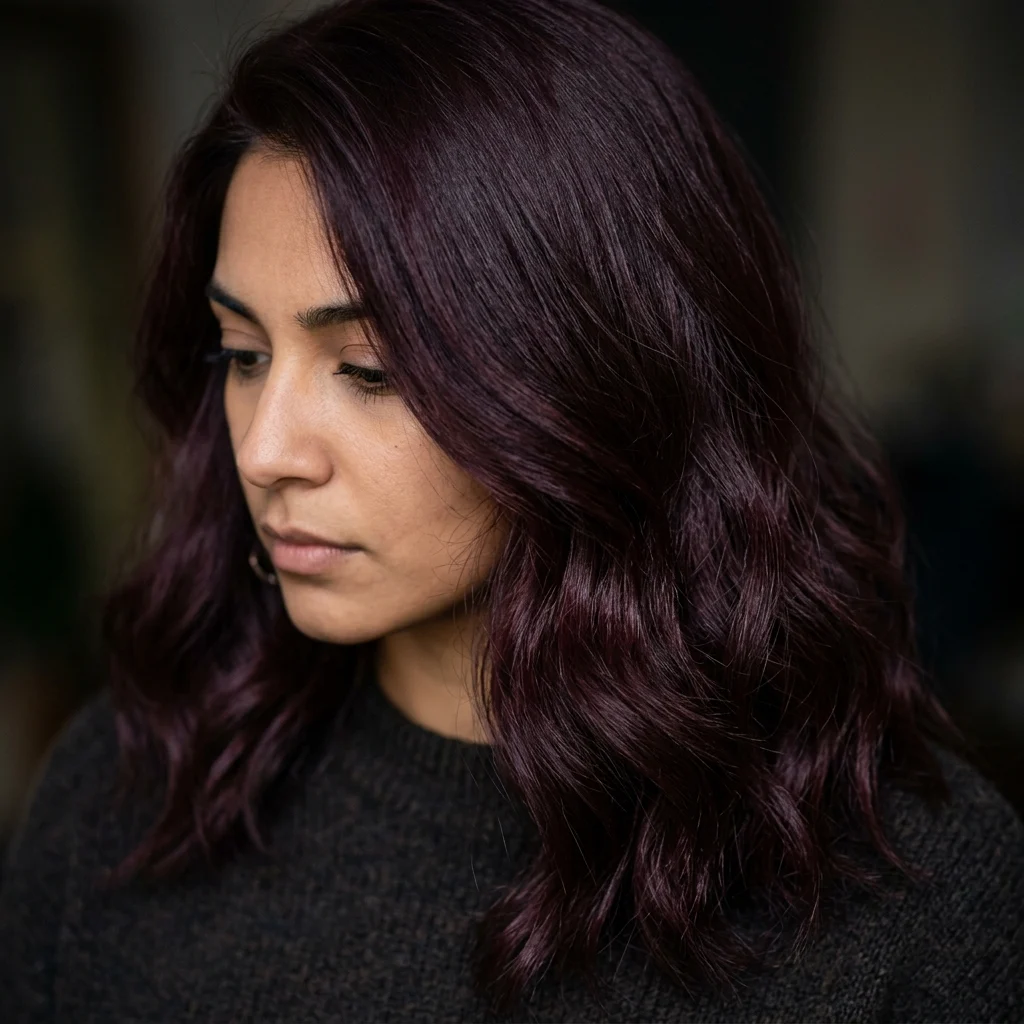
Vibe: Grounded, the color equivalent of a dim, candlelit room.
Why it works: Wine maroon uses a low level (3–4) with heavy red-violet pigment, so it absorbs light rather than reflecting it: dense, almost-black until the sun hits it. It’s a monochromatic formula, so no dimension competes for attention, and regrowth blends forgivingly at a dark base.
How to get it: Ask for a demi-permanent formula mixed at a 3–4 level with a red-violet base. Many colorists use a 1:1 mix of red-violet and natural-brown demi tone rather than a single-shade box color, which prevents muddiness from uneven pigment mixing.
Shop the Look
| Product |
| Color-depositing purple-red toning shampoo for cool maroon tones |
| Sulfate-free color-safe shampoo and conditioner set |
| Silk pillowcase to reduce color fade from friction |
| Leave-in heat protectant spray for color-treated hair |
| Wide-tooth detangling comb for wet, freshly colored hair |
2. Maroon Balayage Over a Dark Brown Base
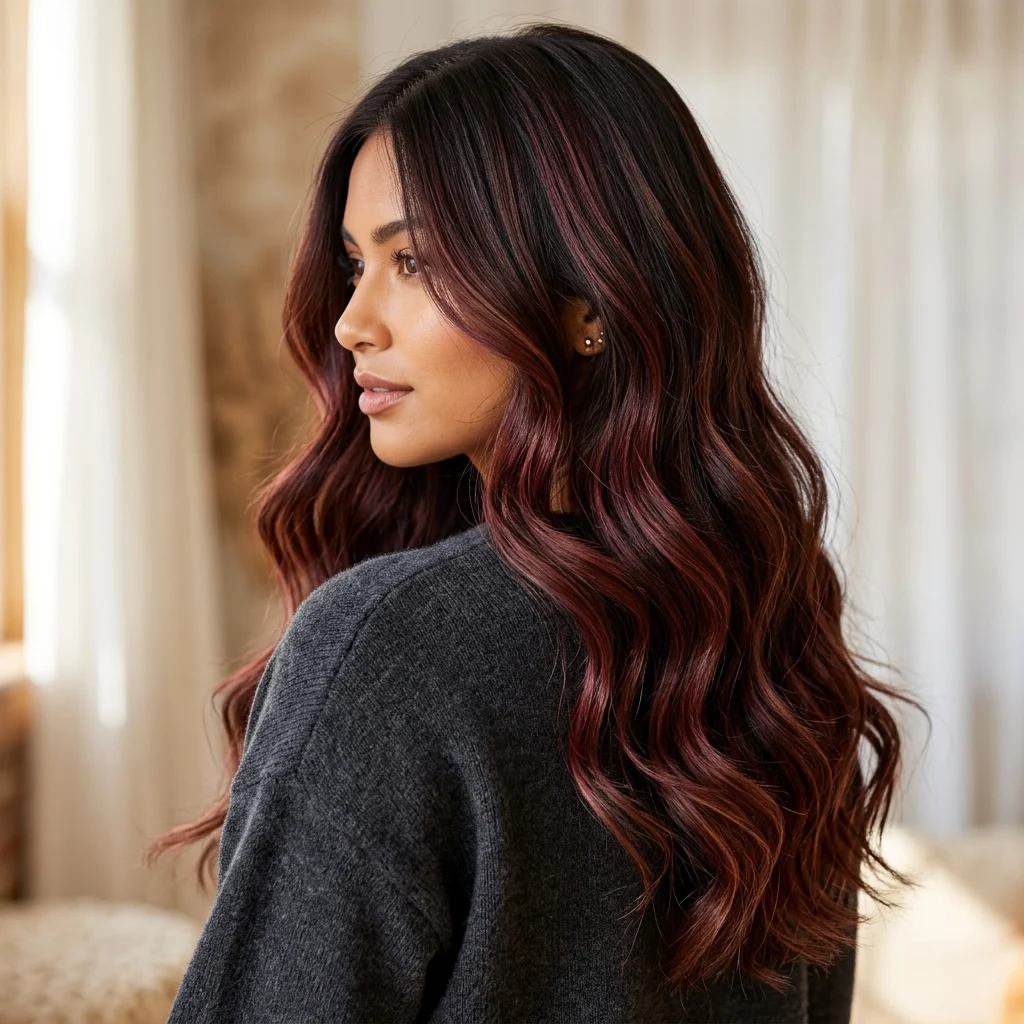
Vibe: Layered, the kind of color that looks different every time the light shifts.
Why it works: Balayage runs on graduated contrast: pigment is hand-painted lightly near the root and built up toward the ends, reading as dimension rather than a flat block. Dark brown does the “shadow” work while maroon does the “highlight,” a lower-maintenance technique than full foils.
How to get it: Request a low-lift balayage using a red-violet gloss rather than a permanent lightener, so maroon deposits onto slightly-lifted brown instead of bleached-blonde hair, keeping contrast subtle.
💡 Quick Win: A temporary gloss on just your ends previews it cheaply first.
Shop the Look
| Product |
| Semi-permanent maroon or garnet hair gloss for at-home preview |
| Tinted color-depositing conditioning mask |
| Boar bristle brush for distributing natural shine |
| Argan oil hair serum for gloss and shine |
| Satin-lined scrunchie set to prevent breakage |
3. High-Gloss “Glass Hair” Maroon Finish
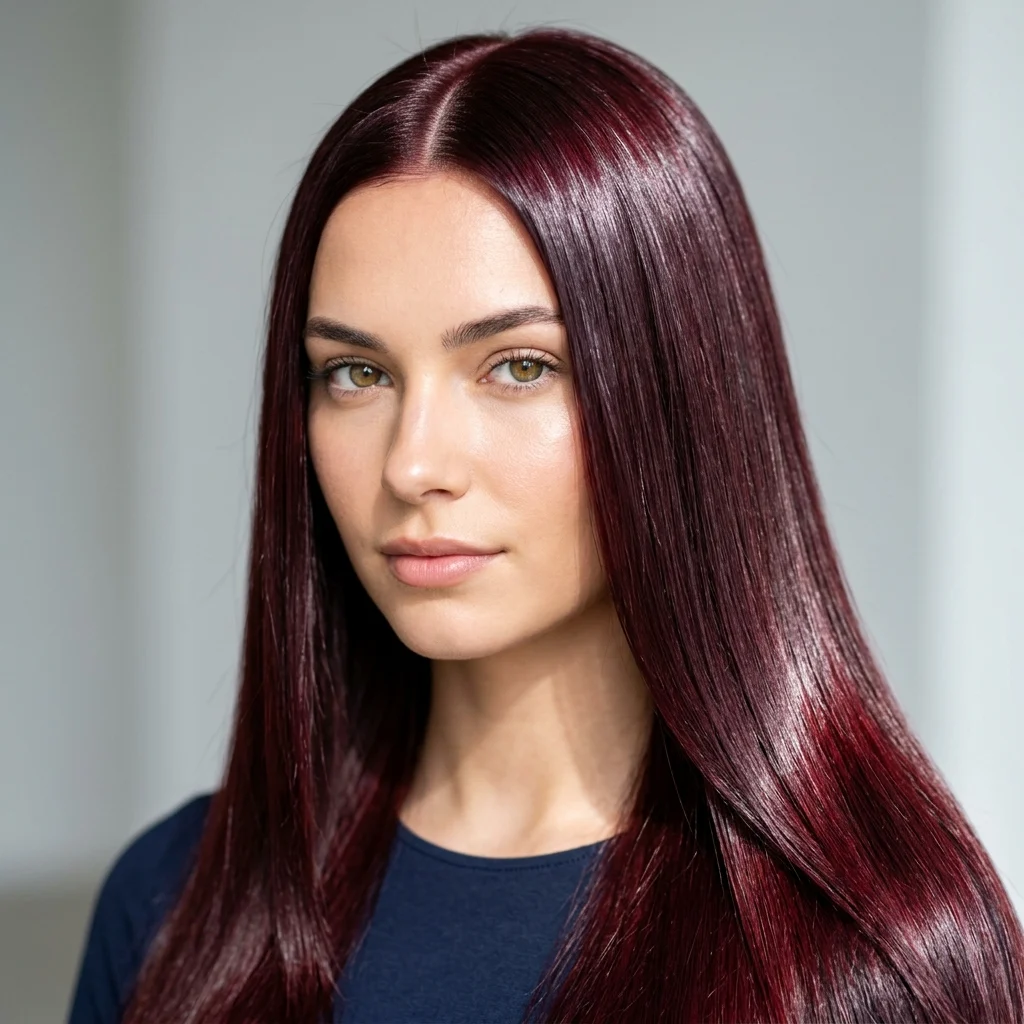
Vibe: Luminous, this finish makes maroon look almost lacquered.
Why it works: “Glass hair” is about light behavior, not formula: sealing the cuticle flat so light bounces one direction instead of scattering. Maroon suits this well because its density hides dullness, while red-violet pigment picks up warm highlights under direct light. It works best on naturally smooth or relaxed textures.
How to get it: After your color service, ask for a clear glossing treatment, then blow-dry with a round brush before flat-ironing on a low setting (around 300°F) with ceramic plates to seal the cuticle without stripping shine.
Shop the Look
| Product |
| Ceramic flat iron with adjustable low-heat settings |
| Clear glossing hair treatment for shine and cuticle sealing |
| Round boar bristle blow-dry brush |
| Anti-frizz smoothing serum for color-treated hair |
| Ionic hair dryer with concentrator nozzle |
4. Long Layers With a Maroon Money Piece
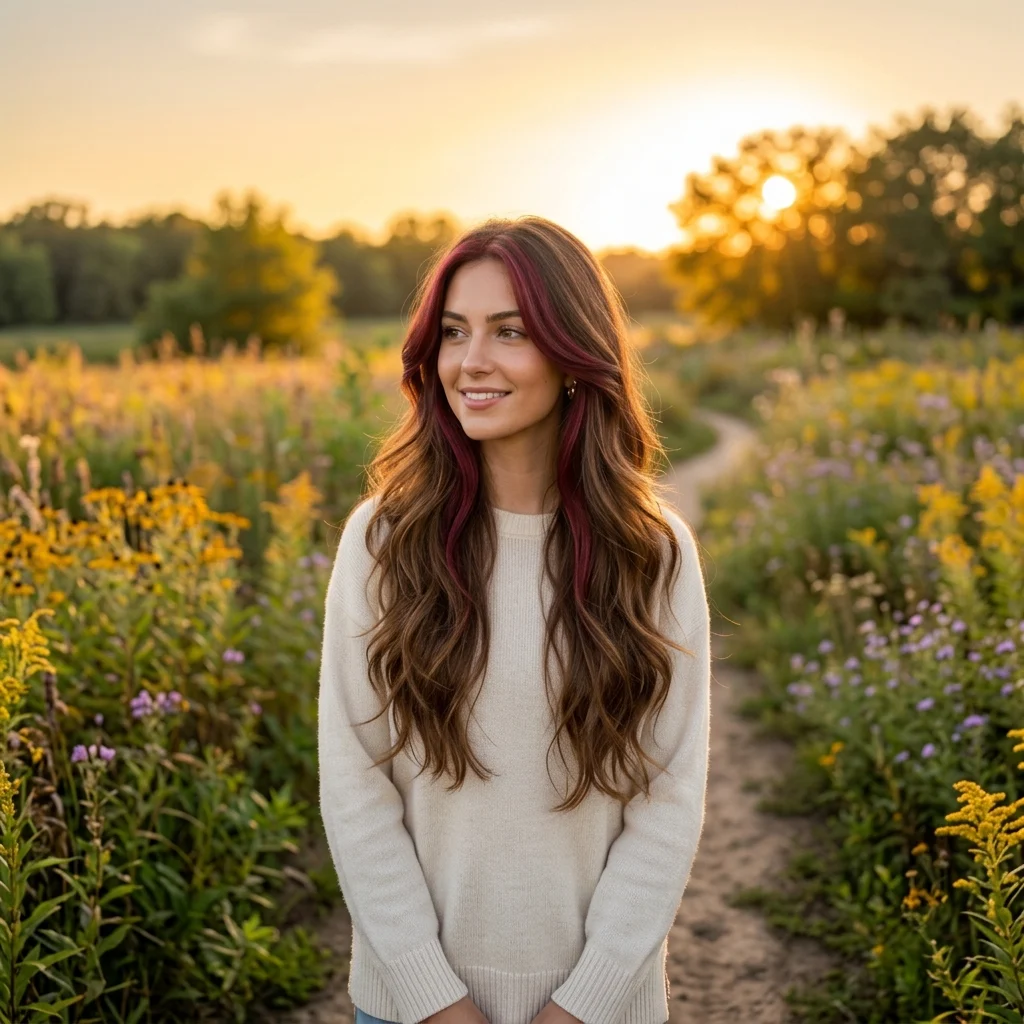
Vibe: Warm-sun-caught, a small dose of color that does a lot of work.
Why it works: This is a proportion play: saturated maroon only at the two face-framing pieces creates visual weight where the eye lands first, without committing the whole head to bold color. The long layers give those pieces room to move and catch light independently.
How to get it: Section off two 1-inch face-framing pieces and have your colorist lift and tone only those to garnet-maroon, leaving the rest natural. Most salons finish this single-foil technique in under 45 minutes.
💡 Quick Win: A matching clip-in extension lets you test the placement first.
Shop the Look
| Product |
| Clip-in human hair extensions in maroon/burgundy tone |
| Sectioning hair clips for precise color placement |
| Root touch-up powder in matching maroon shade |
| Wide-barrel curling iron for soft face-framing waves |
| Texturizing spray for lived-in movement |
5. Blackberry Maroon (Cool-Toned)
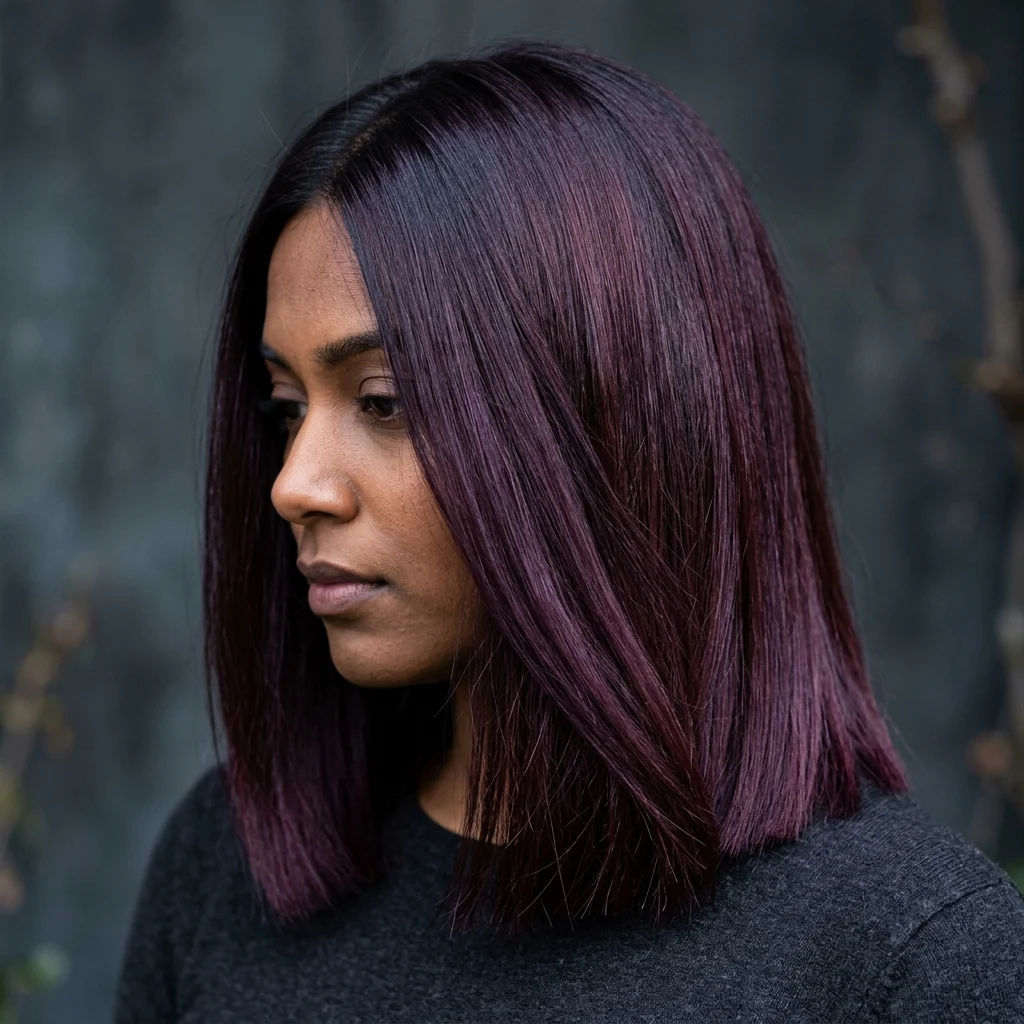
Vibe: Cool and hushed, this shade feels like dusk rather than firelight.
Why it works: Blackberry maroon shifts the red-violet ratio toward violet, which cancels warmth and reads as cooler and more muted than a standard maroon. This makes it the most flattering option for cool or neutral undertones, since it won’t fight with pink or rosy skin tones the way a warmer red-brown might.
How to get it: Have your colorist mix a violet-based demi-permanent color (rather than a straight red) at a level 3–4, and ask specifically for “blackberry” or “plum-mahogany” as a reference. Naming the undertone prevents an accidental warm result.
Shop the Look
| Product |
| Purple-toned color-safe shampoo for cool maroon upkeep |
| Cool-toned hair gloss treatment |
| Silk hair wrap for overnight color protection |
| Deep conditioning hair mask for color-treated hair |
| Matte-finish hair pomade for touch-ups between washes |
6. Soft Beachy Waves to Show Off Dimension
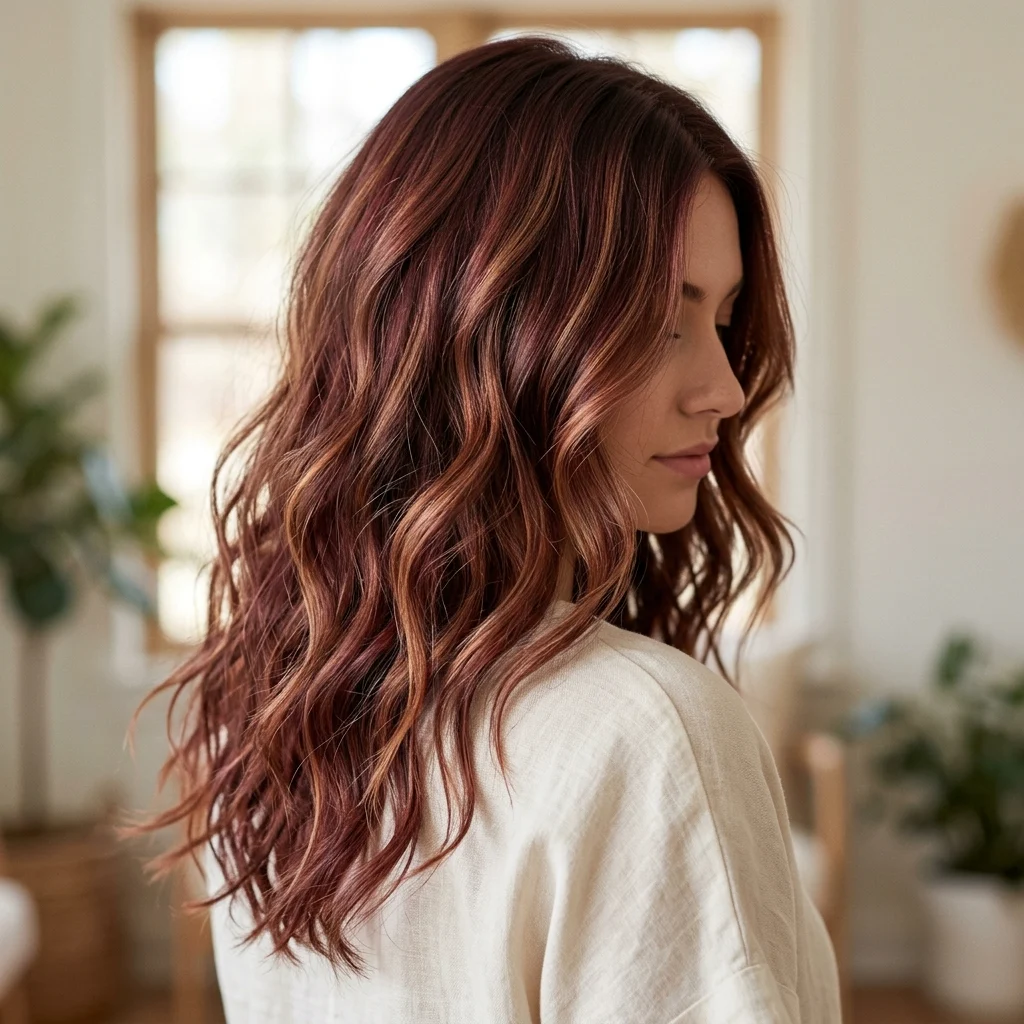
Vibe: Effortless, texture that lets the color do the talking.
Why it works: Dimensional maroon relies on movement to show its full range: flat, straight hair compresses tonal variation into one plane, while loose waves create peaks and valleys that catch light differently across each strand, the same principle that makes balayage photograph so well.
How to get it: Use a 1-inch curling wand, wrapping alternating sections away from your face, then run fingers (not a brush) through cooled curls to break them into a looser, more natural pattern.
💡 Quick Win: Sea-salt spray on damp hair before air-drying creates a similar wave without heat.
Shop the Look
| Product |
| Sea-salt texturizing spray for beachy texture |
| 1-inch curling wand with cool-tip barrel |
| Lightweight curl-defining mousse |
| Wide-tooth comb for post-curl finger styling |
| Heat protectant mist for wand styling |
7. Maroon Root Melt on Dark Hair
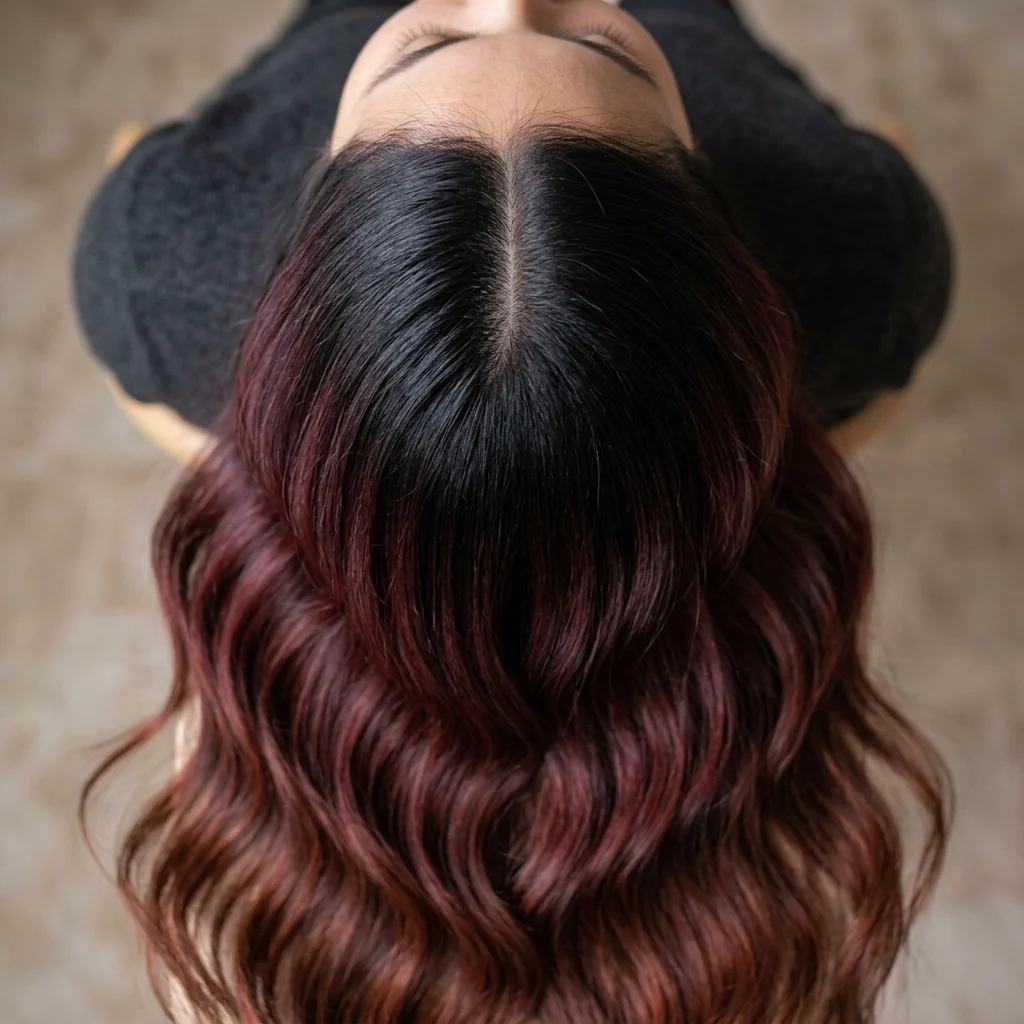
Vibe: Seamless, color that transitions instead of announcing itself.
Why it works: A root melt blends the natural root into maroon with a soft, feathered application instead of a hard line, so as regrowth appears, it reads as an intentional shadow, not obvious roots. It’s a shading technique, not a lightening one, so it suits darker natural bases without heavy bleaching.
How to get it: Ask your colorist to “melt” the root with a diffused, back-combed application of maroon toner two to three inches down, softening the edge with a clean brush before it sets, rather than painting a hard line.
Shop the Look
| Product |
| Root-blending temporary color spray |
| Fine-tooth tail comb for precise sectioning |
| Color-depositing dry shampoo in brunette-maroon tone |
| Tinted root touch-up spray |
| Nourishing scalp oil treatment |
8. Warm Gold Jewelry and Makeup Pairing
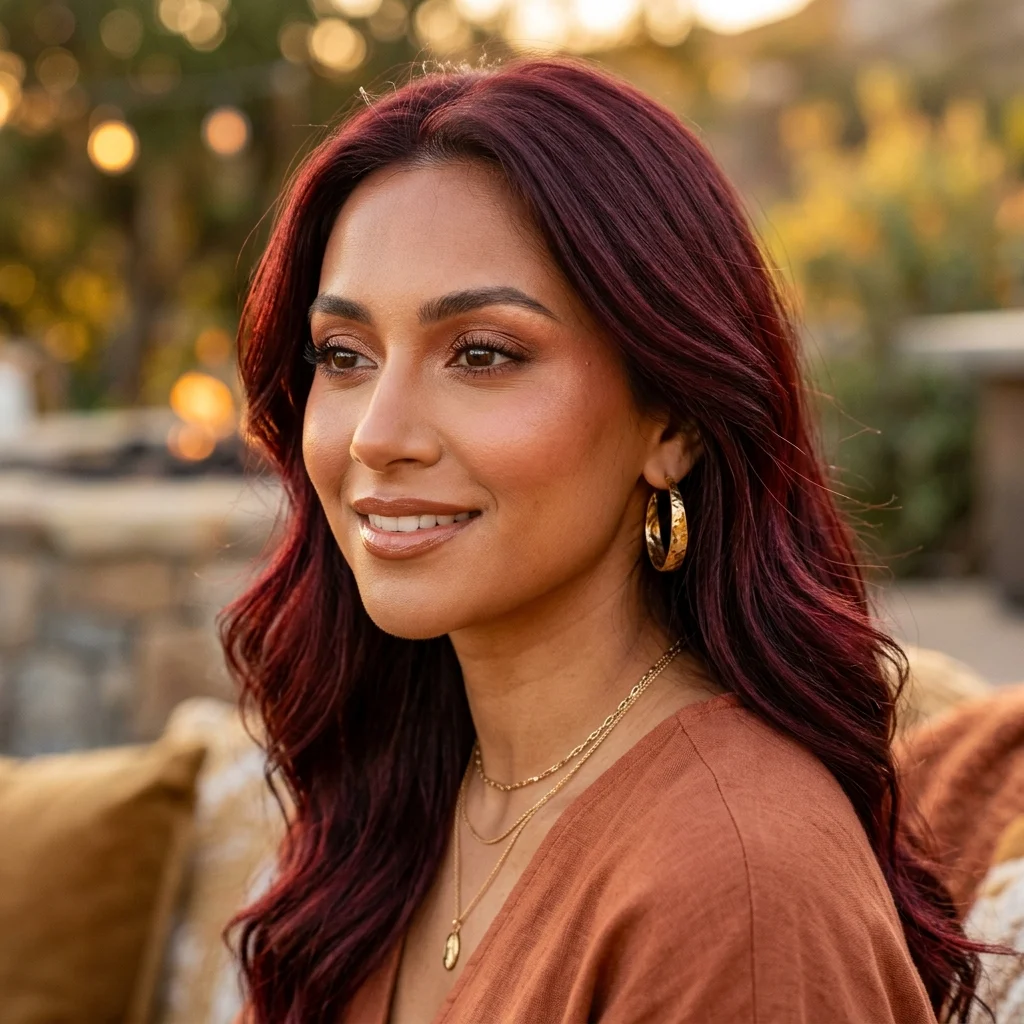
Vibe: Warm and considered, the styling that finishes the color.
Why it works: Maroon has enough visual weight to compete with cool silver jewelry, but it harmonizes with warm metals because gold and garnet-red sit close together on the color wheel. Pairing analogous warm tones (gold, bronze, terracotta) creates cohesion, while cool silver or icy makeup can wash out the hair’s richness.
How to get it: Swap silver jewelry for warm gold or rose-gold pieces, and lean into bronzer and terracotta blush over cool pink tones. This single swap does more than any extra hair product.
Shop the Look
| Product |
| Warm gold hoop earring set |
| Bronzer and terracotta blush duo palette |
| Rose-gold hair pins and clips |
| Warm-toned lip tint in brick or terracotta |
| Gold-tone hair cuff accessory |
9. Cherry Cola Maroon (Warm-Toned)
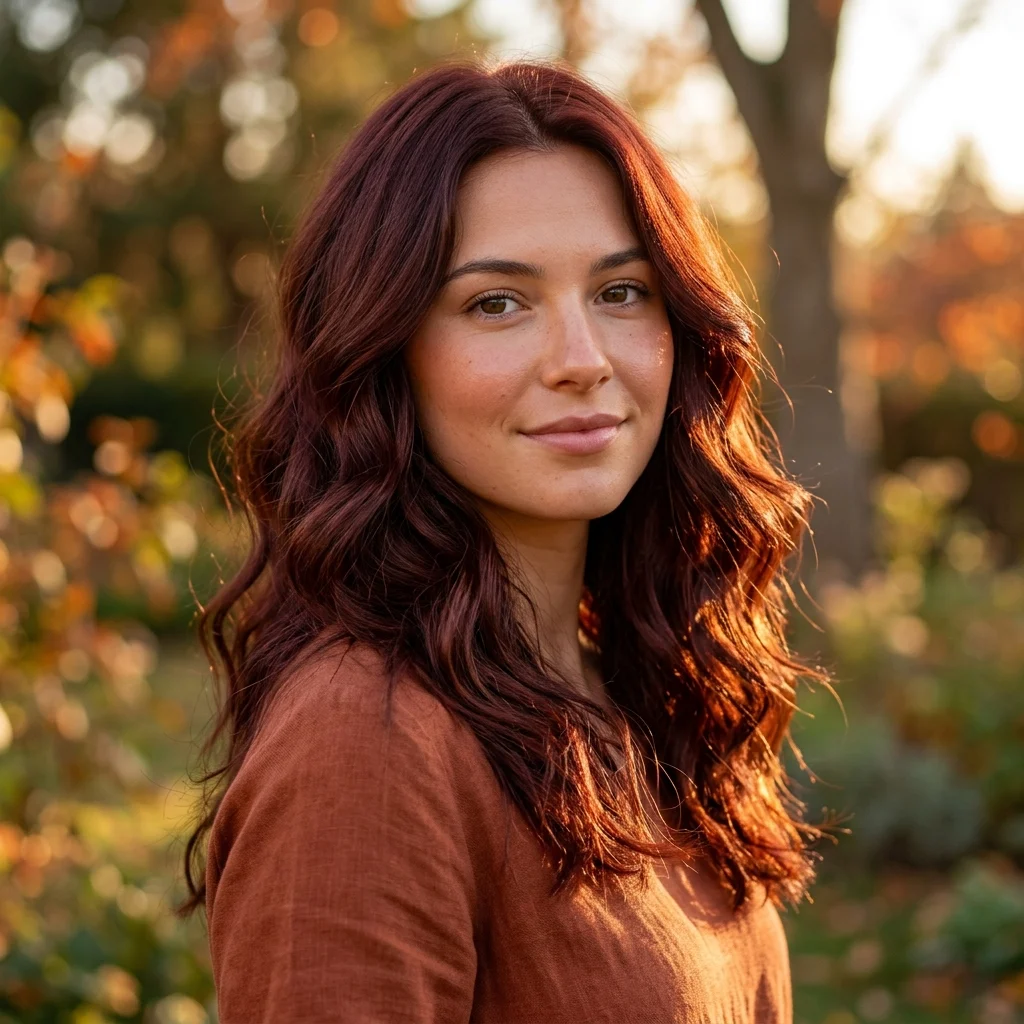
Vibe: Sun-warmed, this shade glows rather than broods.
Why it works: Cherry cola maroon raises the red-orange ratio relative to violet, giving it an amber-lit quality in sunlight while still reading as deep and controlled indoors. It flatters warm and olive undertones because it echoes, rather than contrasts, the skin’s natural warmth.
How to get it: Ask for a level 4–5 formula with a “mahogany” or “cherry cola” base rather than straight burgundy, since burgundy skews purple-cool. The naming distinction matters when briefing your colorist.
💡 Quick Win: A weekly warm-toned color mask refreshes vibrancy between visits, no extra lift needed.
Shop the Look
| Product |
| Weekly warm-red color-refreshing hair mask |
| Copper-toned toning shampoo |
| Heat protectant spray with UV filter |
| Wide-tooth wet detangling brush |
| Silk scarf for sun protection and color preservation |
10. Textured Maroon Bob
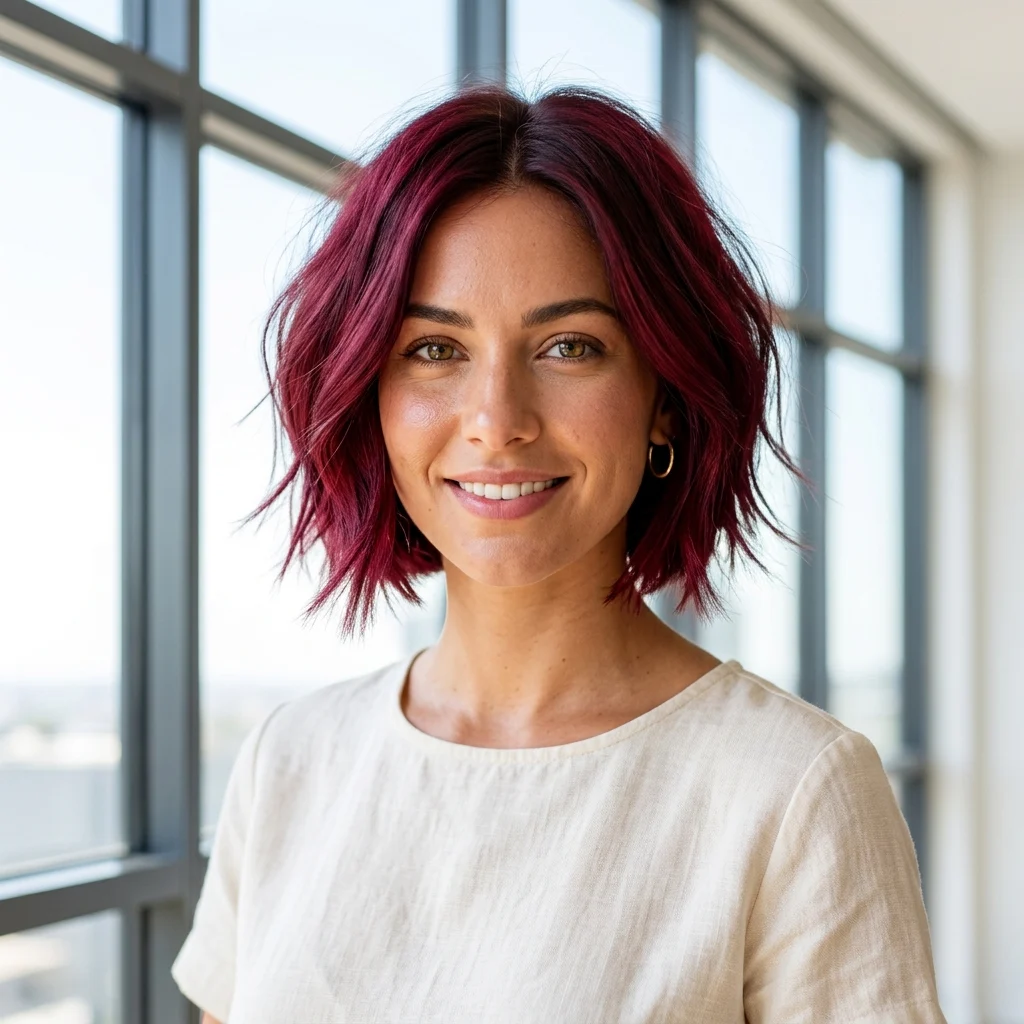
Vibe: Confident, a shape that makes color read as sharp, not soft.
Why it works: A blunt or lightly textured bob concentrates color saturation along a single, defined edge, a scale-and-proportion principle: the shorter the shape, the less room the color has to fade or dilute across length, so a bob typically shows the truest, most vivid version of a maroon formula.
How to get it: Request a chin-to-collarbone length bob cut with a razor (not scissor-only) finish on the ends, which softens the line just enough to prevent the maroon from looking like a flat, single block of color.
Shop the Look
| Product |
| Round paddle brush for bob blow-drying |
| Texturizing pomade for piecey ends |
| Small-barrel curling iron for bob-length waves |
| Color-safe volumizing shampoo |
| Flexible-hold finishing spray |
11. Matte Maroon for an Edgy Look
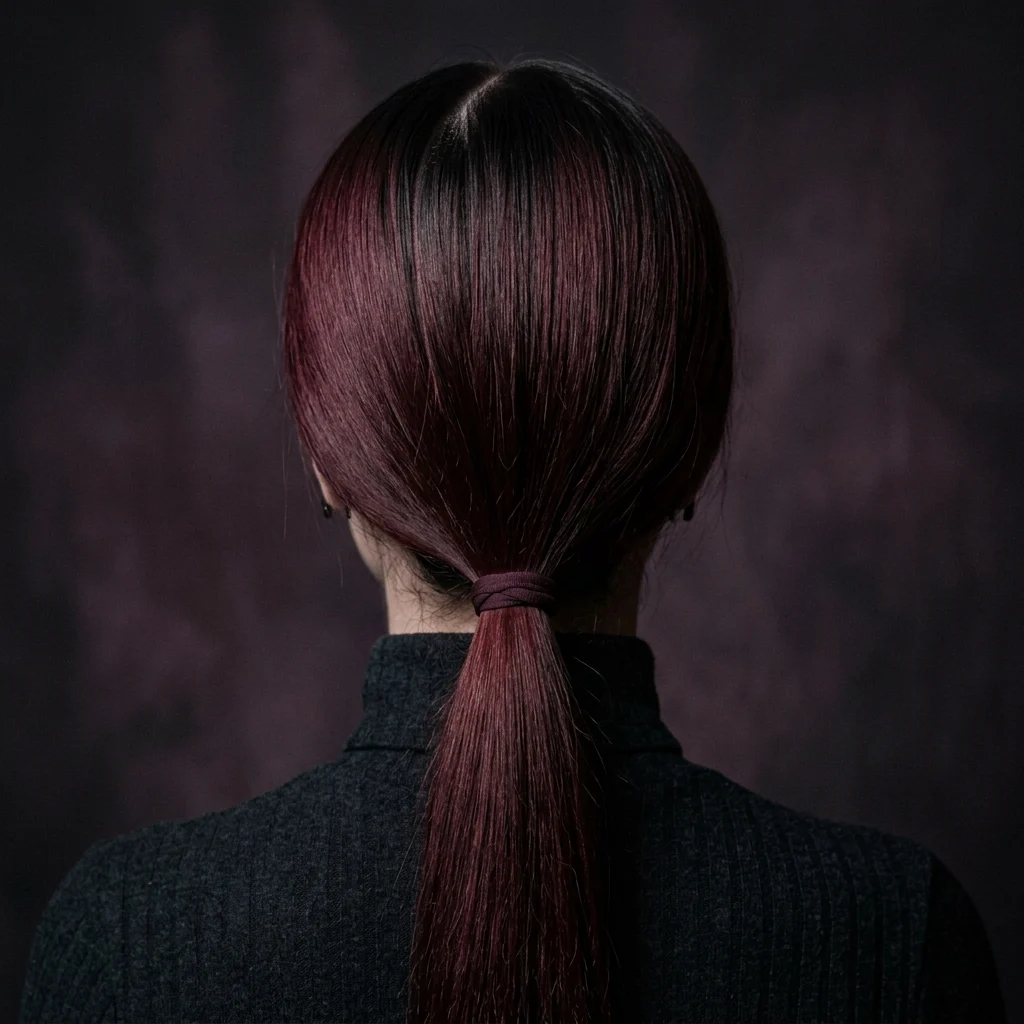
Vibe: Edgy, color with intentionally muted shine.
Why it works: Matte finishes work by disrupting cuticle reflection rather than sealing it, the opposite mechanism from the “glass hair” gloss technique. The result is a flatter, more graphic-looking color block that reads as modern and a little severe rather than soft or romantic.
How to get it: Use a matte or clay-based styling product rather than a shine serum, and skip the glossing top-coat step at the salon. Ask your colorist specifically to omit the final glaze if you want the flattest possible finish.
Shop the Look
| Product |
| Matte clay styling paste |
| Volumizing dry texture spray (no-shine formula) |
| Matte-finish setting spray |
| Fine-tooth comb for a sharp center part |
| Anti-humidity matte hairspray |
12. Sleek Straight Maroon With a Center Part
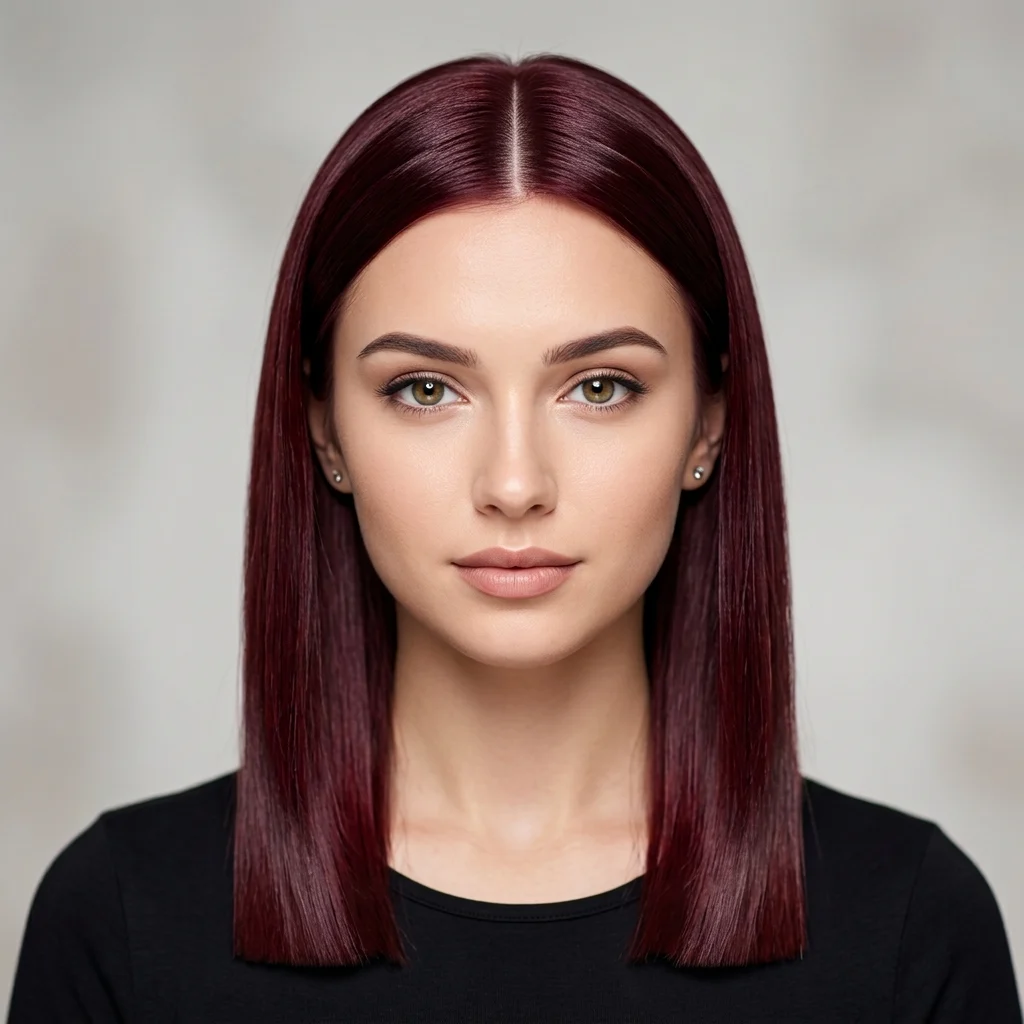
Vibe: Still, a look built on symmetry and calm.
Why it works: A center part creates visual balance by splitting negative space evenly on either side of the face, drawing attention to color depth rather than shape or movement. Straightened hair flattens the surface so maroon’s density reads as a single, unbroken plane of color, a striking contrast to the layered-wave looks earlier on this list.
How to get it: Flat-iron in small, one-inch sections working from root to end in a single smooth pass, and finish with a light-hold shine spray applied only at mid-lengths and ends to avoid weighing down the crown.
Shop the Look
| Product |
| Flat iron with ceramic tourmaline plates |
| Anti-frizz straightening balm |
| Light-hold finishing shine spray |
| Fine-tooth rat-tail comb for a precise part |
| Heat-resistant sectioning clips |
13. Maroon Ombré From Dark Roots
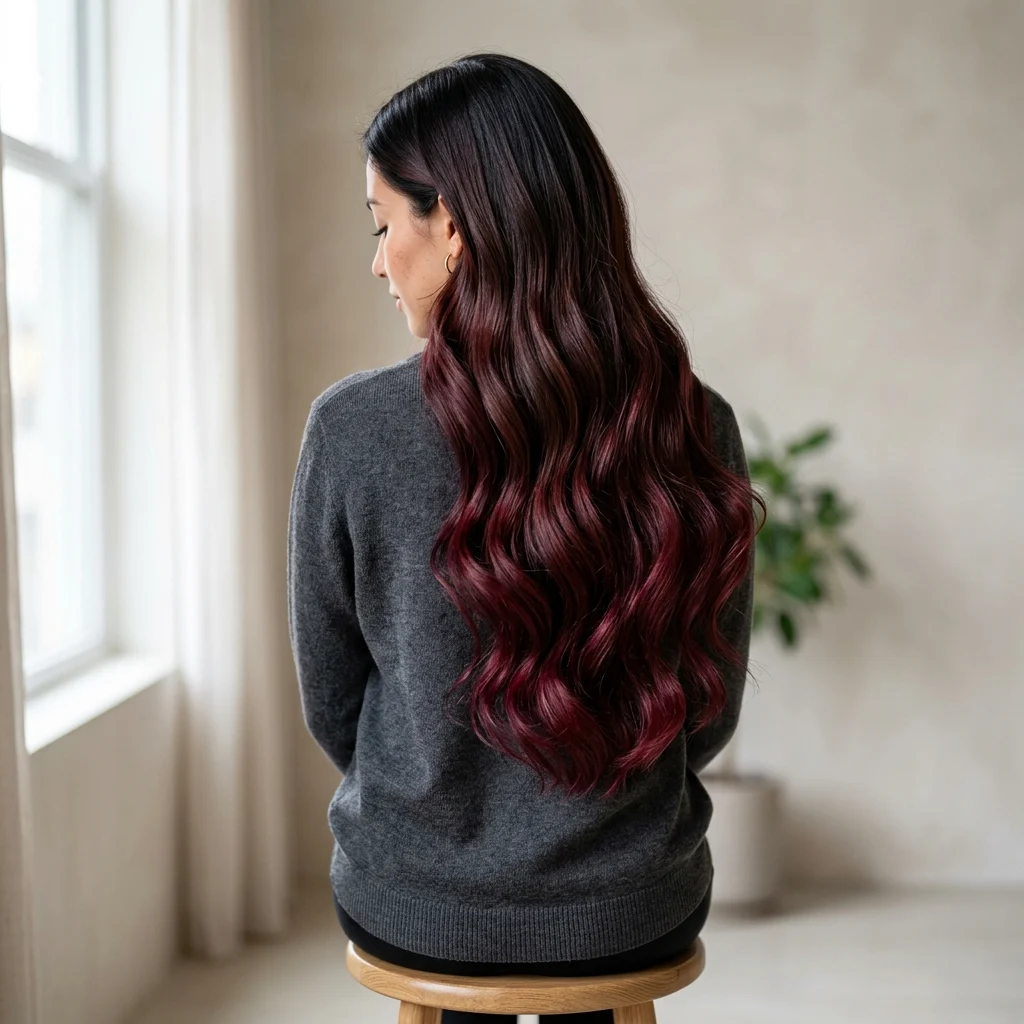
Vibe: Gradient, a color story that moves top to bottom.
Why it works: Unlike balayage’s irregular painted sections, ombré builds a deliberate vertical gradient: dark at the root, progressively more saturated toward the ends. It relies on controlled contrast: too little difference looks accidental, too much looks like two separate colors.
How to get it: Have your colorist lighten only the bottom third to half of your hair before applying maroon toner, keeping a natural root. The transition zone should span two to three inches to avoid a visible band.
💡 Quick Win: Maroon hair chalk on just the ends previews the ombré before you book anything.
Shop the Look
| Product |
| Temporary maroon hair chalk or color spray |
| Bond-building treatment for lightened ends |
| Color-depositing conditioner for gradient upkeep |
| Wide-barrel curling iron to blend the transition zone |
| UV-protectant leave-in spray for lightened ends |
14. Low-Commitment Maroon Gloss for Fine or Fragile Hair
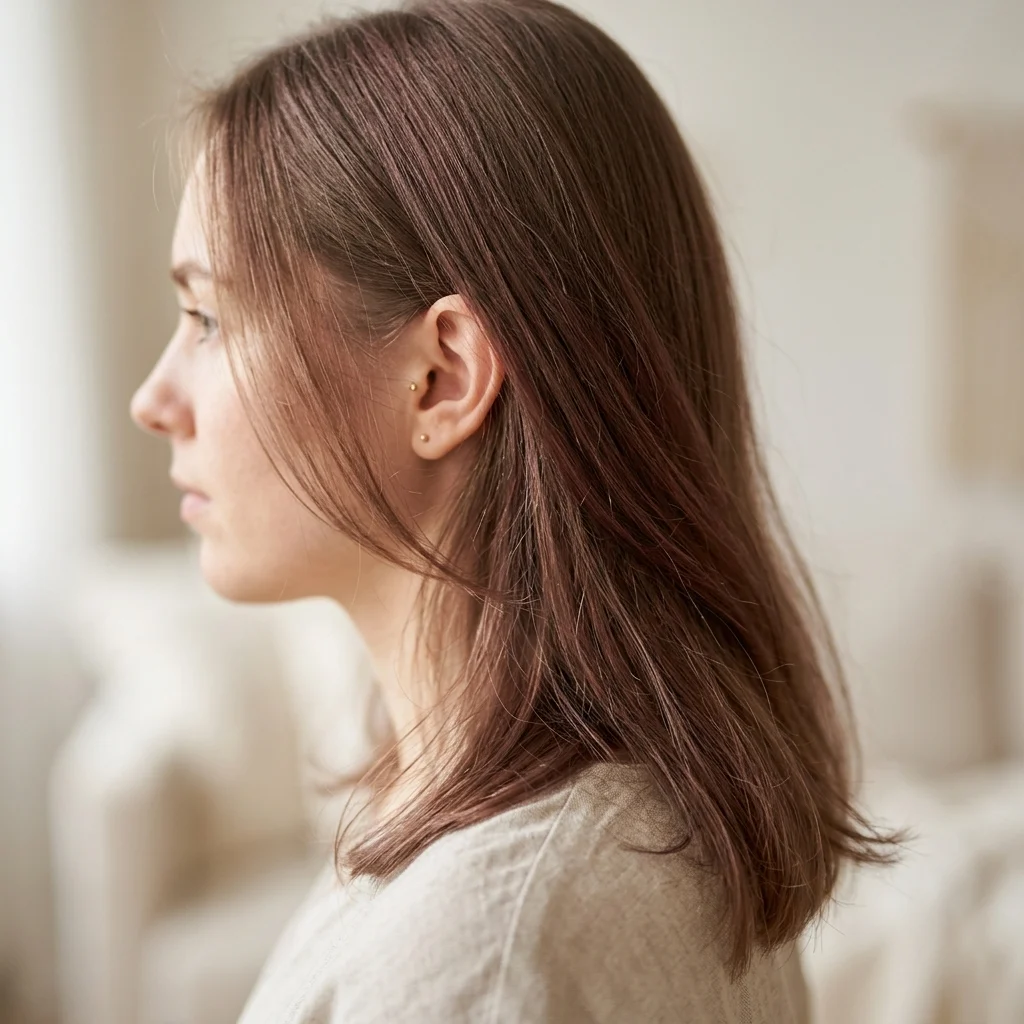
Vibe: Gentle, maroon without the commitment or the damage.
Why it works: Fine or chemically fragile hair often can’t tolerate repeated lightening, so a semi-permanent gloss deposits pigment onto the hair’s surface without opening the cuticle the way permanent color does. This means less structural stress and a shade that fades gradually and evenly rather than growing out with a hard line.
How to get it: Choose a clear-base, ammonia-free gloss in a maroon or garnet shade, applied over clean, towel-dried hair and left on for the manufacturer’s recommended time. This is a treatment your stylist can add to a normal haircut appointment without extra chemical processing.
Shop the Look
| Product |
| Ammonia-free semi-permanent maroon hair gloss |
| Bond-repair leave-in treatment for fine hair |
| Lightweight protein hair mask |
| Microfiber hair towel to reduce breakage |
| Volumizing color-safe dry shampoo |
15. Compact Maroon Pixie for Low Upkeep
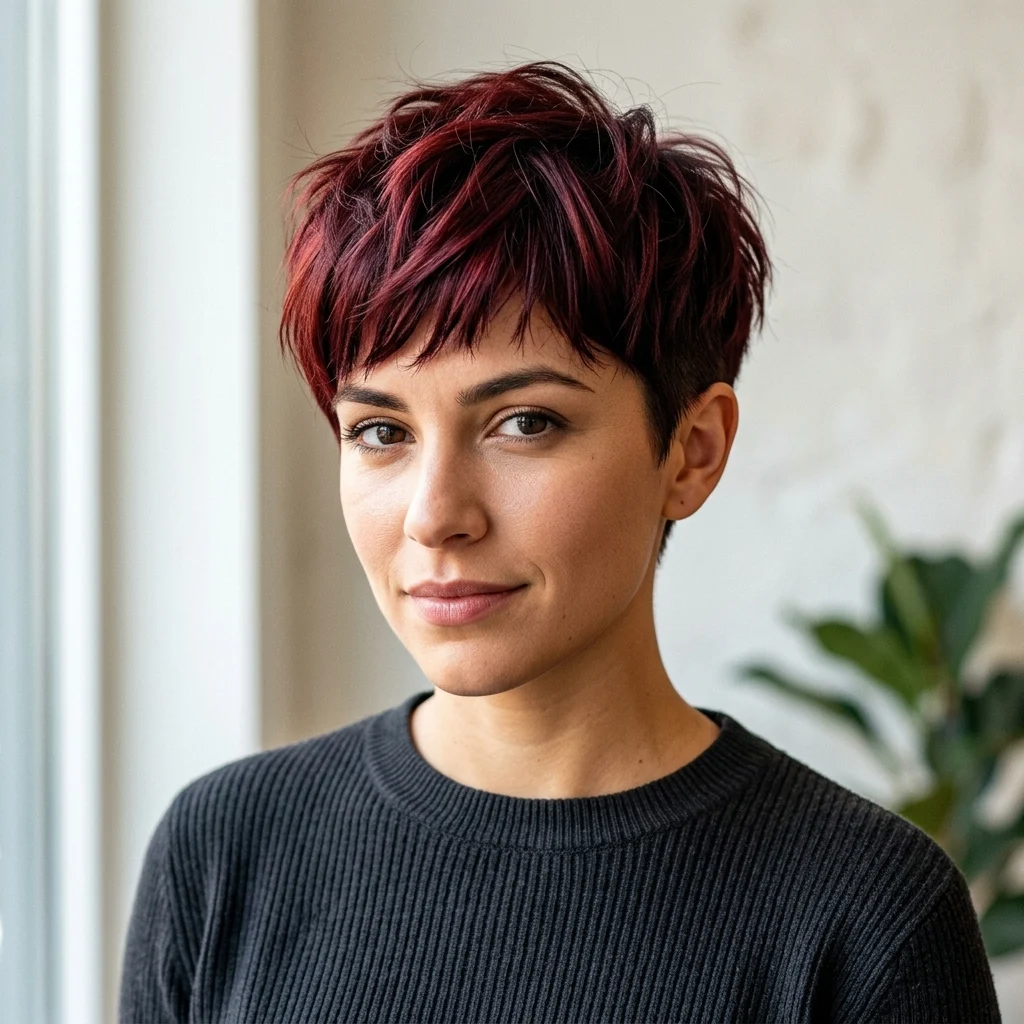
Vibe: Grounded, bold color carried by a small, easy-to-manage shape.
Why it works: Short hair is the equivalent of a small space in interior design: less surface area means less color to maintain, and full saturation is achievable in fewer sessions since there’s less hair to process. A pixie also grows out faster into a fresh trim, which naturally removes faded ends before they become noticeable.
How to get it: Ask for a full, all-over maroon application rather than partial highlights. On short hair, dimension isn’t necessary to create visual interest, so a single saturated formula gives the most impact for the least maintenance.
Shop the Look
| Product |
| Texturizing wax for cropped pixie styling |
| Color-safe shampoo and conditioner mini set |
| Root-touch-up spray for fast regrowth coverage |
| Small round brush for pixie blow-drying |
| Shine-boosting finishing cream |
How to Start Your Maroon Hair Transformation
Start with one move: book a consultation and ask for a demi-permanent gloss in a garnet or wine tone, rather than a full permanent color right away. A gloss deposits pigment without lifting your natural color, so you can preview how maroon reads against your undertone.
The most common mistake is choosing the wrong warmth for your undertone. A warm cherry-cola maroon on cool-pink undertones (or the reverse) looks slightly “off” even when applied well. Fix this by bringing daylight photos of your skin to the consultation and asking your colorist to name the undertone explicitly.
Three items under $50 for immediate impact: a semi-permanent maroon gloss treatment, a silk pillowcase to slow color fade from friction, and a color-depositing red-toned shampoo for upkeep between visits.
A single gloss appointment takes 60–90 minutes; a full lift-and-tone on dark hair takes two to three sessions spaced weeks apart. Budget $80–150 for a demi-permanent gloss, $250–400+ for a full lightening service, or $10–15 for an at-home semi-permanent option.
Frequently Asked Questions About Maroon Hair Ideas
What’s the difference between maroon and burgundy hair?
Maroon leans more brown and muted, while burgundy leans more purple and vivid, making maroon burgundy’s earthier, less saturated cousin. Both sit in the deep red-violet family, but maroon formulas typically use more natural-brown base in the mix, which is why maroon reads as slightly warmer and less “wine glass” than burgundy. Many colorists use the terms loosely, so it’s worth bringing a reference photo to your appointment.
What skin tones does maroon hair color suit?
Maroon is genuinely one of the more universally flattering deep reds because colorists can shift the undertone to match almost any skin tone. Cool or pink undertones tend to suit blackberry or plum-mahogany maroon, while warm or olive undertones lean better toward cherry cola or garnet maroon. Neutral undertones have the most flexibility and can typically wear either direction successfully.
How much does maroon hair color cost at a salon?
A demi-permanent gloss in maroon typically runs $80–150 depending on hair length and salon tier, while a full transformation involving lightening on dark hair can range from $250 to $400 or more across multiple sessions. At-home semi-permanent maroon glosses cost roughly $10–20 and are a reasonable way to test the shade before booking a salon appointment. Maintenance costs (toning, root touch-ups) typically add $50–100 every 6–8 weeks.
Will maroon hair color work on dark brown or black hair without bleaching?
Yes, but the result will be more subtle. A demi-permanent maroon gloss applied directly to dark brown or black hair typically produces a warm, low-visibility tint that shows up mainly in direct sunlight rather than a saturated, all-over maroon. For a fully vivid maroon on very dark hair, most colorists recommend at least partial lightening to a level 6–7 before depositing color, since dark strands don’t hold red-violet pigment as vividly without some lift.
How do I maintain maroon hair color and keep it from fading?
Wash with cool water and a sulfate-free, color-safe shampoo, since hot water and sulfates strip pigment fastest from red-based tones. Use a color-depositing conditioner or gloss treatment weekly to refresh vibrancy, and apply a leave-in UV-protectant spray before sun exposure, since red and violet pigments fade faster under UV light than brown or blonde tones. Most maroon color lasts 4–6 weeks before it noticeably shifts toward brown.
Ready to Create Your Dream Maroon Hair Look?
These 15 maroon hair ideas cover color, technique, cut, and upkeep, so you don’t need to choose the boldest option to get it right. Today, the simplest next step is booking a consultation and bringing one reference photo of the exact tone you’re drawn to. Save your favorite shade from this list now, future-you will thank you for already knowing the word “blackberry” or “cherry cola.”