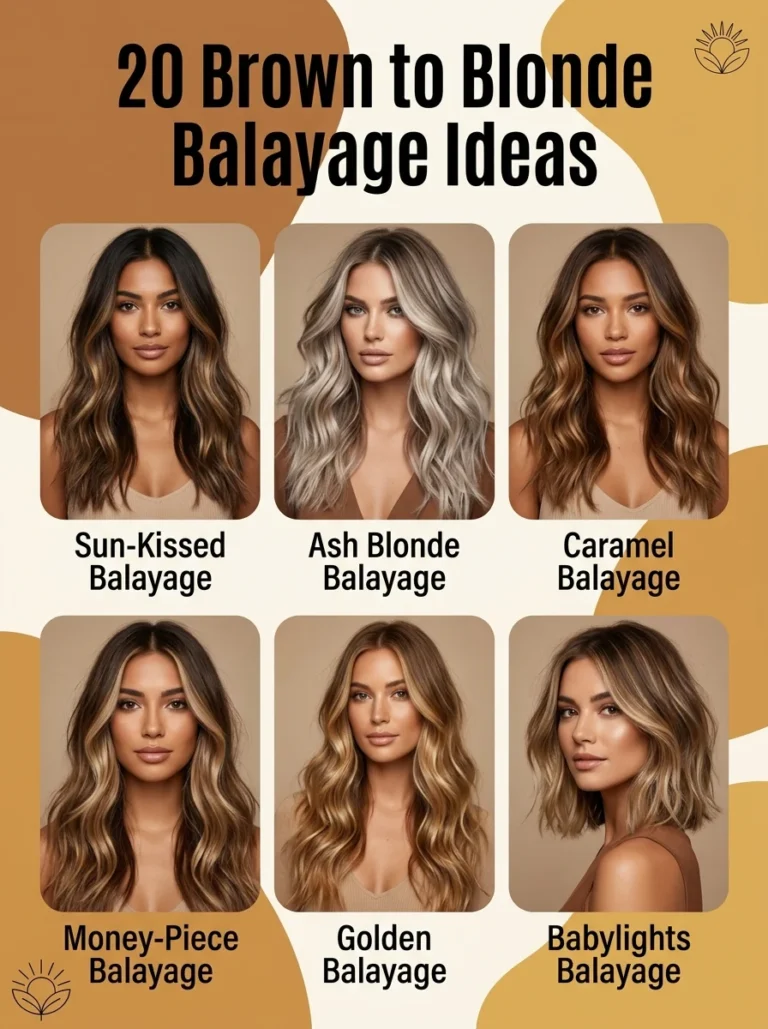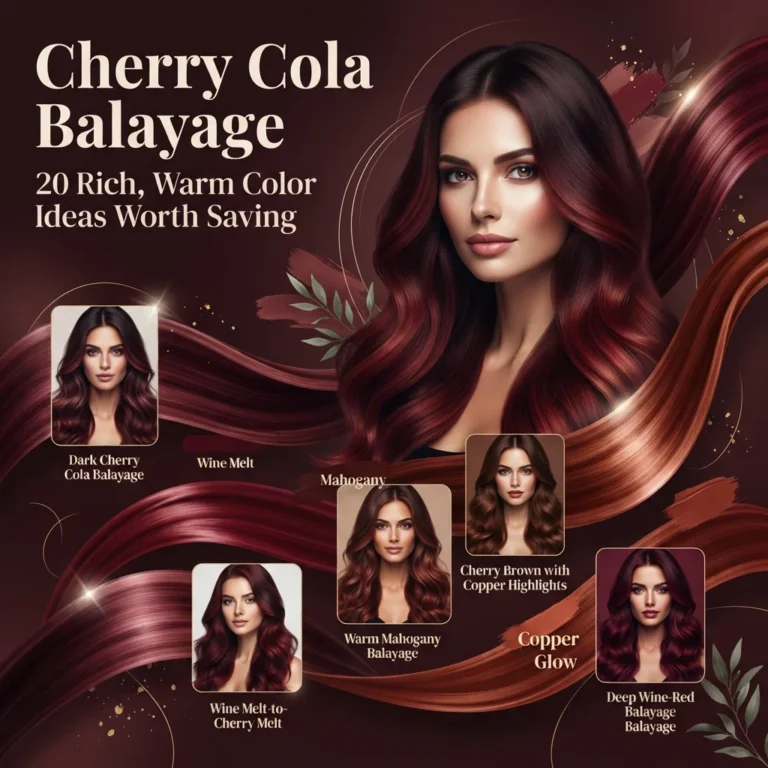
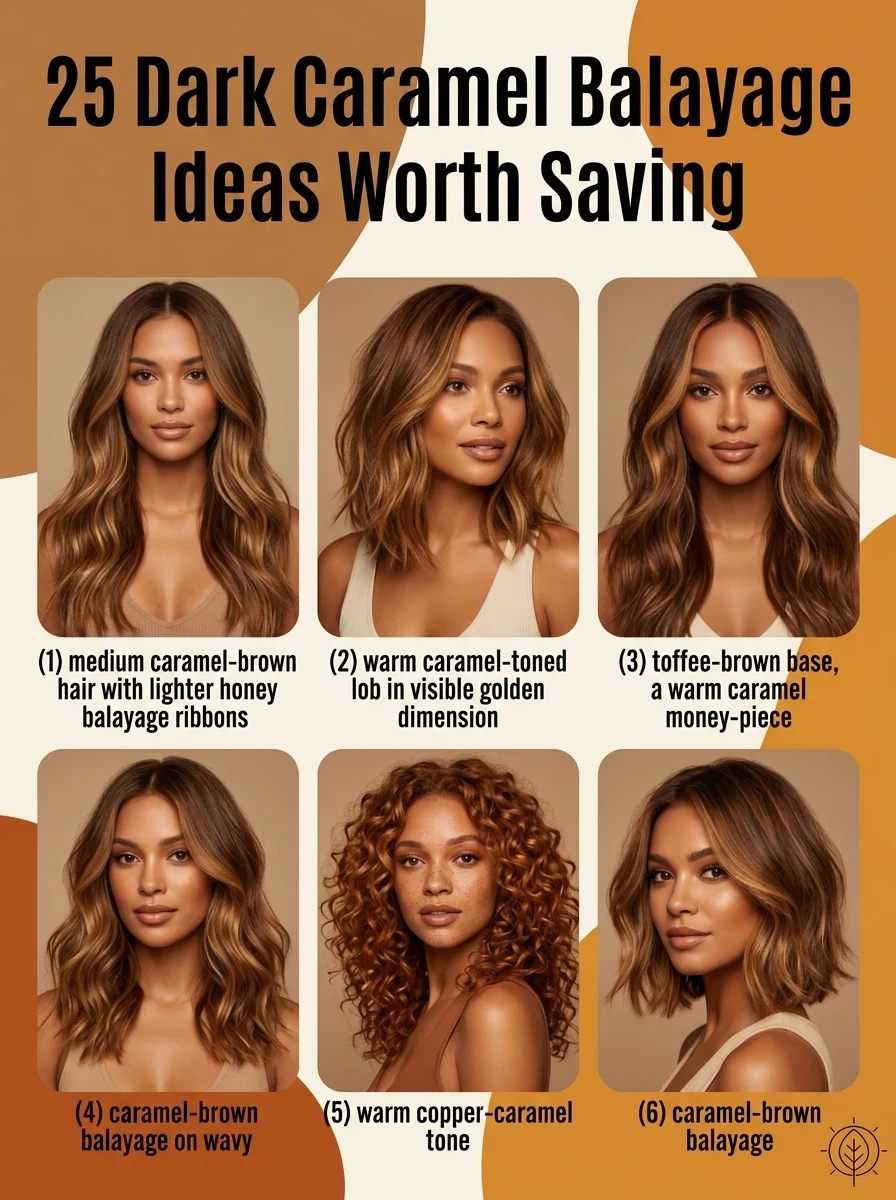
25 Dark Caramel Balayage Ideas Worth Saving

Dark caramel balayage is a hand-painted color technique that sweeps warm, honey-amber tones through a deep brunette or espresso base, creating soft, sun-kissed dimension without a hard line of demarcation. This article gives you 25 dark caramel balayage ideas, from face-framing placements to full-head transformations, each with the exact technique and styling details you need to bring it to your colorist.
The style feels rich and lived-in, like the last hour of golden light through a coffee shop window. It sits somewhere between moody and warm, deep roots grounding the look while caramel ribbons catch every bit of movement. There is a quiet confidence to it, the kind of color that looks effortless because the work is hidden in the blend. Here are 25 ideas worth saving, and stealing.
Why Dark Caramel Balayage Works So Well
Balayage originated in 1970s French salons as a freehand painting technique, applied without foils to mimic how hair naturally lightens in the sun. Dark caramel balayage keeps that soft, hand-swept logic but pairs it with a deeper base, typically espresso, chestnut, or cool-toned brunette, so the caramel ribbons read as dimension rather than contrast. It is distinct from traditional highlights because the color is painted on the surface of sections rather than woven through with foils, which is what gives it that soft, grown-out gradient instead of stripes.
The core palette runs through espresso brown, chestnut, warm honey, and true caramel, with occasional cinnamon or toffee ribbons for added depth. Textures that showcase it best include glossy, well-conditioned strands, loose waves, and layered cuts where the light can travel across multiple lengths. Golden and copper-based glazes are often used to keep the caramel from reading brassy.
Search interest in dark caramel balayage has climbed alongside a broader shift toward low-maintenance color that grows out gracefully. As more people stretch salon visits to save money and time, colorists have leaned into root-forward techniques that blur regrowth instead of exposing it, and dark caramel balayage is one of the most requested versions of that approach.
Fine or thin hair can absolutely wear dark caramel balayage, but placement matters more than volume. Concentrating the caramel around the face and through the ends, rather than saturating the whole head, keeps the color from washing out fine strands while still delivering visible warmth and dimension.
Style at a Glance
| Element | Base Tone | Caramel Tone |
|---|---|---|
| Philosophy | Hand-painted, low-contrast dimension | Sun-warmed, natural-looking lift |
| Key Materials | Espresso, chestnut, cool brunette base | Honey, toffee, cinnamon-caramel glaze |
| Key Colors | Deep brown, near-black brunette | Warm caramel, golden amber |
25 Dark Caramel Balayage Ideas
1. Coffee-to-Caramel Root Melt
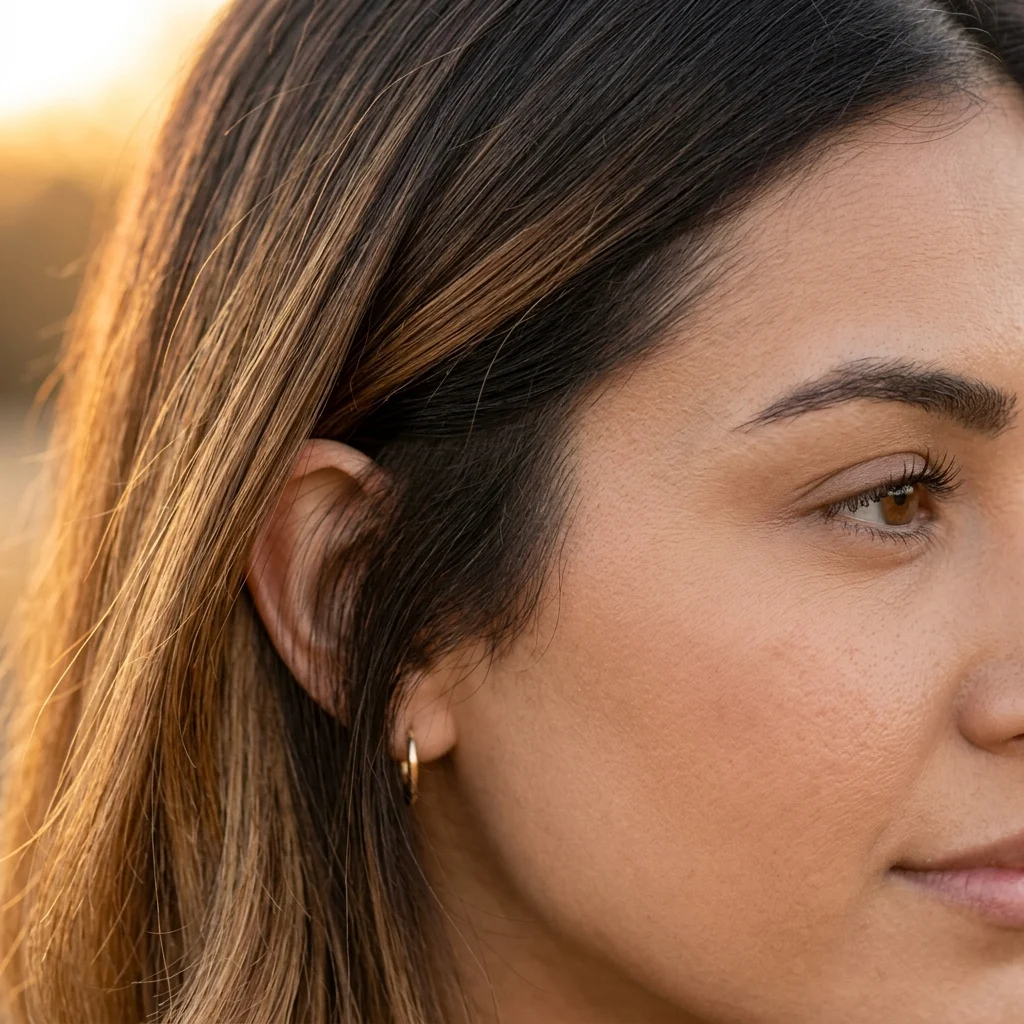
Vibe: Warm and grounded, like the color deepens the closer it gets to the scalp.
Why it works: The root melt uses a technique called shadow rooting, where the colorist blends a soft espresso glaze into the natural root before the caramel begins, softening the transition point. This eliminates the harsh contrast that makes regrowth obvious, and it works because the eye reads gradual value shifts as natural light rather than color change.
How to get it: Ask your colorist for a “root smudge” using a demi-permanent glaze one to two shades deeper than your natural color, blended with a diffusing brush before the caramel balayage is painted through the mid-lengths and ends.
💡 Quick Win: A root touch-up powder in a matching espresso shade extends the fresh-root look by two to three weeks between salon visits.
Shop the Look
| Item |
|---|
| Root touch-up concealer powder in espresso brown |
| Color-safe sulfate-free shampoo for brunette hair |
| Purple-free glaze-boosting glossing treatment |
| Wide-tooth detangling comb for wet hair |
| Silk pillowcase in warm neutral tone |
2. Foilyage Face-Frame
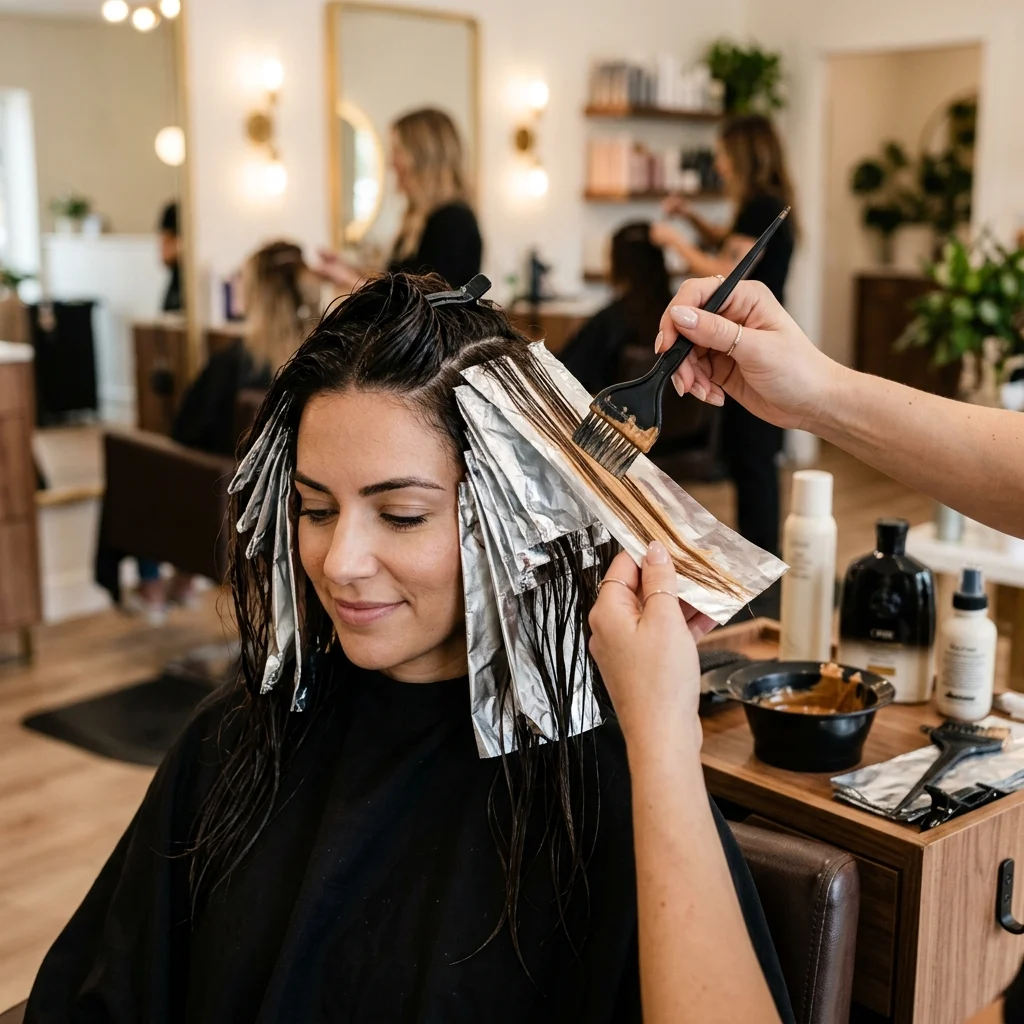
Vibe: Sharp and luminous, with the brightest caramel concentrated exactly where light hits first.
Why it works: Foilyage combines the hand-painted softness of balayage with the lifting power of foils, allowing the colorist to push the face-framing pieces two to three levels lighter than the rest of the balayage. This creates a focal point using contrast and visual weight, drawing the eye toward the face without lightening the whole head.
How to get it: Request foilyage specifically around the two front face-framing pieces only, using a lightener that lifts to a warm gold base before toning with a caramel glaze, while the rest of the head stays traditional balayage.
Shop the Look
| Item |
|---|
| Heat protectant spray for color-treated hair |
| Golden-toned glossing gloss treatment |
| Boar bristle round brush for face-framing pieces |
| Flat iron with ceramic plates for smoothing |
| Leave-in conditioner for lightened sections |
3. Sun-Struck Money Piece
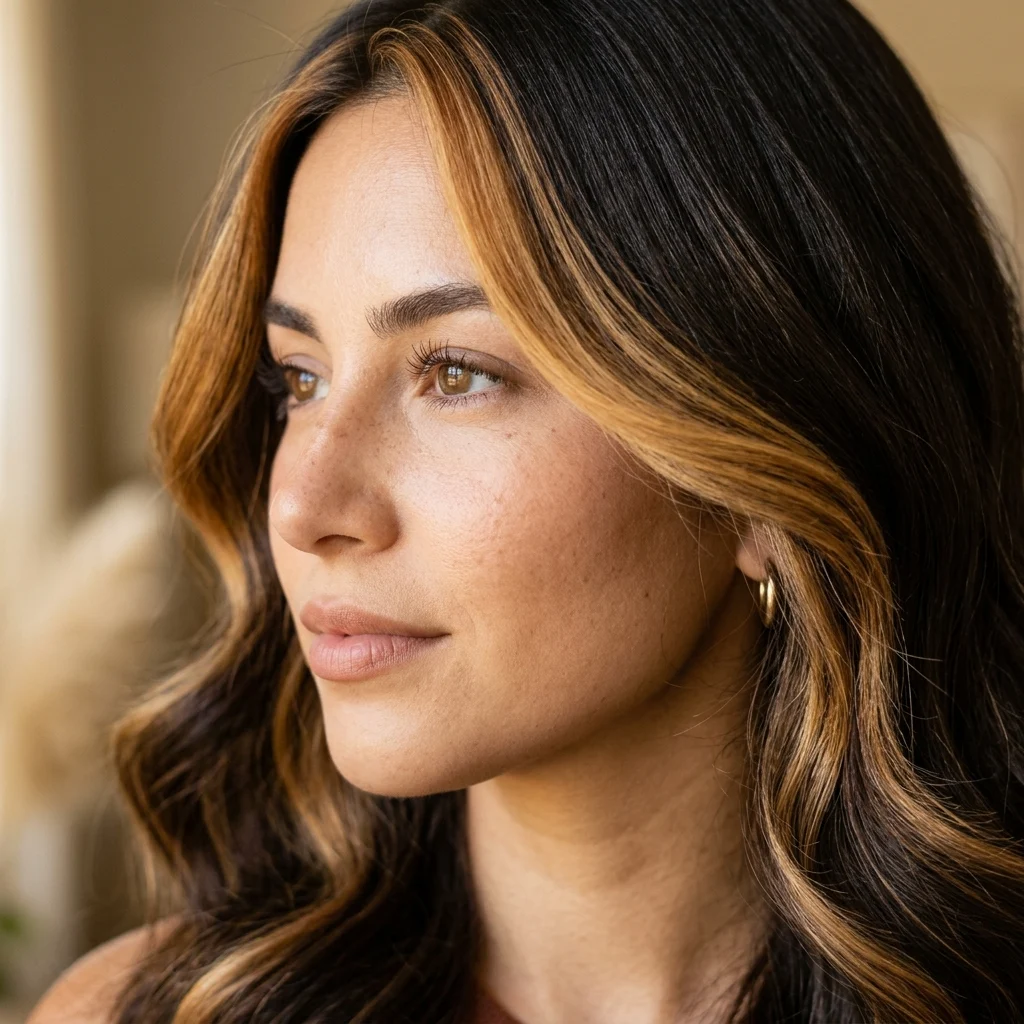
Vibe: Luminous, like a single ribbon of light caught mid-motion.
Why it works: A money piece uses focal contrast, one or two bold, chunky pieces placed at the hairline, to create maximum visual impact with minimal color processed. Because it sits closest to the face, it reflects light directly onto the skin, which is a lighting principle colorists borrow from portrait photography.
How to get it: Section out only the two pieces framing your part line, lighten them one to two shades brighter than the rest of your balayage, and finish with a warm caramel gloss so they stand out without looking disconnected from the base.
💡 Quick Win: A caramel-toned temporary hair chalk or root spray lets you preview a money piece before committing to permanent color.
Shop the Look
| Item |
|---|
| Caramel temporary color spray for preview testing |
| Small sectioning clips for precise placement |
| Anti-frizz serum for smooth face-framing pieces |
| Curling wand for 1-inch loose waves |
| Amber-tinted hair oil for shine |
4. Caramel Balayage on Long Layers
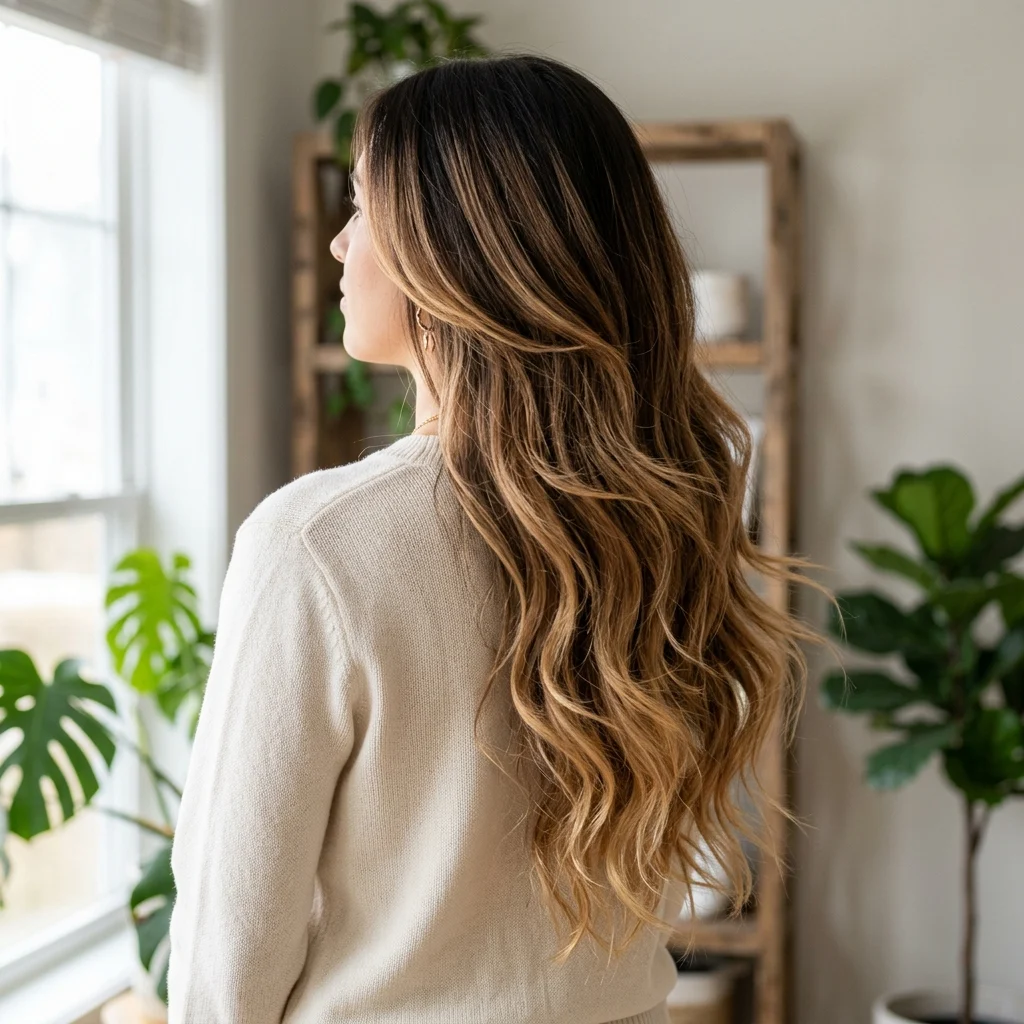
Vibe: Flowing and layered, with color that moves as the hair does.
Why it works: Long layers create multiple horizontal planes for the balayage to travel across, so each layer catches light differently and produces visible depth rather than a flat wash of color. This is proportion at work, the length gives the technique room to build gradual, believable dimension.
How to get it: Ask for balayage painted in a diagonal, upward sweeping motion along each layer rather than straight down the length, which mimics how the sun naturally lightens hair from underneath.
Shop the Look
| Item |
|---|
| Lightweight texturizing spray for layered ends |
| Wide barrel curling iron for loose movement |
| Bond-repair leave-in treatment |
| Volumizing dry shampoo in caramel tone |
| Satin hair scrunchies to prevent breakage |
5. Tortoiseshell Clip Contrast
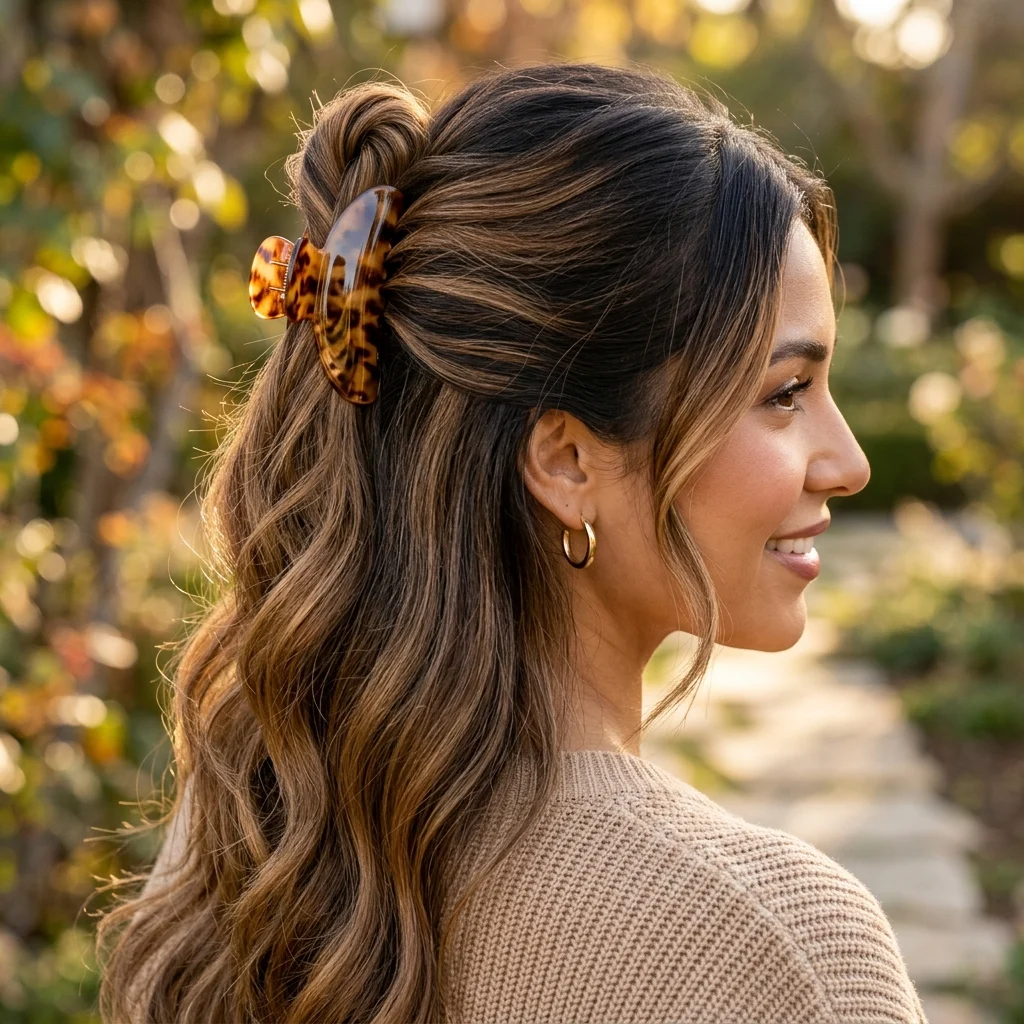
Vibe: Warm and polished, with the accessory echoing the hair color instead of competing with it.
Why it works: Tortoiseshell patterns share the same amber-to-espresso color family as dark caramel balayage, so a clip in this material reads as a tonal extension of the hair rather than a separate accessory. This is color harmony, matching undertones across materials to unify a look.
How to get it: Choose a tortoiseshell claw clip in a warm amber-and-brown pattern, and use it to secure a half-up style so the caramel pieces at the crown stay visible while framing the face.
💡 Quick Win: A tortoiseshell clip is one of the fastest ways to elevate a second-day hair style without any additional styling tools.
Shop the Look
| Item |
|---|
| Tortoiseshell claw clip large size |
| Tortoiseshell hair pins set |
| Texturizing sea salt spray |
| Amber resin hair sticks |
| Tortoiseshell headband thick style |
6. Espresso Base with Honey Caramel Ends
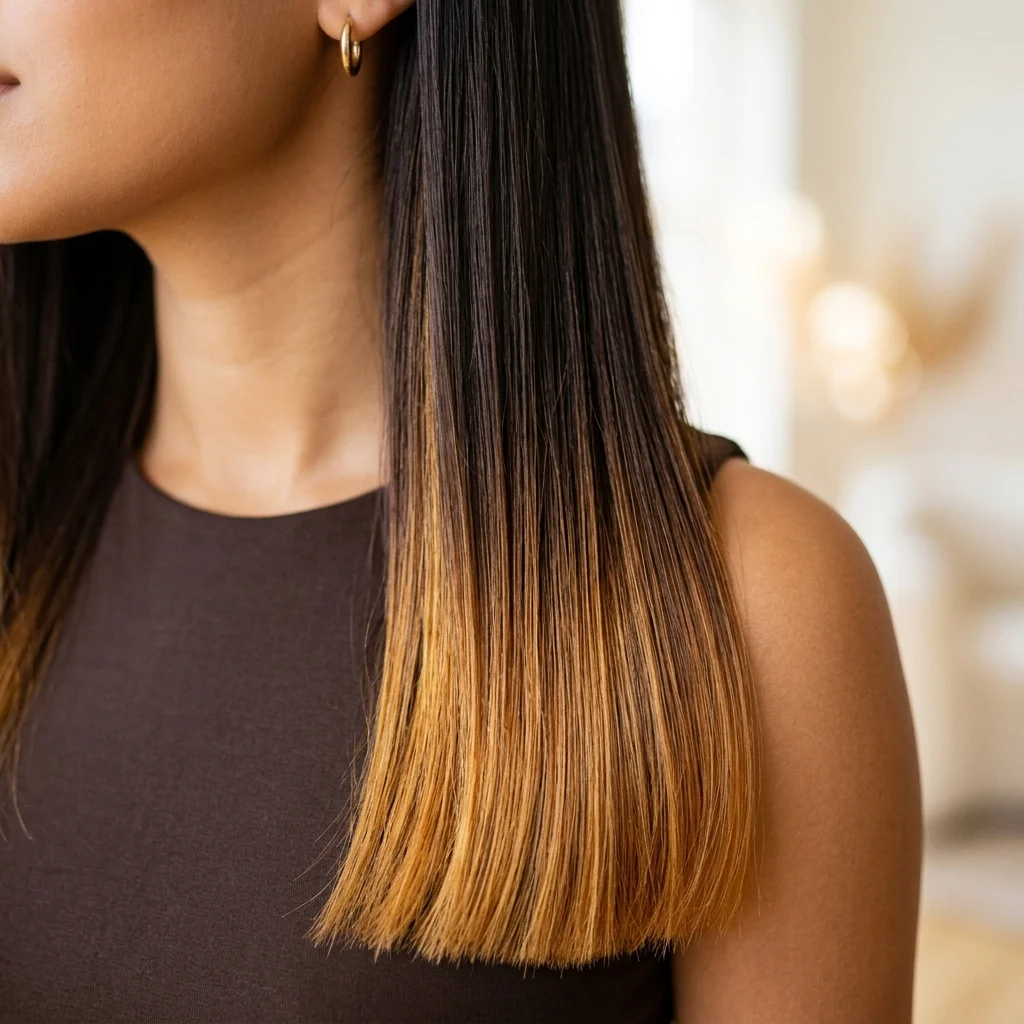
Vibe: Sleek and warm, with the brightness saved entirely for the ends.
Why it works: Concentrating lightener only on the last three to four inches uses end-weighted color placement, a technique that reads as sun-bleached rather than salon-processed because it mimics where hair naturally fades first from repeated exposure and heat styling.
How to get it: Request that your colorist paint caramel exclusively from the mid-shaft down, leaving the espresso base untouched above that point, then finish with a glassy, high-shine gloss to seal the cuticle.
Shop the Look
| Item |
|---|
| Glossing hair gloss treatment for shine |
| Flat iron for glass-hair finish |
| Silicone-free shine serum |
| Heat protectant mist |
| Microfiber hair towel to reduce frizz |
7. Face-Framing Only Balayage
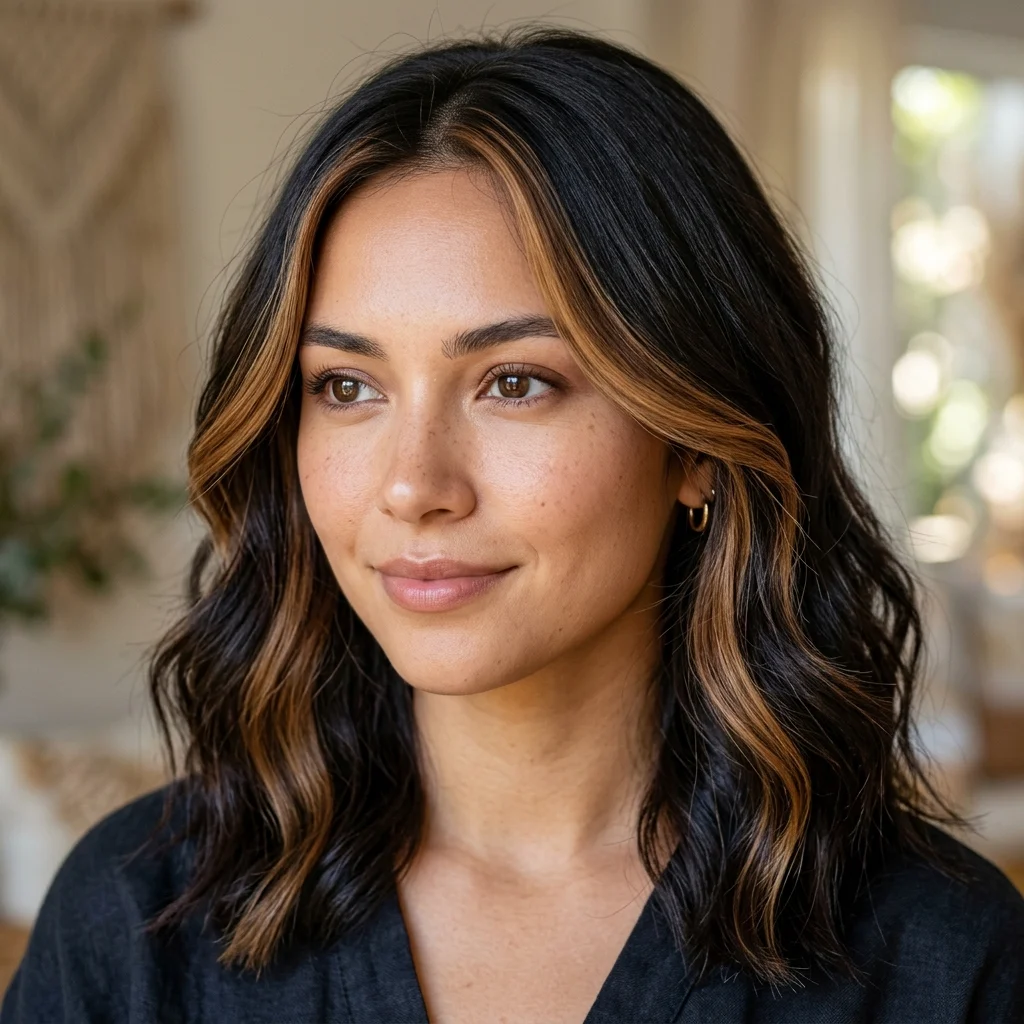
Vibe: Subtle and warm, with restraint doing most of the work.
Why it works: Limiting balayage to the face-framing pieces uses negative space, the untouched espresso length acts as a visual rest point that makes the caramel framing feel intentional rather than incomplete. It is a placement-first approach rather than a full-head commitment.
How to get it: Section only the two pieces that fall along your cheekbones and jawline, and ask your colorist to paint caramel there exclusively, keeping the rest of the head in its natural or base-toned state.
💡 Quick Win: This is the lowest-commitment version of the trend and typically costs less than a full-head balayage service.
Shop the Look
| Item |
|---|
| Small sectioning clips |
| Root-to-tip detangling brush |
| Frizz-taming edge control gel |
| Lightweight hair oil for face-framing pieces |
| Fine-tooth rat tail comb for clean parting |
8. Babylights Woven Through Caramel
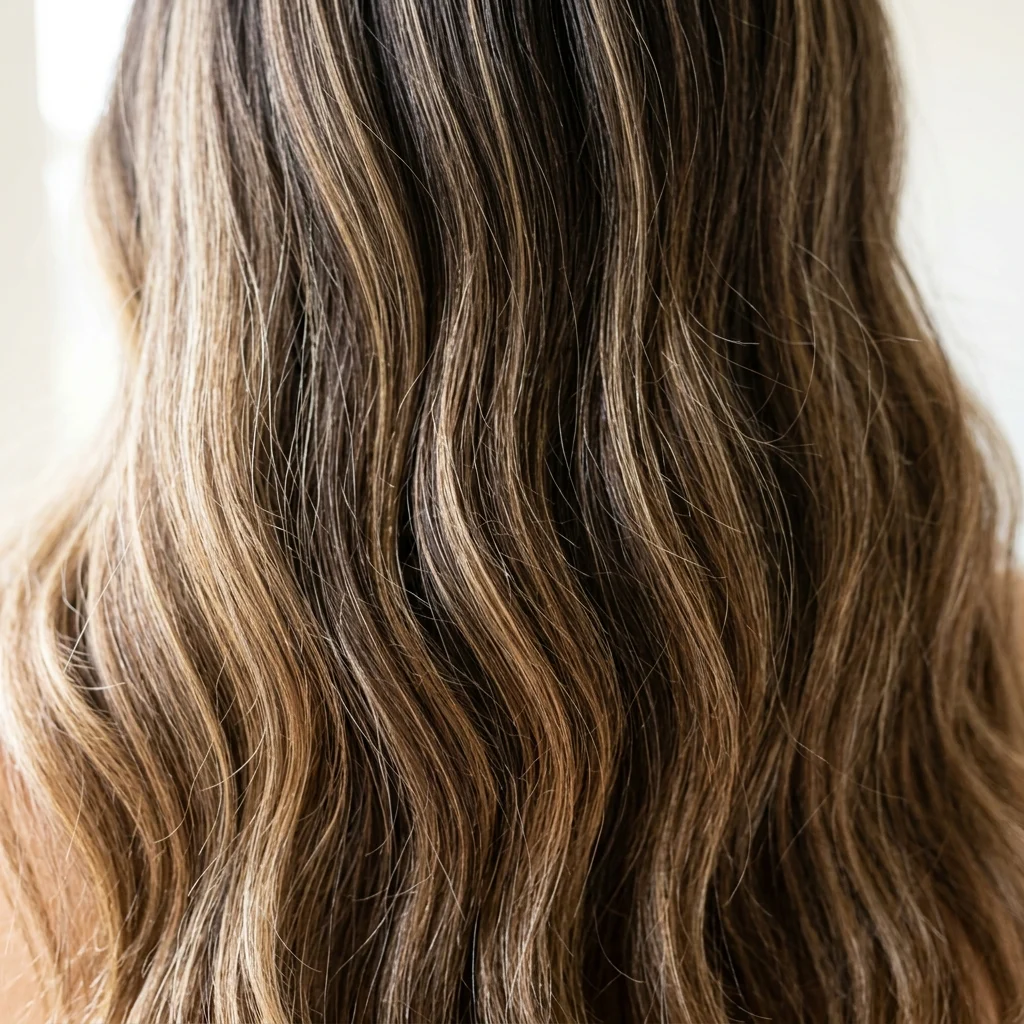
Vibe: Fine and airy, with light scattered in tiny, believable increments.
Why it works: Babylights are foiled in very fine sections, roughly a quarter-inch wide, which creates micro-contrast within the broader caramel balayage. This layered texturing technique adds depth without adding visible bulk, which is especially useful for finer hair textures that can look flat under larger color blocks.
How to get it: Ask your colorist to weave babylights through the crown and part line using foils, then paint the traditional balayage caramel through the rest of the lengths for a blended, multi-dimensional finish.
Shop the Look
| Item |
|---|
| Fine-mist volumizing spray |
| Lightweight anti-frizz cream |
| Wide-tooth comb for detangling fine strands |
| Sulfate-free shampoo for fine, color-treated hair |
| Root-lifting mousse |
9. Root Smudge for Grow-Out Ease
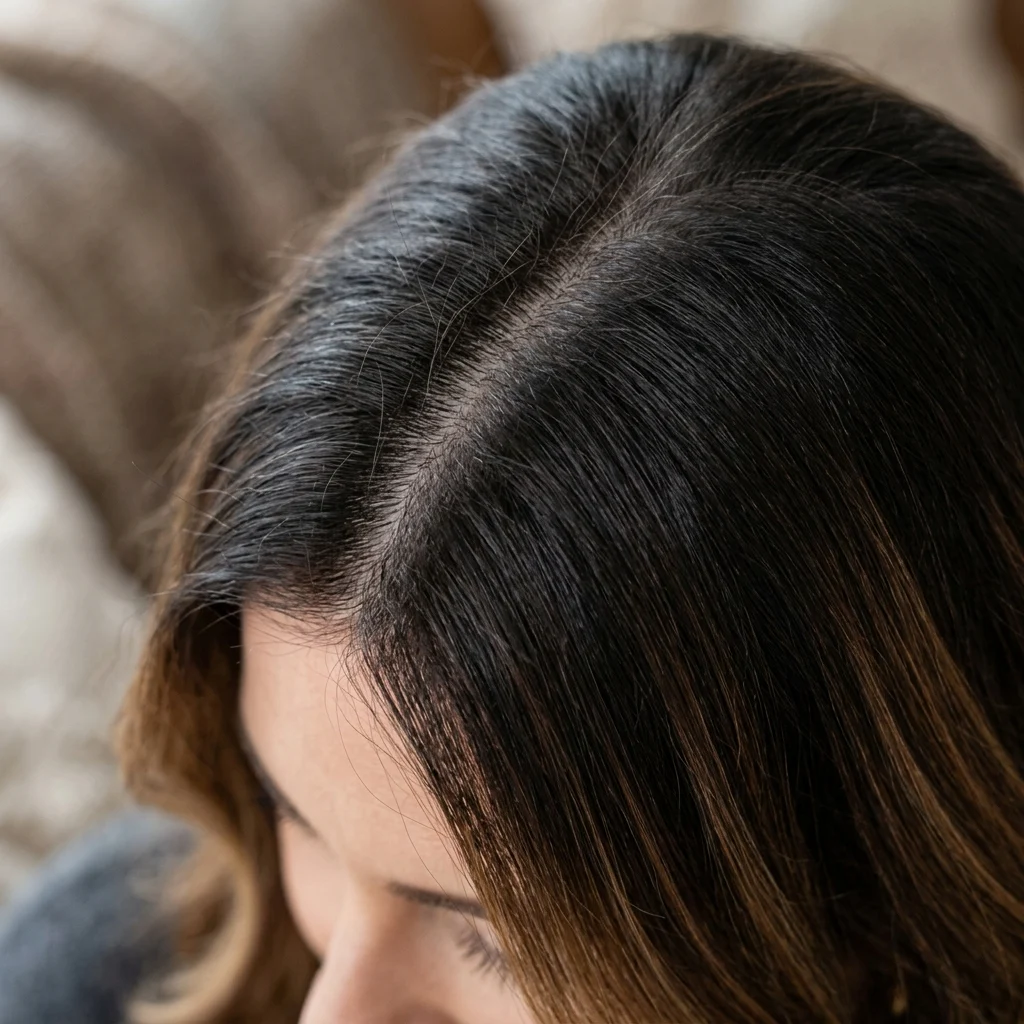
Vibe: Relaxed and forgiving, built to stretch far past the salon date.
Why it works: A root smudge deliberately softens the boundary between natural regrowth and color using a diffused, brushed-in application rather than a precise line. This exploits how the eye perceives gradual value change as shadow, so regrowth reads as intentional dimension instead of a maintenance issue.
How to get it: Request a shadow root two shades deeper than your natural color, blended two to three inches down before the caramel balayage begins, which extends the time between appointments to three or four months.
💡 Quick Win: A root spray in a matching brown tone can stretch this even further between color appointments.
Shop the Look
| Item |
|---|
| Root concealer spray in warm brown |
| Color-depositing brown hair mask |
| Scalp massage brush for even product distribution |
| Dry shampoo tinted for brunette roots |
| Detangling leave-in spray |
10. Underlight Peekaboo Caramel
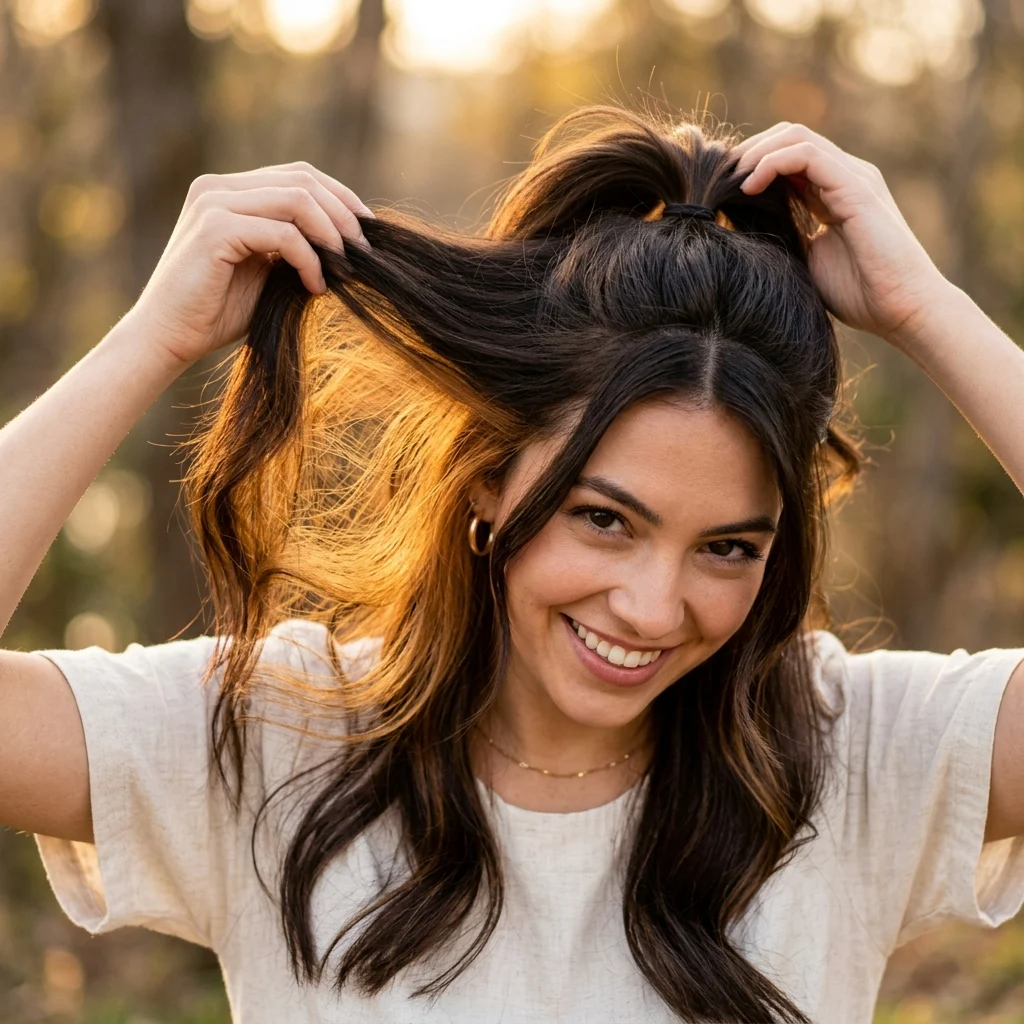
Vibe: Playful and warm, a surprise that only shows on movement.
Why it works: Underlighting places the boldest caramel tones beneath the top layer of hair, so the color is only visible when hair moves or is lifted. This uses concealment and reveal as a design principle, keeping the everyday look understated while still delivering a bold statement underneath.
How to get it: Ask your colorist to section the hair horizontally, painting a saturated caramel balayage on the underneath sections only while leaving the top layer in its natural or lightly balayage-toned state.
Shop the Look
| Item |
|---|
| Sectioning clips for horizontal parting |
| Volumizing mousse for lift |
| Texturizing spray for movement |
| Wide barrel curling wand |
| Shine-boosting hair mist |
11. Caramel Balayage Lob
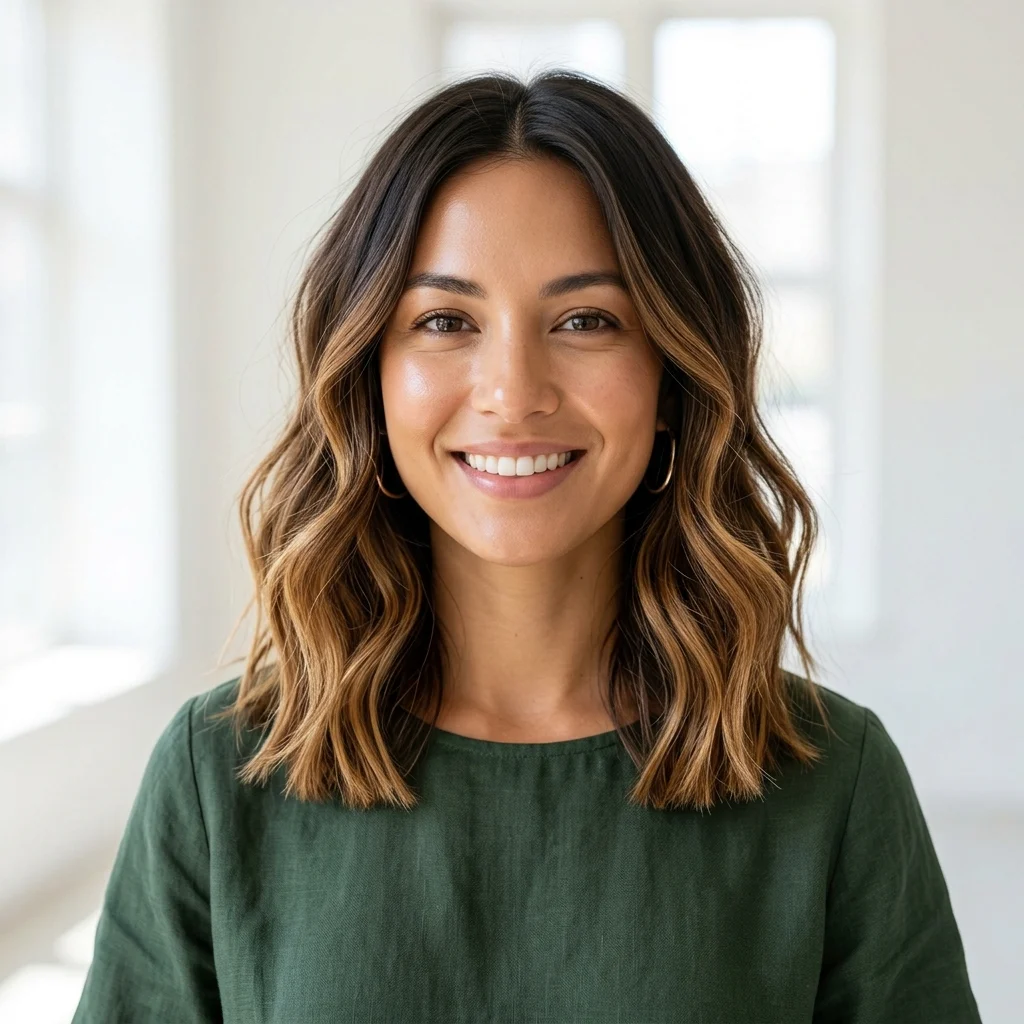
Vibe: Fresh and compact, with the color doing more work in less length.
Why it works: A lob offers less surface area than long hair, so the balayage must be scaled down in placement to avoid overwhelming the cut. Concentrating caramel at the bottom third respects proportion, the shorter the hair, the smaller and more precise the color sections need to be.
How to get it: Ask for balayage painted only from the ear down, using narrower sections than you would for long hair, which keeps the color from reading heavy on a shorter length.
Shop the Look
| Item |
|---|
| Texturizing salt spray for lob styling |
| Small barrel curling iron for shorter lengths |
| Volumizing root spray |
| Anti-frizz smoothing cream |
| Satin bonnet for overnight hair protection |
12. Gold Hair Cuffs for Warm Tones
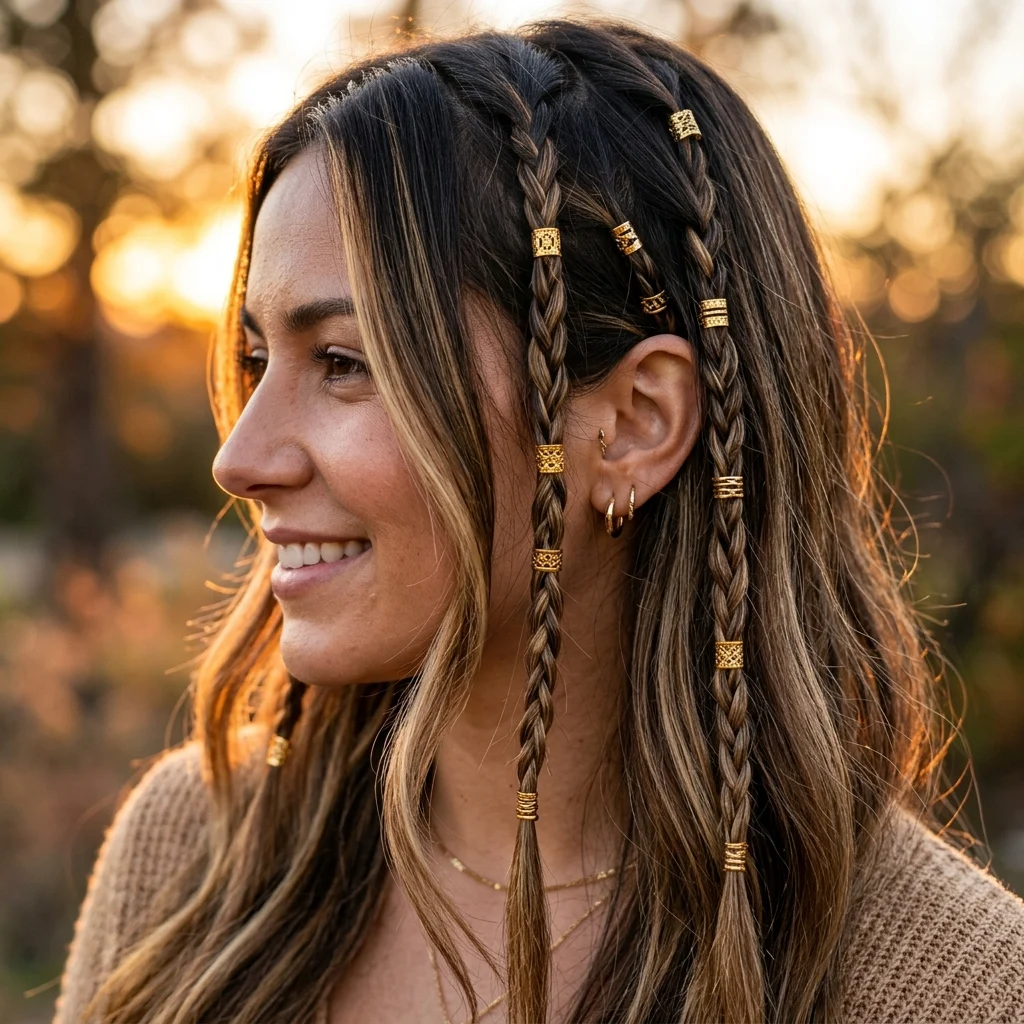
Vibe: Decorative and warm, with metal that mirrors the caramel undertone.
Why it works: Gold-toned metal shares the same warm undertone family as caramel balayage, so hair jewelry in this finish blends rather than clashes. This is undertone matching, a principle that keeps accessories from fighting with hair color the way a cool silver tone often does against warm caramel.
How to get it: Section off two or three thin pieces near the face, braid them loosely, and slide on small gold cuffs to catch light along the caramel ribbons.
💡 Quick Win: Gold hair cuffs are reusable and slide onto any braid or twist, making them a low-cost way to accessorize the look for special occasions.
Shop the Look
| Item |
|---|
| Gold-tone hair cuffs set |
| Thin gold hair rings adjustable |
| Small braiding comb |
| Texturizing gel for sleek braids |
| Bobby pins in gold finish |
13. Chestnut Base with Caramel Ribboning
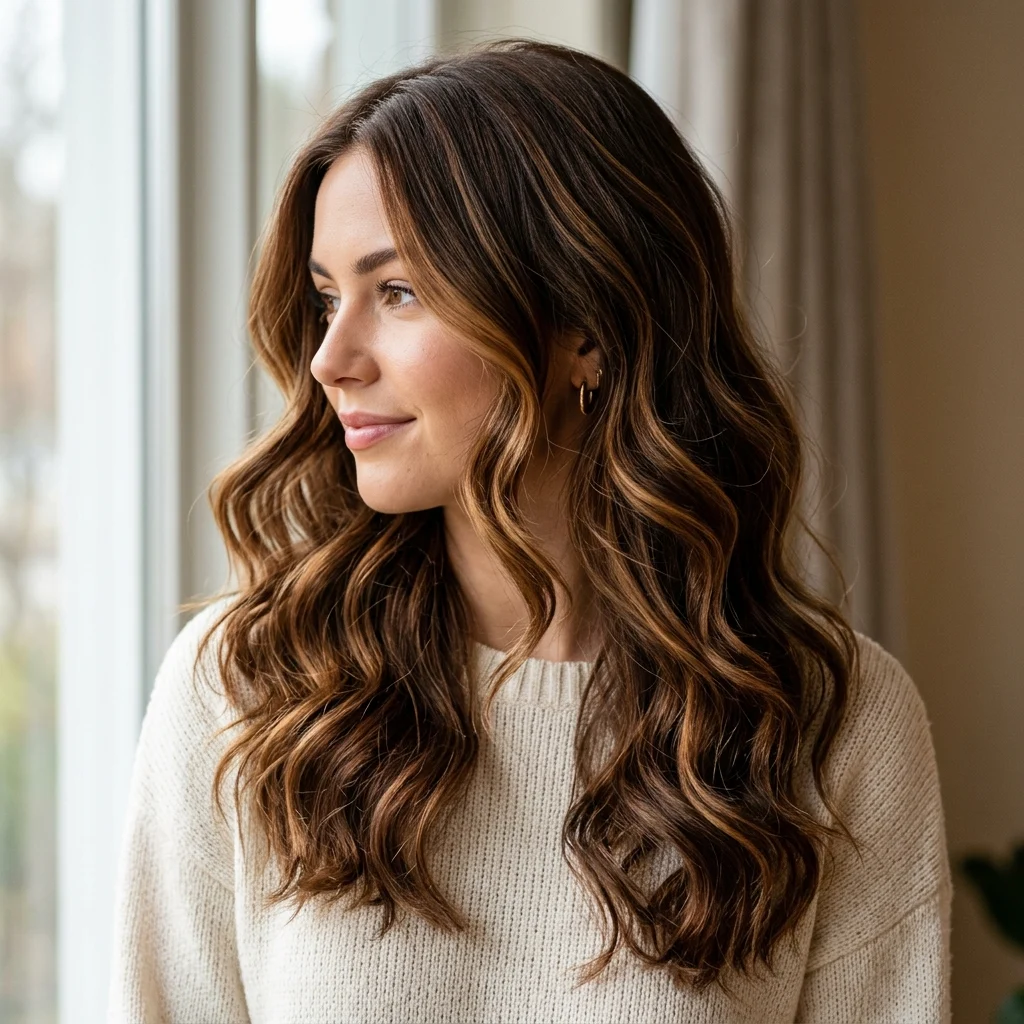
Vibe: Warm and dimensional, with color that ribbons rather than blocks.
Why it works: A chestnut base carries more red-brown undertone than espresso, which shifts the entire palette warmer and makes the caramel ribbons appear more golden by contrast. This is undertone theory, pairing a warm base with a warm highlight amplifies richness instead of competing for attention.
How to get it: Start with a chestnut brown base color if your natural shade is cooler, then have the caramel painted in thin, ribbon-width sections rather than broad chunks to keep the warmth looking natural.
Shop the Look
| Item |
|---|
| Color-depositing chestnut brown gloss |
| Copper-toned shine serum |
| Sea salt spray for beach waves |
| Warm-toned dry shampoo |
| Bond-building conditioner mask |
14. Hand-Painted Ombre Blend
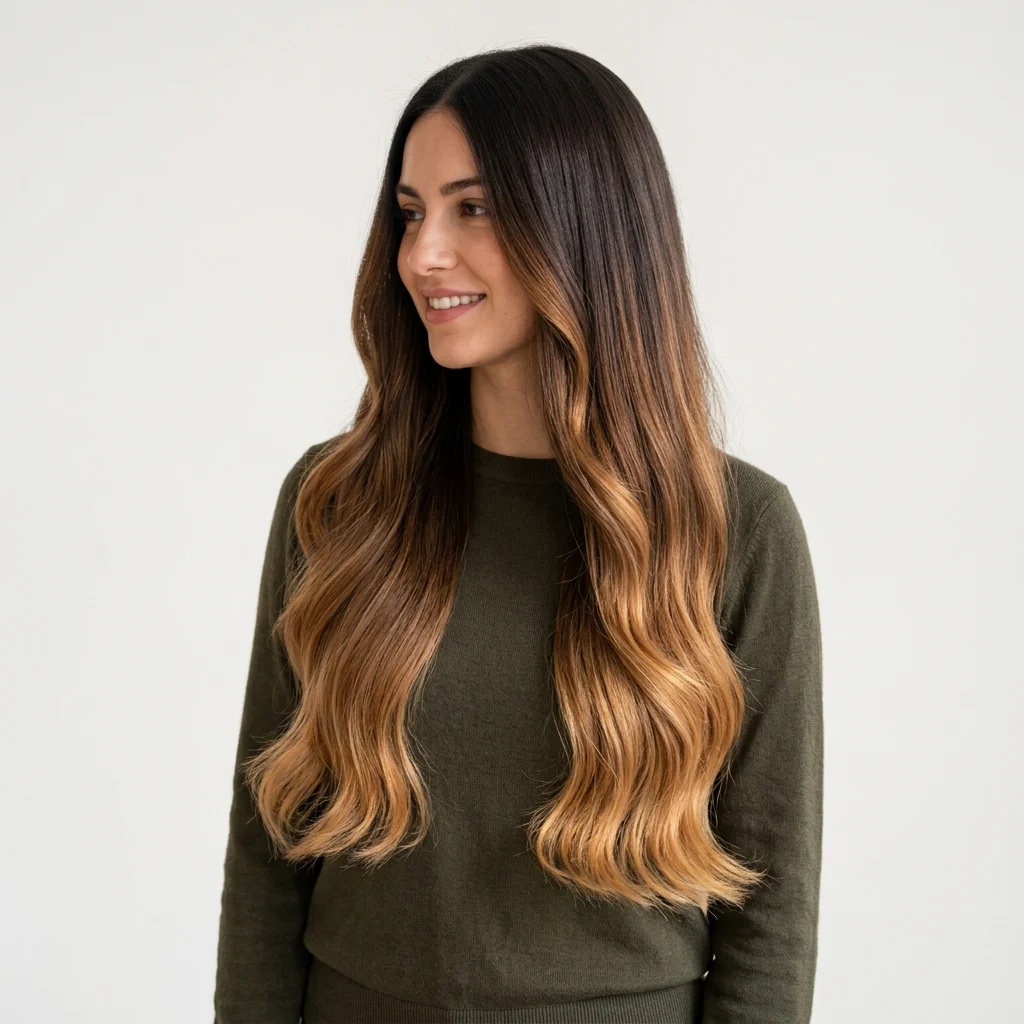
Vibe: Gradual and painterly, like watercolor bleeding down the strand.
Why it works: Unlike balayage’s sectioned placement, an ombre blend uses continuous gradation from root to end, applied with a technique called back-combing before painting to soften the boundary between colors. This creates a smoother value transition, which reads as one continuous color shift rather than distinct highlighted pieces.
How to get it: Ask your colorist to back-comb small sections before applying lightener, which helps diffuse the edge between the espresso base and the caramel ends into a seamless gradient.
Shop the Look
| Item |
|---|
| Gradient-friendly toning gloss |
| Deep conditioning hair mask |
| Wide-tooth comb for gentle detangling |
| Heat protectant spray |
| Argan oil hair serum |
15. Curtain Bangs with Caramel Framing
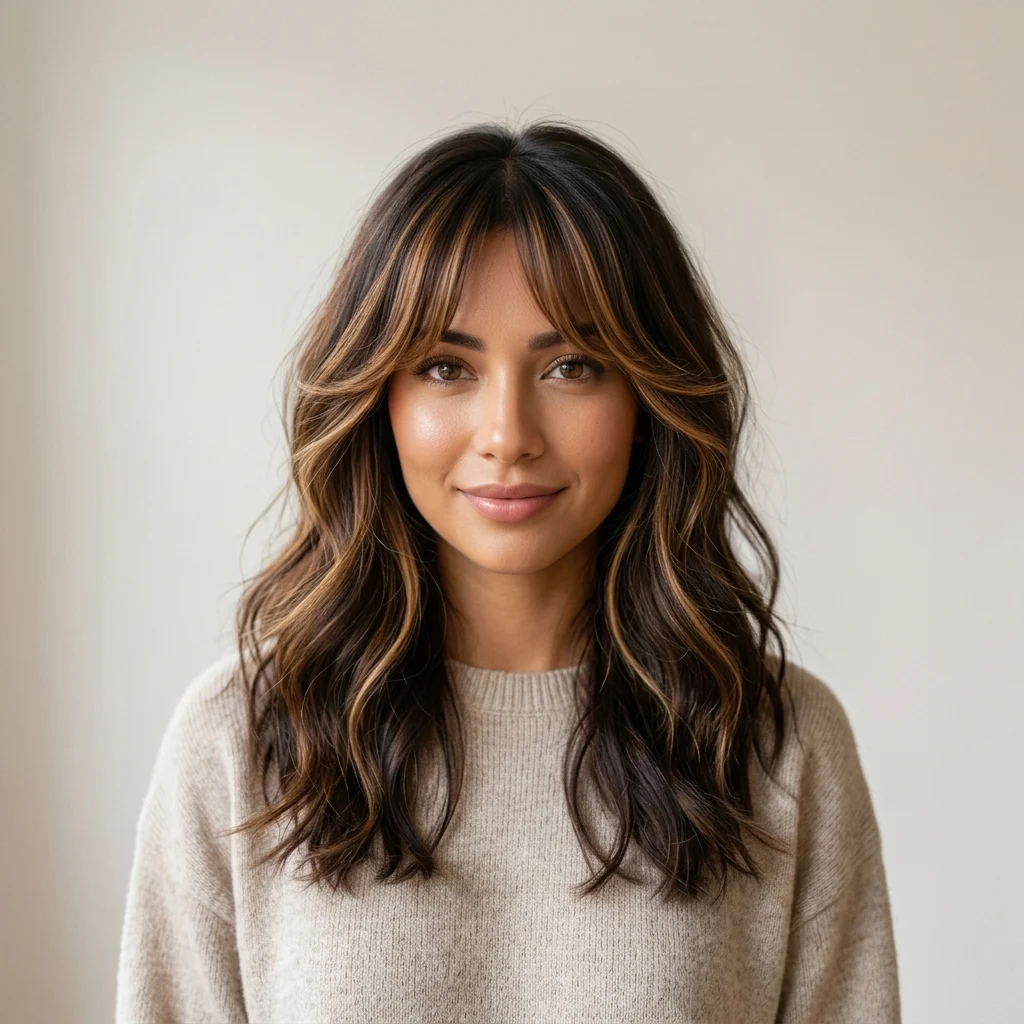
Vibe: Soft and romantic, with the fringe doing the framing work.
Why it works: Curtain bangs sit directly against the cheekbones, so placing caramel along this section proximity to draw the eye toward the face immediately. This is a placement strategy borrowed from portraiture, where the lightest values are positioned closest to the focal point.
How to get it: Ask your stylist to cut curtain bangs that hit at the cheekbone, then have caramel balayage painted specifically along the bang pieces so they catch light differently from the rest of the hair.
💡 Quick Win: A round brush and low-heat blow dry can recreate the soft curtain bang curve daily without additional color touch-ups.
Shop the Look
| Item |
|---|
| Small round brush for bang styling |
| Lightweight hairspray for hold without stiffness |
| Bang-taming pomade |
| Mini flat iron for fringe touch-ups |
| Heat protectant spray travel size |
16. Cool Espresso with Warm Caramel Contrast
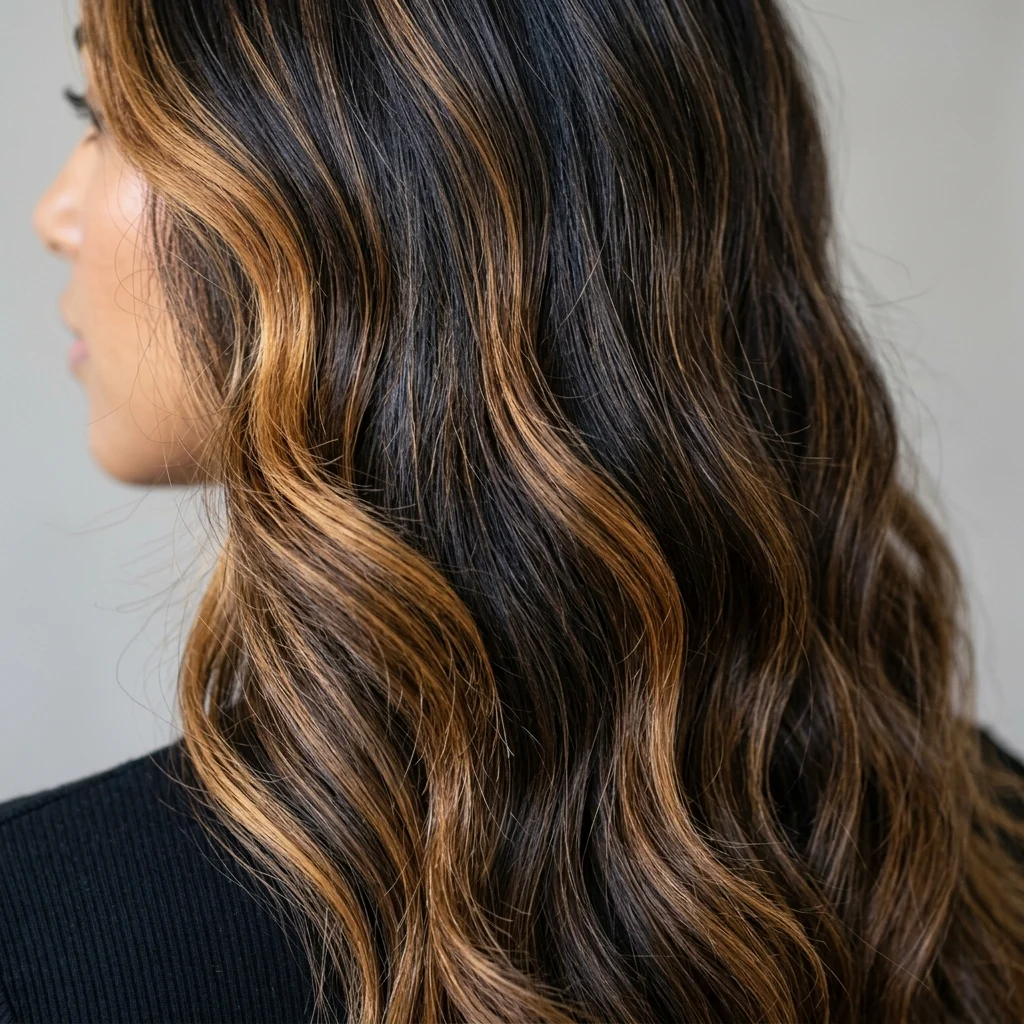
Vibe: Bold and contrasted, where temperature does the visual heavy lifting.
Why it works: Pairing a cool, ash-leaning espresso base with warm caramel highlights uses color temperature contrast, a principle where opposing warmth levels create more visible depth than tone-on-tone combinations. The cooler base also helps prevent the overall look from skewing too orange.
How to get it: Request an ash-toned espresso base color specifically, then have your colorist balance it with a warm, gold-based caramel balayage so the two temperatures play off each other instead of blending into one flat tone.
Shop the Look
| Item |
|---|
| Ash-toning purple shampoo for the base |
| Warm caramel gloss for highlighted sections |
| Color-safe conditioner for dual-toned hair |
| UV protection hair spray |
| Glossing hair oil |
17. Low-Maintenance Caramel for Fine Hair
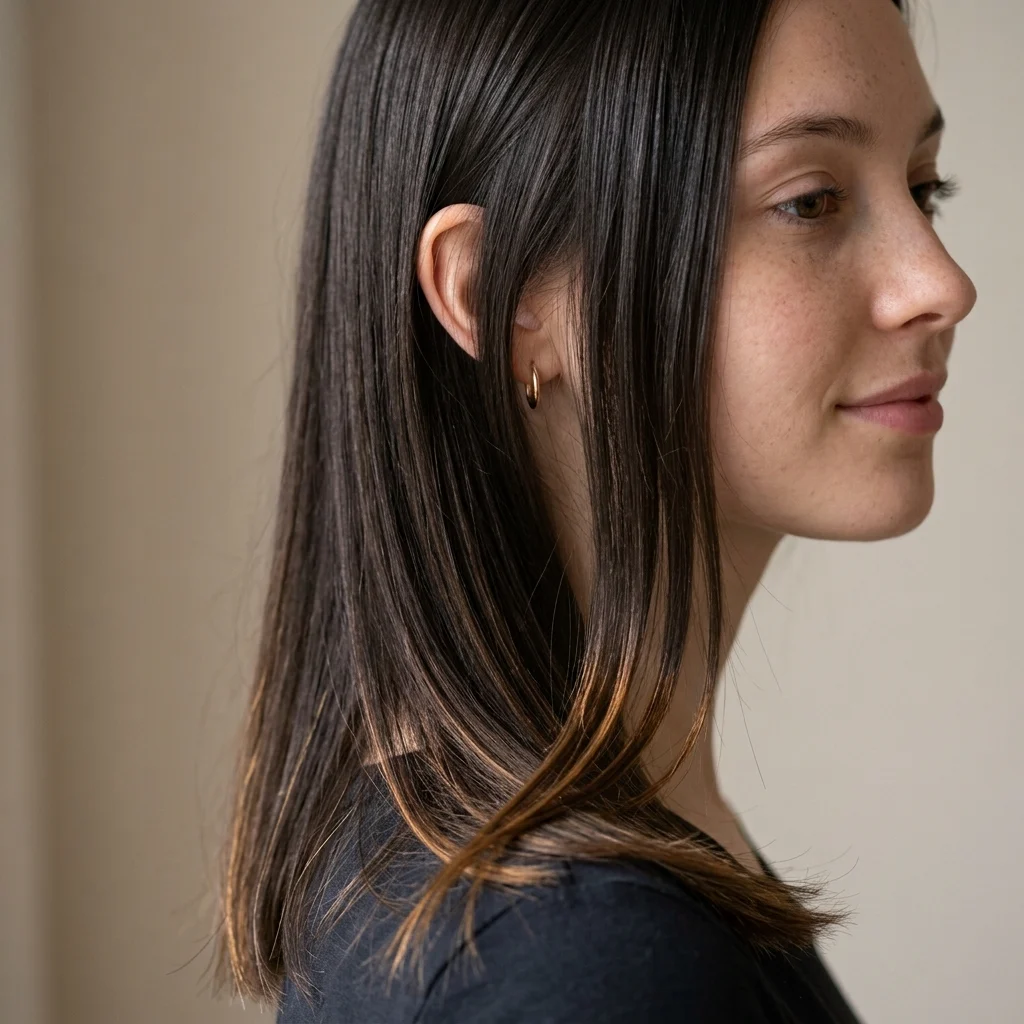
Vibe: Delicate and minimal, with color that whispers instead of shouts.
Why it works: Fine hair has fewer strands per section, so heavy balayage placement can look patchy rather than dimensional. Limiting the caramel to the ends and using thinner sections respects the hair’s natural density, a scale adjustment that keeps the color proportionate to the amount of hair available to carry it.
How to get it: Ask your colorist to use narrower sections than standard and concentrate caramel only on the bottom two inches, which adds visible warmth without overwhelming fine strands.
💡 Quick Win: A volumizing mousse applied at the roots before styling helps fine hair carry visible dimension without looking flat.
Shop the Look
| Item |
|---|
| Volumizing mousse for fine hair |
| Lightweight leave-in conditioner |
| Fine-tooth detangling brush |
| Root-lifting spray |
| Silicone-free shine mist |
18. Caramel Balayage on Curly Texture
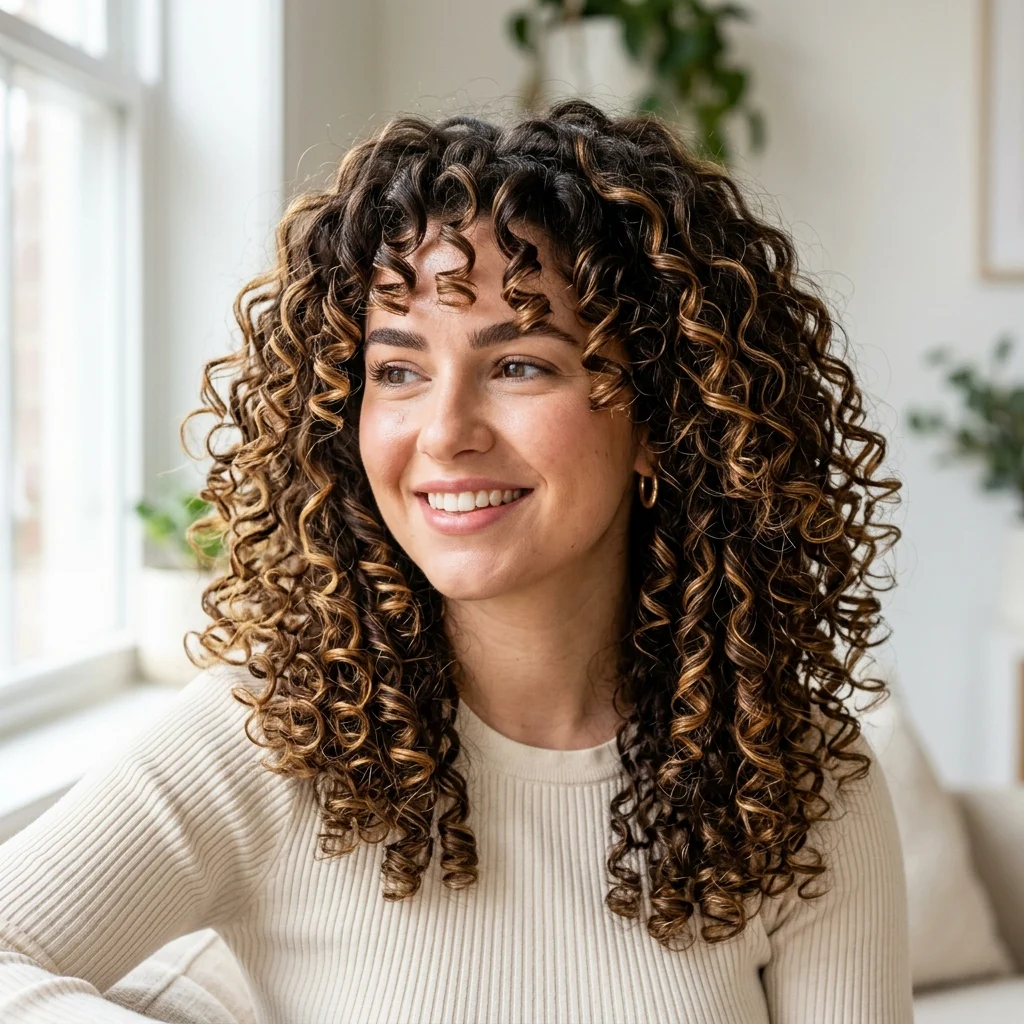
Vibe: Textured and lively, with color that follows the curl instead of fighting it.
Why it works: Curly hair coils rather than falling straight, so balayage applied while the hair is stretched can end up misplaced once the curl pattern springs back. Painting on dry, unstretched curls respects the hair’s natural texture, ensuring the caramel lands exactly where the curl clump will show it.
How to get it: Ask your colorist to apply balayage on dry, undisturbed curls rather than blown-out or stretched hair, so the color placement matches your curl pattern once it dries naturally.
Shop the Look
| Item |
|---|
| Curl-defining cream for color-treated curls |
| Sulfate-free curl cleanser |
| Diffuser attachment for blow dryer |
| Leave-in curl conditioner |
| Curl-refreshing spray |
19. Short Bob Caramel Balayage
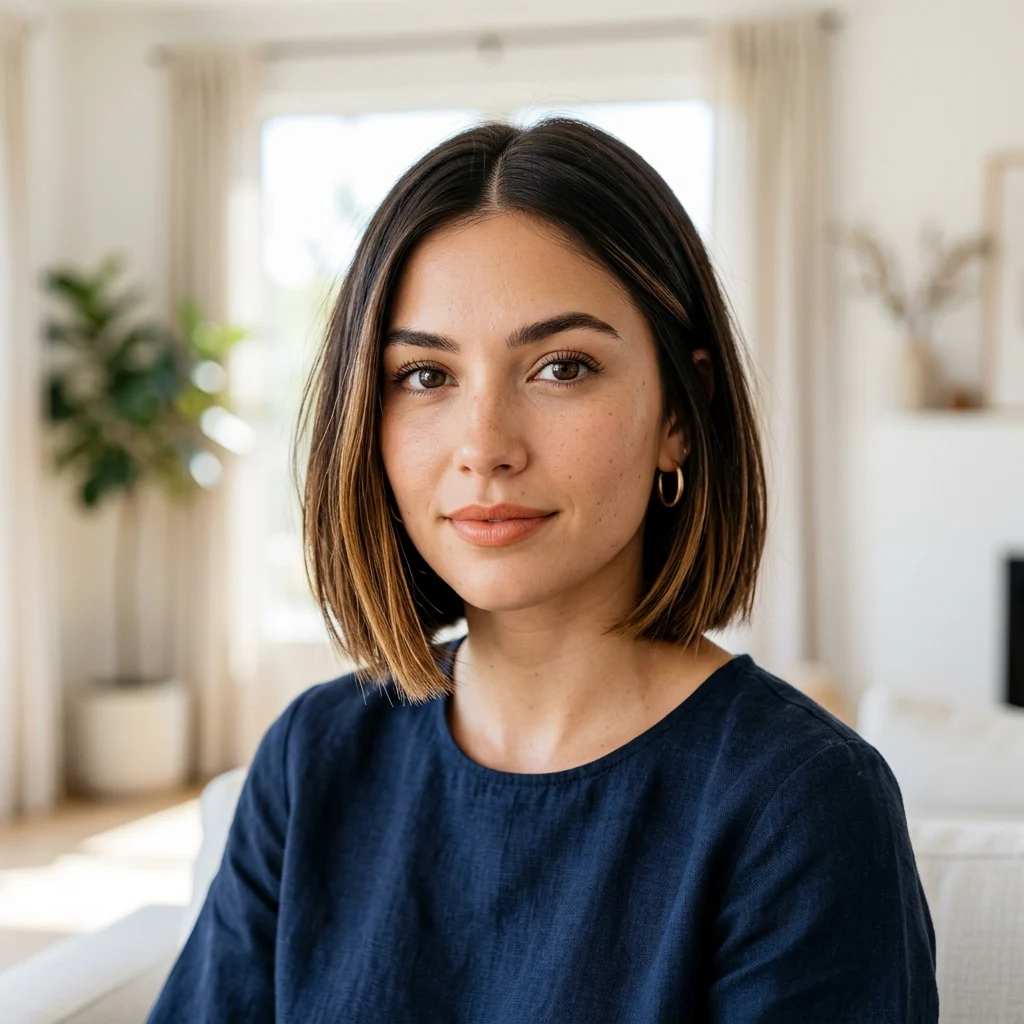
Vibe: Crisp and warm, with color compressed into a small, precise space.
Why it works: Short hair has significantly less surface area than long or medium lengths, so the balayage must be scaled down using finer, more concentrated sections. This proportion adjustment keeps the color from looking blocky on a bob, where large sections would otherwise overwhelm the cut.
How to get it: Request narrow, closely spaced balayage sections concentrated around the part line and ends, avoiding broad painted chunks that read as too heavy on shorter lengths.
Shop the Look
| Item |
|---|
| Texturizing paste for short hair styling |
| Small-barrel curling iron for bob waves |
| Volumizing dry shampoo |
| Shine spray for short cuts |
| Flexible-hold hairspray |
20. Silk Scarf Styling for Caramel Tones
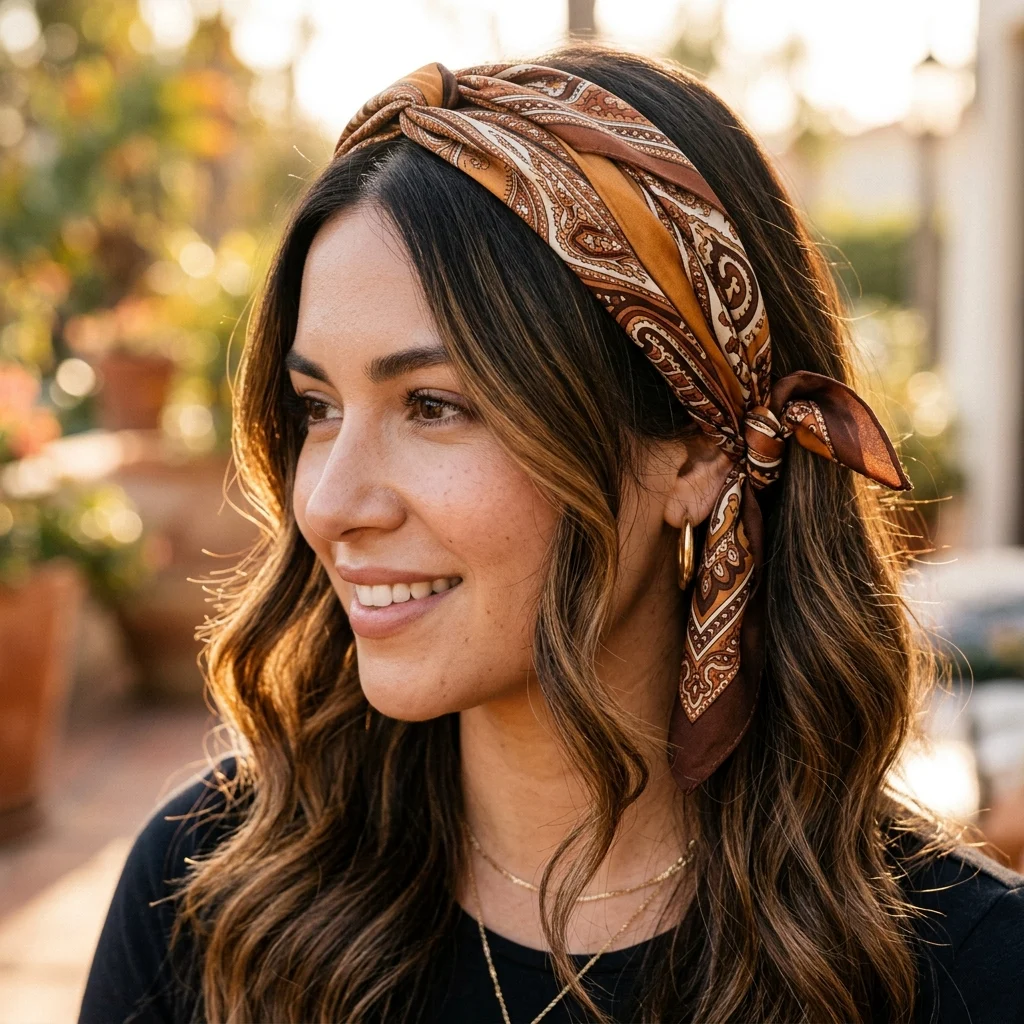
Vibe: Warm and decorative, with fabric that extends the color story past the hairline.
Why it works: A silk scarf in warm amber or rust tones echoes the caramel balayage’s undertone, extending the color palette beyond the hair itself. This uses palette continuity, a styling principle where accessories repeat existing tones rather than introducing competing colors.
How to get it: Choose a silk scarf in a warm caramel, rust, or amber print, fold it into a thin band, and tie it at the nape or in a bow at the crown to frame the balayage pieces.
💡 Quick Win: A scarf headband is a no-heat styling option that protects hair from daily heat damage while still showcasing the color.
Shop the Look
| Item |
|---|
| Silk scarf in warm amber print |
| Satin headband alternative |
| Bobby pins to secure scarf ends |
| Texturizing spray for scarf-adjacent waves |
| Small mirror for at-home styling |
21. Reverse Balayage Caramel Base
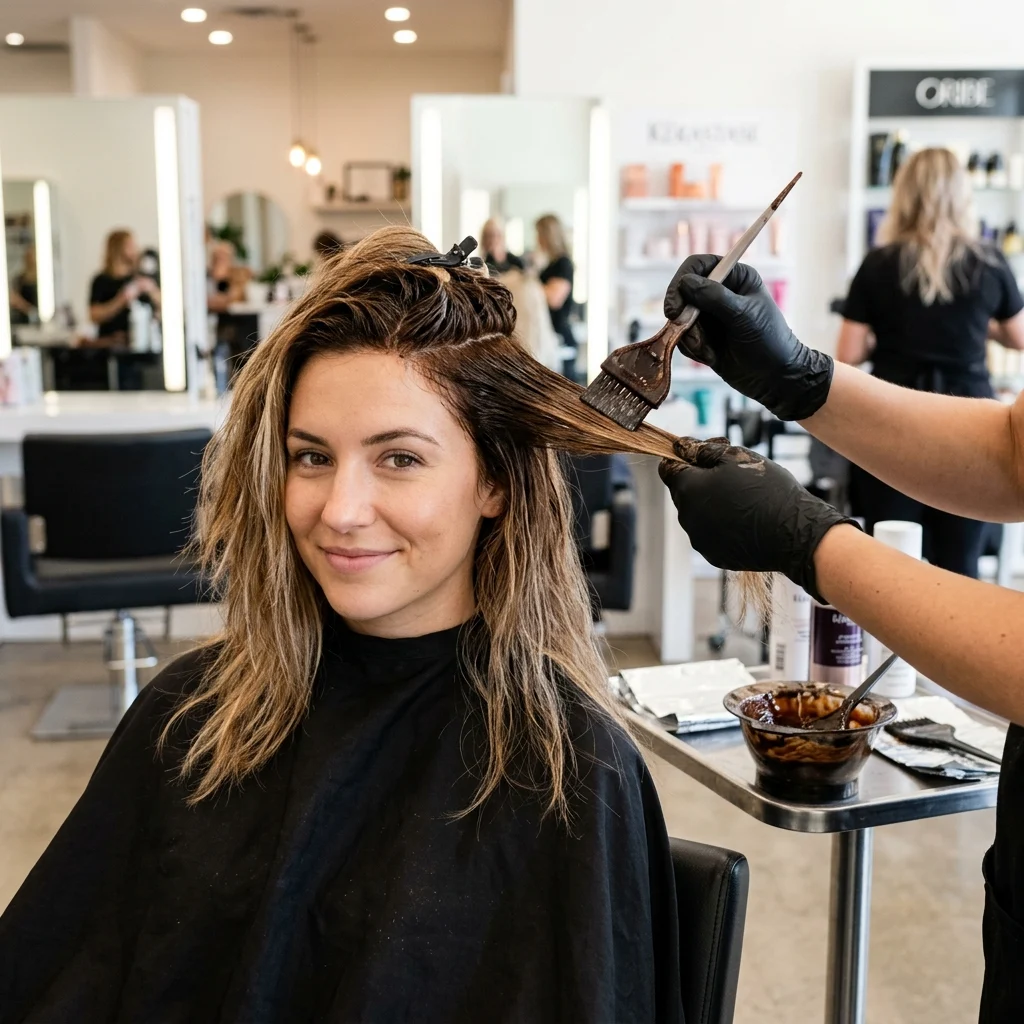
Vibe: Transformative and warm, color moving in instead of out.
Why it works: Reverse balayage paints a deeper caramel or espresso tone over previously lightened hair rather than lifting color further, using a technique that layers pigment onto porous, already-processed strands. This works because dark demi-permanent color deposits more evenly on lightened hair, giving a richer, longer-lasting result than trying to lighten already-damaged sections again.
How to get it: If you’re transitioning from a heavily highlighted look, ask your colorist to paint caramel and espresso tones over the existing lightness rather than adding more foils, which reduces damage while achieving the same dimensional effect.
Shop the Look
| Item |
|---|
| Bond-repair treatment for previously lightened hair |
| Color-depositing caramel mask |
| Porosity-correcting pre-treatment |
| Deep conditioning hair oil |
| Gentle sulfate-free color-safe shampoo |
22. Cinnamon-Caramel Fusion
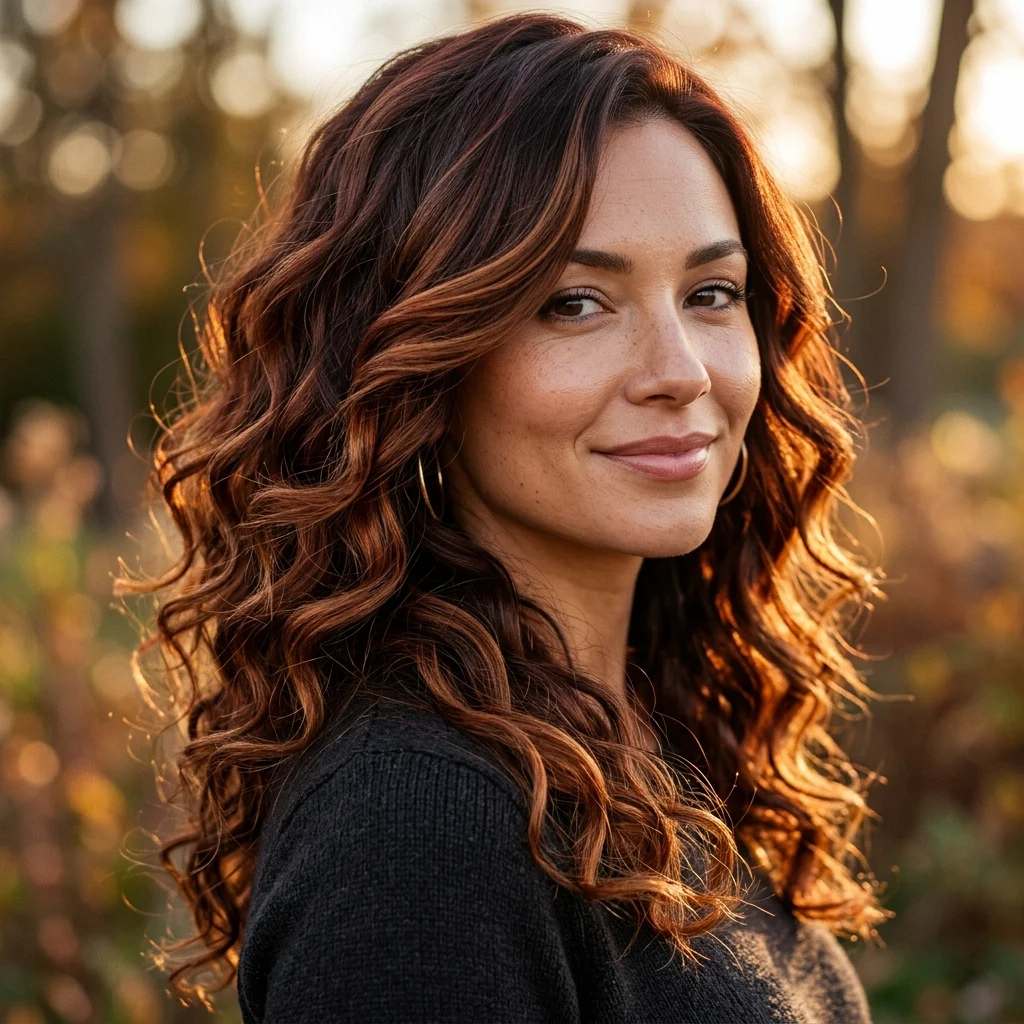
Vibe: Rich and spiced, with a red undertone warming the caramel further.
Why it works: Adding a cinnamon-red pigment to the caramel formula shifts the tone warmer on the color wheel, deepening the richness without darkening the overall value. This is pigment layering, mixing a red-based toner into a gold-based caramel to build a more complex, multidimensional warm tone.
How to get it: Ask your colorist to mix a small amount of red-copper toner into your caramel glaze, which adds a cinnamon-like warmth that reads as rich rather than brassy.
Shop the Look
| Item |
|---|
| Copper-red color-depositing conditioner |
| Warm-toned glossing treatment |
| Heat protectant for color vibrancy |
| Red-brown root touch-up spray |
| UV-protectant shine serum |
23. Part-Line Caramel Highlight
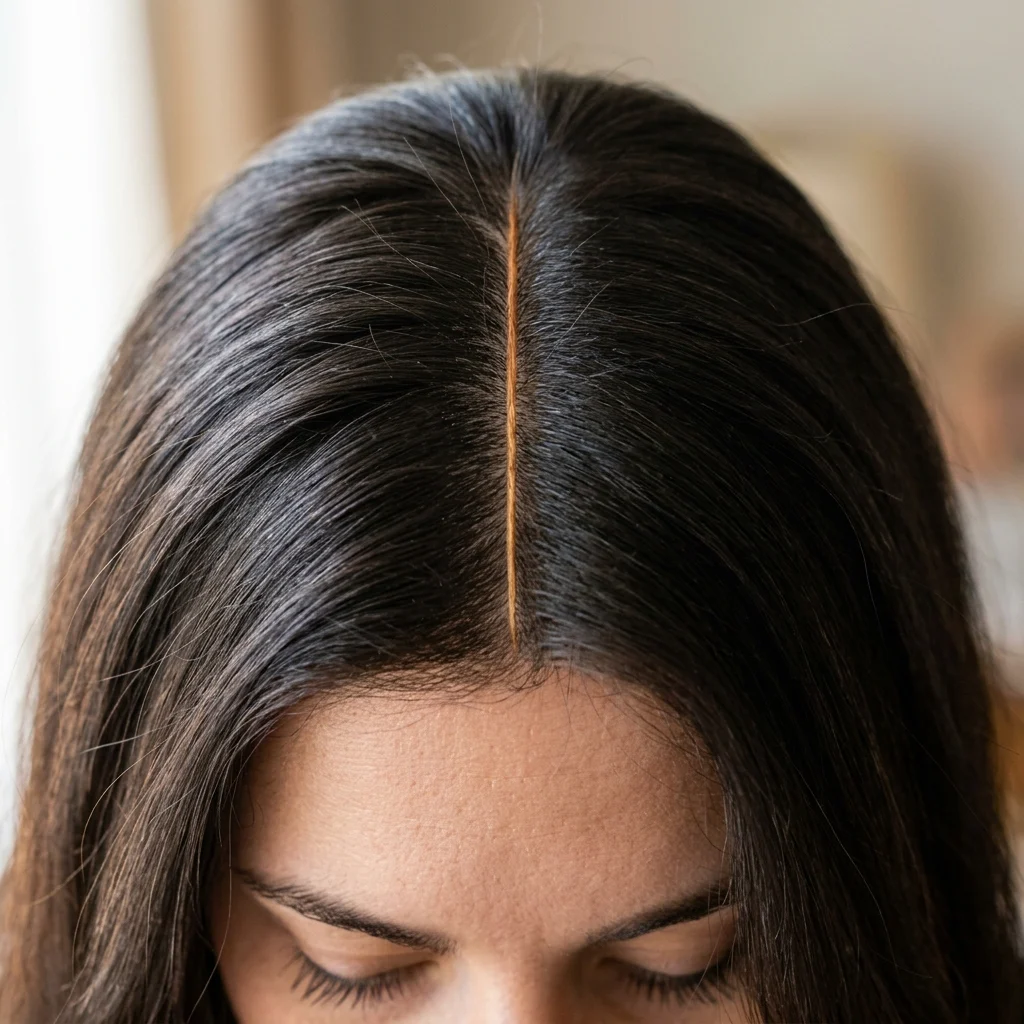
Vibe: Precise and warm, with a single defined line doing all the work.
Why it works: The part line is one of the most visible sections of hair from a top-down view, so placing a bright caramel strip there uses focal placement to maximize visibility with minimal color processed. It’s an efficient technique for adding brightness without a full balayage service.
How to get it: Ask your colorist to paint a half-inch-wide strip of caramel directly along your natural part, blending it softly into the surrounding espresso base so it doesn’t look like a stripe.
Shop the Look
| Item |
|---|
| Fine-tooth rat tail comb for precise parting |
| Root-brightening spray |
| Small detail brush for touch-ups |
| Shine-enhancing part-line serum |
| Color-safe styling gel |
24. Caramel Balayage for Deep Skin Tones
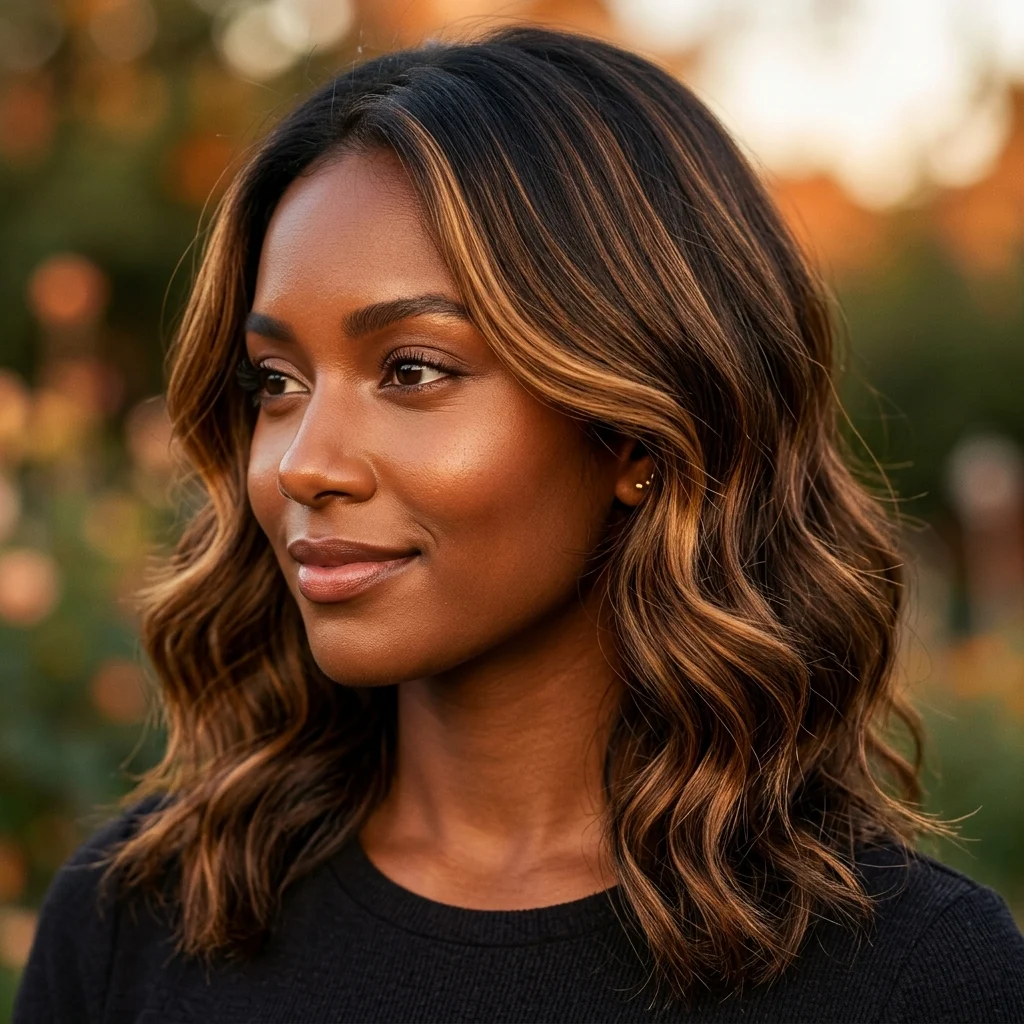
Vibe: Rich and radiant, with warmth that complements rather than washes out.
Why it works: Gold and amber-based caramel tones sit on the warm side of the color wheel, which typically flatters deep skin tones by echoing their own warm undertones rather than contrasting against them. This is undertone matching between hair and skin, a principle colorists use to avoid ashy or gray-toned results that can flatten deeper complexions.
How to get it: Request a caramel formula mixed with gold rather than beige or ash base, and ask your colorist to concentrate the richest tones around the face for maximum warmth where it matters most.
💡 Quick Win: A gold-tinted glossing treatment applied between salon visits keeps the caramel from fading into a duller, less flattering tone.
Shop the Look
| Item |
|---|
| Gold-toned glossing treatment |
| Deep conditioning oil for warmth retention |
| Color-safe shine spray |
| Amber-tinted leave-in treatment |
| Wide-tooth comb for even product distribution |
25. Caramel Balayage on Pixie and Short Cuts
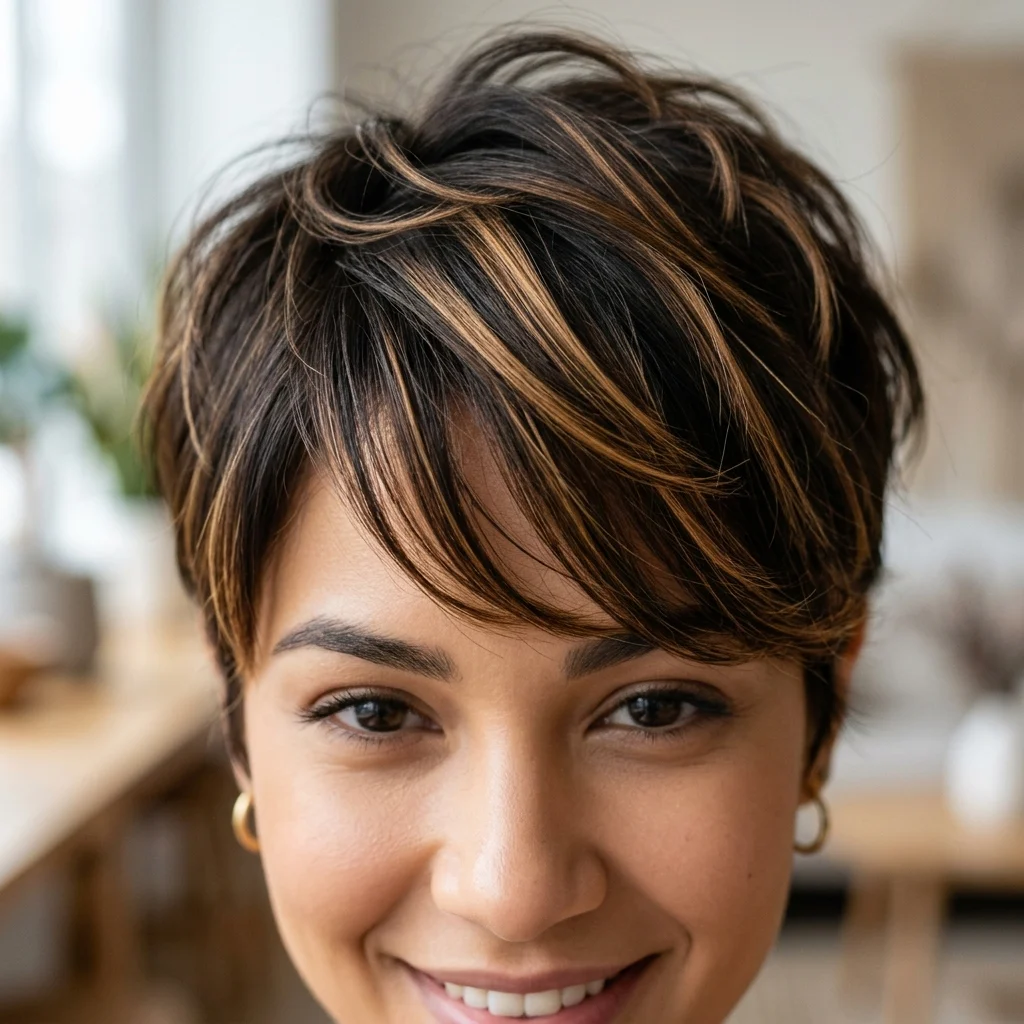
Vibe: Crisp and playful, with color reduced to its smallest, most efficient form.
Why it works: Pixie cuts offer the least amount of surface area of any length, so balayage must be scaled down to fine, feather-light sections concentrated at the crown and fringe. This is extreme proportion management, since even a small amount of misplaced color can dominate a very short cut.
How to get it: Ask your colorist to paint caramel only at the very tips of the crown and fringe pieces using a fine brush, rather than sectioning the way they would for longer hair.
Shop the Look
| Item |
|---|
| Texturizing wax for pixie styling |
| Small detail brush for precise color touch-ups |
| Volumizing spray for short crown pieces |
| Shine pomade for pixie cuts |
| Travel-size heat protectant spray |
How to Start Your Dark Caramel Balayage Transformation
The single best first move is booking a consultation focused on your base color, not the caramel itself. Your colorist needs to determine whether your natural or current color needs to shift toward espresso or chestnut before any caramel is painted, since the base tone controls how warm or cool the final caramel will read. Getting this right first prevents the most common and expensive fix later on.
The most common mistake is requesting caramel balayage without addressing an existing brassy or orange base, which causes the new caramel to blend into an already warm foundation and lose all contrast. The fix is a toning service before balayage begins, using an ash-based glaze to neutralize unwanted warmth so the caramel has a clean, deep canvas to stand out against.
Three items under fifty dollars that create immediate impact: a purple-free color-depositing brown mask to maintain the espresso base between salon visits, a bottle of glossing hair oil in a warm amber tint to keep caramel pieces from looking dull, and a set of tortoiseshell hair clips that echo the caramel-espresso palette in everyday styling.
A first balayage service typically takes two and a half to four hours and runs between $150 and $400 depending on hair length and colorist experience, while a full transformation including toning and a haircut can stretch toward $500. A single money piece or face-framing version can be achieved in one weekend appointment, while a full-head root melt with babylights may take two visits spaced a few weeks apart.
Frequently Asked Questions About Dark Caramel Balayage
What is the difference between dark caramel balayage and regular balayage?
Dark caramel balayage specifically pairs a deep espresso or chestnut base with warm, honey-gold caramel tones, while regular balayage can use any base and highlight combination, including cooler ash or platinum tones. The “dark” element refers to the depth of the base color, typically level 3 to 5 on the color scale, which keeps the overall look rich rather than heavily lightened. This makes dark caramel balayage a lower-maintenance option since roots blend rather than contrast sharply.
What is the best caramel color for dark hair?
A gold-based caramel formula, mixed to a warm level 6 to 7, tends to show up most clearly against a dark espresso or chestnut base without looking muddy. Colorists often avoid beige or ash-based caramel on dark hair, since it can read as gray rather than warm once processed. A cinnamon or copper-caramel blend also works well for those wanting extra richness.
How much does dark caramel balayage cost?
A single balayage service for dark caramel tones typically runs between $150 and $400, depending on hair length, salon location, and colorist experience level. Adding a toning glaze usually costs an additional $30 to $60, while a haircut and blowout can bring the total closer to $500. Maintenance touch-ups every three to four months typically cost less than the initial service since less color is being processed.
Does dark caramel balayage work on all hair types, including curly or fine hair?
Yes, dark caramel balayage adapts well to curly, straight, and fine hair, though the technique changes slightly for each. Curly hair is best painted while dry and unstretched so the color lands correctly once curls spring back into place, while fine hair benefits from narrower, more concentrated sections to avoid a patchy appearance. Coarser or thicker hair can typically handle broader balayage sections without losing definition.
What is the money piece in dark caramel balayage?
The money piece refers to one or two bold, face-framing sections lightened brighter than the rest of the balayage, usually placed along the hairline near the cheekbones. It is the most concentrated, high-contrast element of the look and is often requested on its own for a lower-commitment version of dark caramel balayage. Because it sits closest to the face, it has the most visible impact relative to how little hair is actually colored.
Ready to Create Your Dark Caramel Balayage?
From root melts and money pieces to curly texture and pixie placements, these 25 dark caramel balayage ideas cover nearly every base tone, cut, and maintenance level. You don’t need to commit to a full-head transformation right away, starting with a single face-framing section or a root smudge is a legitimate way to ease into the color and see how it grows out on you. Book a consultation this week and bring a photo of the specific placement, whether it’s a money piece or a root melt, so your colorist can map the formula to your natural base.
Once it’s done, the color settles into something that feels less like a trend and more like your hair simply catching light the way it always should have. Save your favorite two or three ideas from this list, especially the ones matching your current length, so you walk into your appointment ready to show exactly what you want.