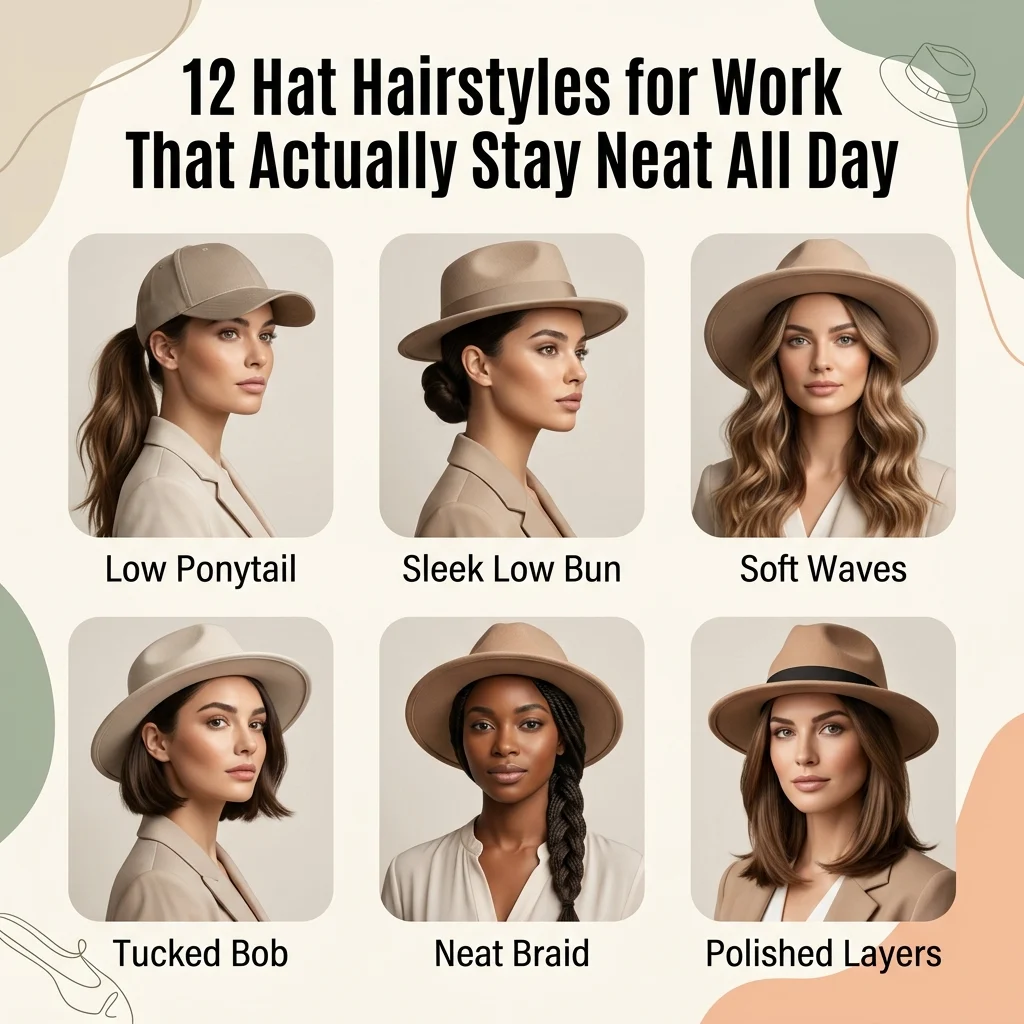
12 Hat Hairstyles for Work That Actually Stay Neat All Day

Hat hairstyles for work are hair-styling techniques built specifically to survive six to eight hours of hat pressure, friction, and static without collapsing, denting, or frizzing, the opposite priority of a regular blowout, which is styled for volume that has nowhere to go once a hat sits on top of it. This article gives you 12 genuinely wearable, office-tested hat hairstyles that hold their shape from the morning commute through a full day of meetings, matched to the specific hat types (wool felt, straw, leather, knit) that create office and smart-casual wardrobes.
There’s a particular kind of calm that comes from not thinking about your hair once you leave the house, no bathroom-mirror repair before the first meeting, no self-conscious hand smoothing down flyaways under fluorescent light. The best hat hairstyles feel structured at the root and soft at the ends, engineered rather than merely tucked away, and they look intentional the instant the hat comes off rather than leaving behind the telltale ring of a rushed, undone style. Here are 12 ideas worth saving, and stealing.
Why Hat Hairstyles Work So Well for the Office
Hat hairstyling as a distinct technique exists because of a mechanical problem that regular hairstyling doesn’t have to solve: sustained pressure and friction against a single point of the scalp for hours at a time. A hat’s sweatband sits directly against the hairline, and its crown presses down against whatever sits underneath it: a loose blowout, a high ponytail, or teased volume will all flatten, dent, or frizz within an hour under that pressure, which is why office hat-hair complaints spiked alongside the return-to-commuting culture of the past several years, when more people began wearing structured outerwear hats (wool felt fedoras, boiled-wool berets, structured wide-brims) for train platforms and outdoor walks between buildings rather than only on weekends. The techniques that solve this problem are borrowed from three older hairdressing traditions: the low chignon and French twist of early-to-mid-20th-century office dress codes, when hats were a daily uniform requirement and hairstyles had to be engineered specifically to fit beneath them; the tension-braiding techniques of protective and travel styling, which distribute pressure across the scalp instead of concentrating it at one elastic; and the flat-set finger-waving and pin-curl methods of the 1920s cloche era, when the fitted, low-crown cloche hat required hair to be styled almost architecturally close to the head.
The materials that actually determine whether a hat hairstyle holds are not the hair products alone but the hat’s lining and shape. Wool felt (used in fedoras, structured wide-brims, and boaters) has the highest static and grip of any common hat material, which means smooth, sealed styles (a slicked bun, a flat twist) outperform loose or fine-textured styles underneath it. Straw and raffia are the most breathable and least grippy materials, giving the most flexibility for higher buns and looser styles. Leather has the lowest friction of any hat lining, meaning styles need firmer tension and stronger hold products since hair slides rather than catches. Knit wool, used in beanies and ribbed caps, sits closest to the scalp of any hat type and rewards braided or twisted bases that lie flat rather than anything with volume at the crown. On the hair-product side, the products that matter most are boar-bristle brushes (Mason Pearson’s Pocket Bristle Brush is the benchmark most stylists reach for), anti-humidity and anti-static serums (Moroccanoil Frizz Control, Oribe’s Balm d’Or), and firm-but-flexible hold products rather than stiff-hold hairsprays, which crack and flake under hat pressure.
This category of styling has grown specifically alongside two overlapping shifts: the return-to-office movement, which put more people back into daily commutes long enough to require actual hat-hair solutions rather than a five-minute walk from car to desk, and the broader outerwear-as-styling trend on Pinterest and TikTok, where structured hats moved from purely functional cold-weather items to daily styling pieces paired deliberately with tailored coats and workwear. Pinterest’s own trend data has repeatedly flagged “hat hair fix” and “hairstyles for hats” as high-growth searches each autumn, tracking almost exactly with the seasonal return of wool and felt hats to daily rotation.
Even fine or short hair can achieve reliably hat-proof styles, though the honest caveat is that very fine, silky hair needs a texturizing step, a salt spray like Oribe’s Maritime Volume Spray or a dry texture spray like Amika’s Perk Up, applied before any braid, twist, or bun, since smooth, product-free strands slip out of tension styles noticeably faster once hat pressure and friction are added to the equation.
Style at a Glance
| Element | Structure-First Styles | Volume-First Styles |
| Philosophy | Flat, tension-based hold designed to survive pressure | Height and lift, intended to be worn without a hat |
| Key Techniques | French twists, flat braids, tight low buns | Round-brush blowouts, teasing, backcombing |
| Key Products | Boar-bristle brush, anti-static serum, firm flexible-hold cream | Volumizing mousse, round brush, heat styling |
12 Hat Hairstyles for Work
1. The Low Sleek Bun Under a Wide-Brim Fedora
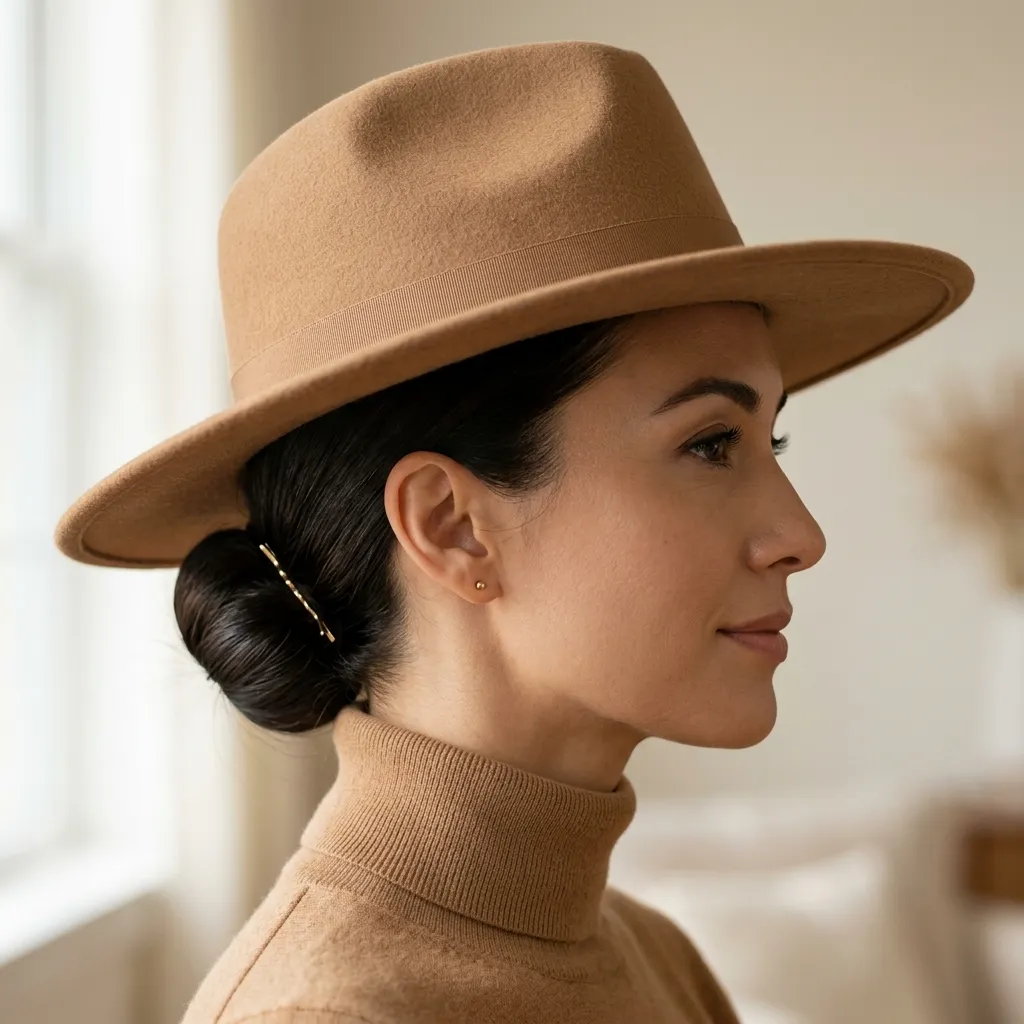
Vibe: Grounded and composed.
Why it works: The low sleek bun is the single most fedora-compatible hairstyle that exists, for a specific structural reason: a wide-brim fedora’s crown sits several inches above the head, but its sweatband circles the hairline at forehead height, meaning anything built up at the crown a high bun, teased volume gets crushed the moment the hat is set down, while anything low and flat at the nape sits entirely clear of the hat’s structure. Wool felt in particular has more static and grip than any other common hat material, so a smooth, sealed bun resists the frizzing that a looser style would pick up within the first hour.
How to get it: Comb a dime-size amount of a smoothing cream (Oribe’s Supershine Moisturizing Cream or a drugstore equivalent like L’Oréal EverPure Smoothing Cream) through damp hair before drying, then twist hair into a low bun at the nape and secure with two crossed bobby pins rather than an elastic, which reduces the bulk that would otherwise press uncomfortably against the fedora’s back curve. Finish the hairline with a boar-bristle brush dipped lightly in the same cream to seal any static before setting the hat.
💡 Quick Win: Keep a travel-size smoothing balm Kitsch’s Flyaway Wand is a compact option, in your bag for a 30-second touch-up before afternoon meetings, applied with a fingertip along the hairline only.
Shop The Look
- Wide-brim camel wool felt fedora hat, women’s
- Smoothing hair cream, anti-frizz travel size
- Gold metal bobby pins, 60-piece set
- Boar-bristle edge control brush, small
- Small gold hairpin, minimalist
2. The Structured Middle-Part with a Wool Beret
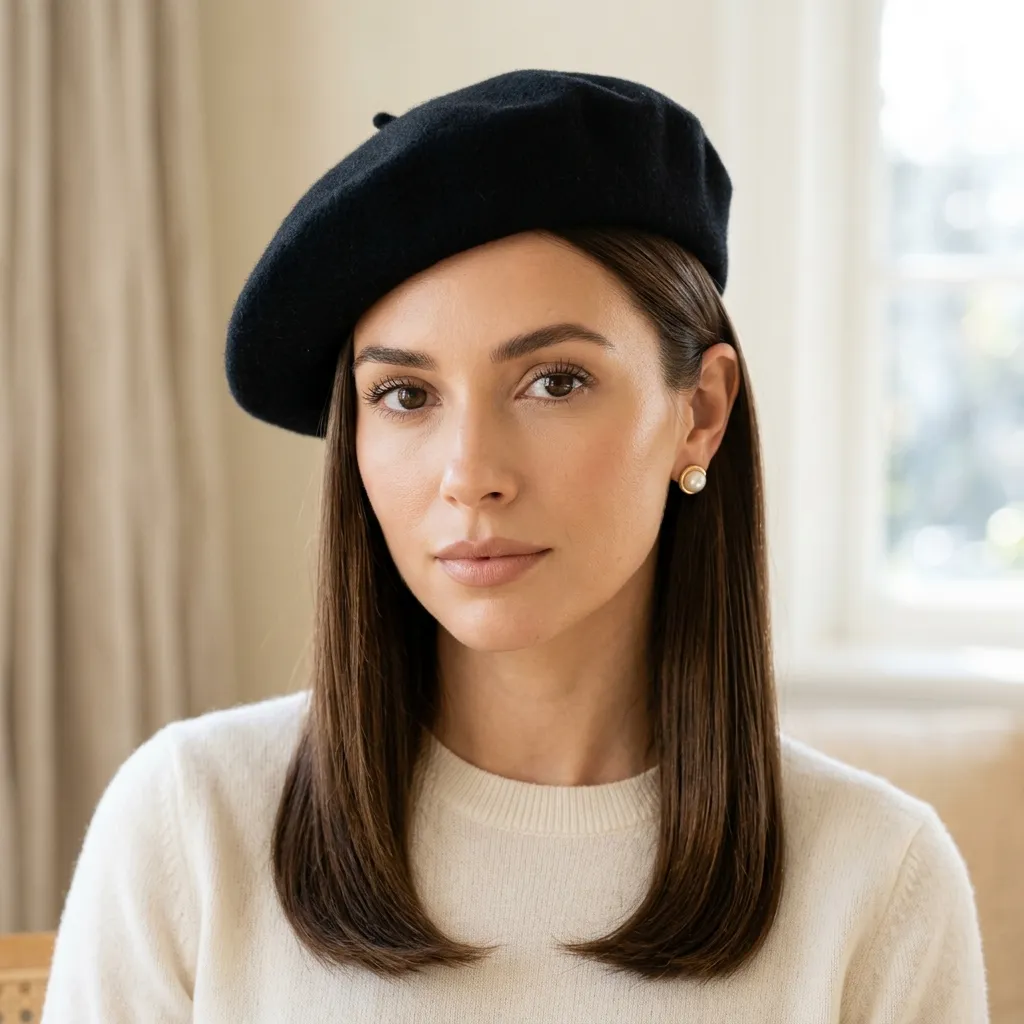
Vibe: Sharp and deliberate.
Why it works: The beret is one of the only hat shapes in this list that doesn’t require hair to be tucked, pinned, or gathered at all, because its soft wool construction has enough give to sit over loose hair without crushing it, which shifts the entire styling problem from containment to precision. A crisp, dead-center middle part creates the visual balance the tilted, asymmetrical beret needs, playing off the hat’s off-center angle with symmetry underneath it rather than competing volume. This pairing has roots in mid-century French and American office dressing, where the beret was worn specifically with sleek, controlled hair as a counterpoint to the hat’s casual silhouette. The hair supplied the polish the hat itself didn’t.
How to get it: Part hair with a fine-tooth rat-tail comb while damp, apply a lightweight glossing serum (Bumble and bumble’s Hairdresser’s Invisible Oil in the lightest amount is a reliable pick), and blow-dry straight using a paddle brush and cool-shot setting for a flat, glass-like finish that won’t puff or frizz under wool fibers. Avoid any root-lifting or volumizing product entirely here. Even a small amount of lift at the crown will show as an odd bump under the beret’s soft dome.
Shop The Look
- Black wool beret, classic French style
- Lightweight glossing hair serum
- Fine-tooth rat-tail comb
- Ceramic paddle hairbrush
- Small pearl stud earrings
3. The Braided Crown Under a Ribbed Knit Beanie

Vibe: Textured and unbothered.
Why it works: A knit beanie sits closer to the scalp than any other hat type in this list, with almost no internal clearance, which makes it the most punishing hat for anything bulky or elastic-based: a braided crown solves this because braids distribute tension evenly across the scalp rather than concentrating it at a single elastic point, and they lie genuinely flat rather than adding height. The visible texture of the braid also does double duty against the specific static problem knit wool creates, since the tightly woven strands have less loose surface area for wool fibers to catch and frizz against than a smooth or loose style would. This is the same logic behind protective braiding for travel and exercise. Pressure-resistant construction rather than product-dependent hold.
How to get it: French braid two sections starting at each temple, working back toward the crown, then pin the braids flat against the head using small clear or matching-color elastics before letting the rest of the hair hang loose beneath the beanie’s edge. Apply a texturizing spray (Amika’s Un.Done Texture Spray works well here) before braiding, not after. Texture gives the braid more grip and a slightly undone look that resists visible flattening better than a sleek braid would.
💡 Quick Win: Dutch braid instead of French braid if your hair is fine or slippery, the raised, on-top strands give the beanie’s ribbed knit something to physically grip rather than sliding loose by midday.
Shop The Look
- Ribbed knit beanie, charcoal wool blend
- Small clear elastic bands for braiding
- Texturizing spray, medium hold
- Gold hoop earrings, small
- Wide-tooth detangling comb
4. The High Bun Under a Straw Boater Hat
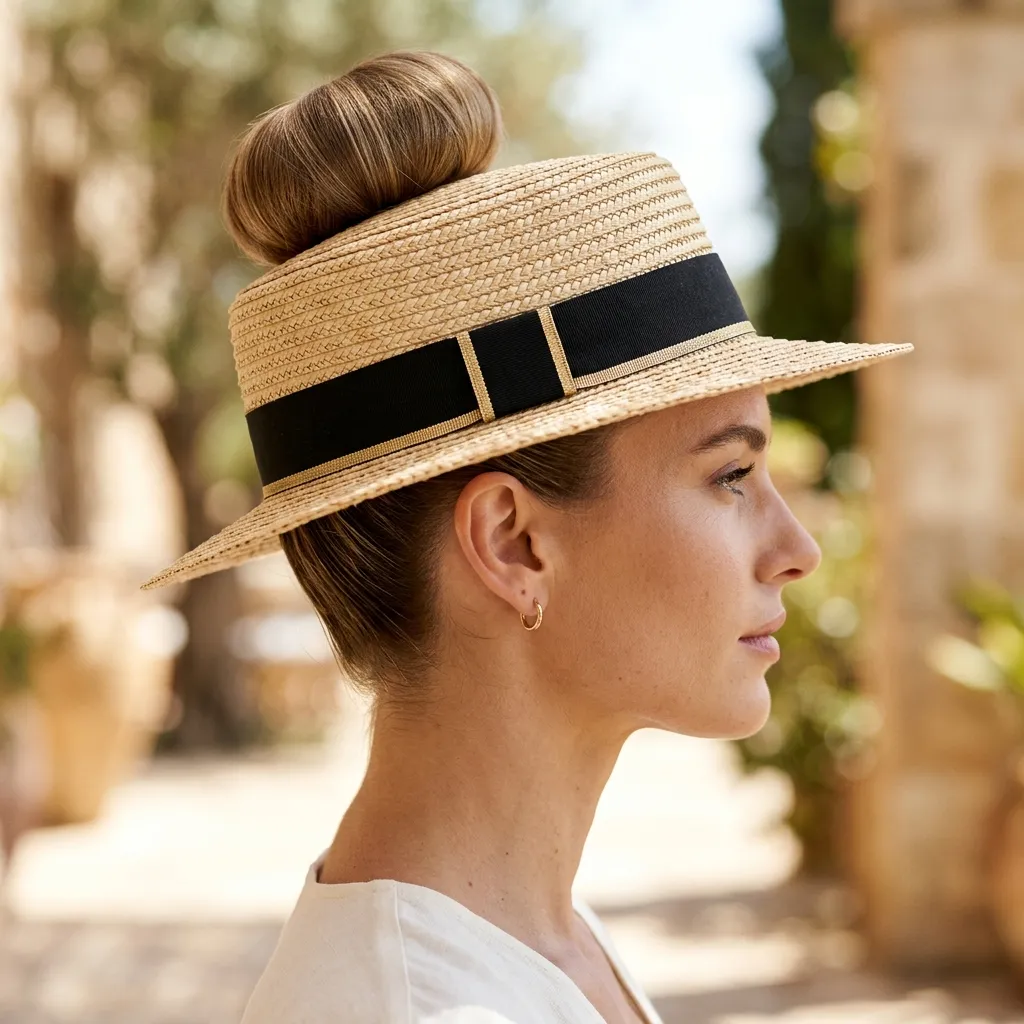
Vibe: Crisp and lifted.
Why it works: The boater hat, originally an Ivy League and rowing-club summer accessory dating back to late-19th-century regatta dress, has a rigid, flat-topped crown with genuine interior clearance, unlike a soft-brim fedora or beanie, it doesn’t flex to accommodate whatever sits underneath it, which means a high bun works here specifically because there’s physical room for it inside the hat’s shape. Straw is also the least grippy, most breathable material of any hat type in this list, so it causes far less static and heat buildup than wool felt or knit, letting a taut, smooth bun hold its shape through a full day without the frizzing wool would cause.
How to get it: Gather hair at the crown (roughly two inches above the ear line, not higher), and twist into a compact bun that sits inside the boater’s opening rather than pressing against its brim edge. Use a hair-donut form under fine or medium hair for a rounder, more structured shape, and finish with a light-hold texturizing spray (Ouai’s Texturizing Spray is a good match for straw’s breathable environment) rather than a heavy gel, which can look greasy in the bright daylight boaters are typically worn in.
Shop The Look
- Straw boater hat, black ribbon, women’s
- Hair-donut bun maker, medium
- U-shaped hair pins for buns
- Light-hold texturizing spray
- Small gold ribbon hair clip
5. Loose Half-Up Waves Under a Wool Cloche
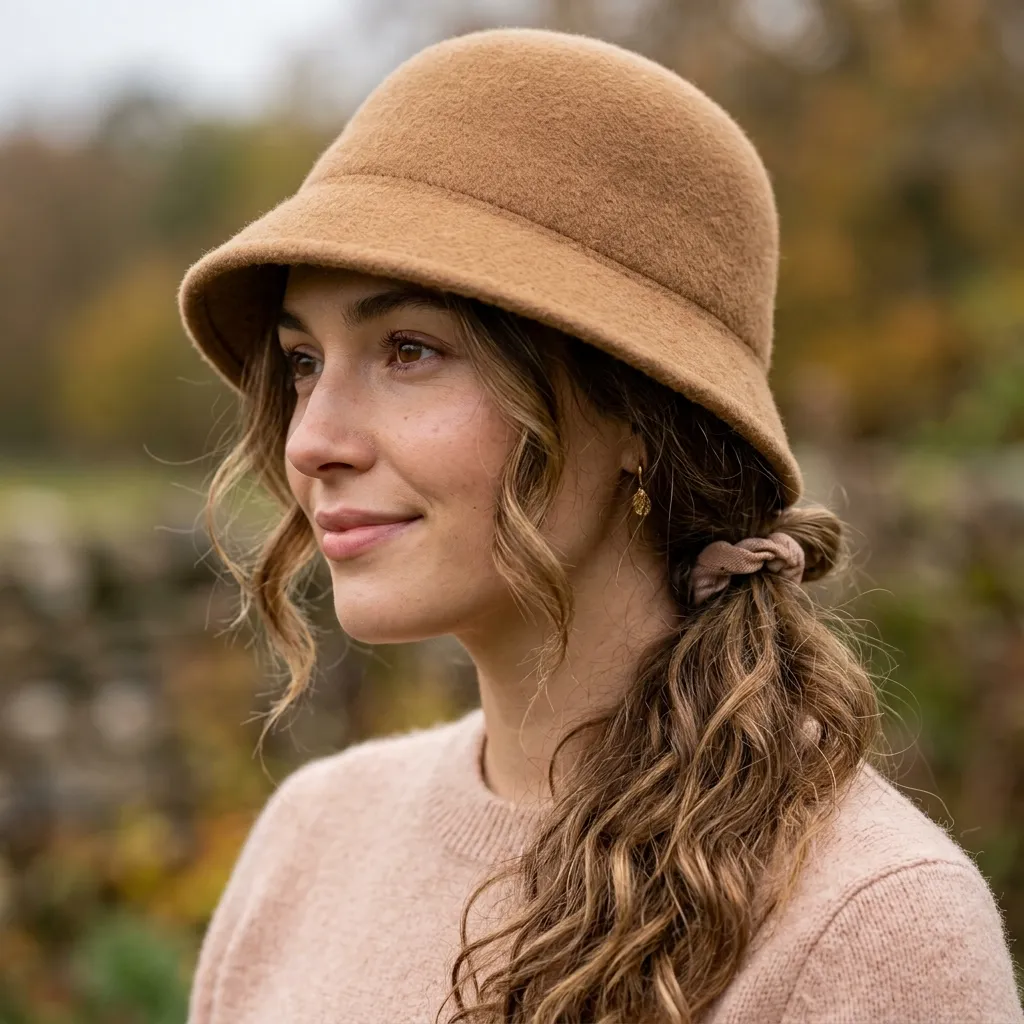
Vibe: Soft and unhurried.
Why it works: The cloche (a close-fitting, bell-shaped hat that defined 1920s women’s fashion and required hair to be styled almost architecturally flat and close to the head) is the strictest hat in this list in terms of forehead and crown coverage, pulled low enough that the front section of hair genuinely cannot move. A half-up construction respects that constraint by keeping the crown and front section controlled while letting the lower half stay loose, so the loose waves beneath the knot also serve a practical purpose: they hide any crease line the cloche’s snug edge inevitably leaves behind.
How to get it: Curl hair with a 1-inch barrel (GHD’s Curve Soft Curl Tong or T3’s SinglePass Curl are both reliable for this size) before leaving the house, section a small piece from the crown into a low half-up knot, and secure it with a fabric-covered elastic rather than plastic, which avoids the hard bump a standard elastic creates under the cloche’s tight-fitting felt. Apply heat protectant before curling since the waves need to hold for hours without a touch-up opportunity once the hat is on.
💡 Quick Win: Run a flat iron over just the front two inches of hair for a smooth, flat line exactly where the cloche’s edge sits, this single pass prevents the most visible crease of the whole style.
Shop The Look
- Wool cloche hat, camel, women’s
- 1-inch curling barrel iron
- Fabric-covered hair elastics, set
- Heat protectant spray, travel size
- Wide-tooth detangling comb
6. The Slicked-Back Bun Under a Leather Panama
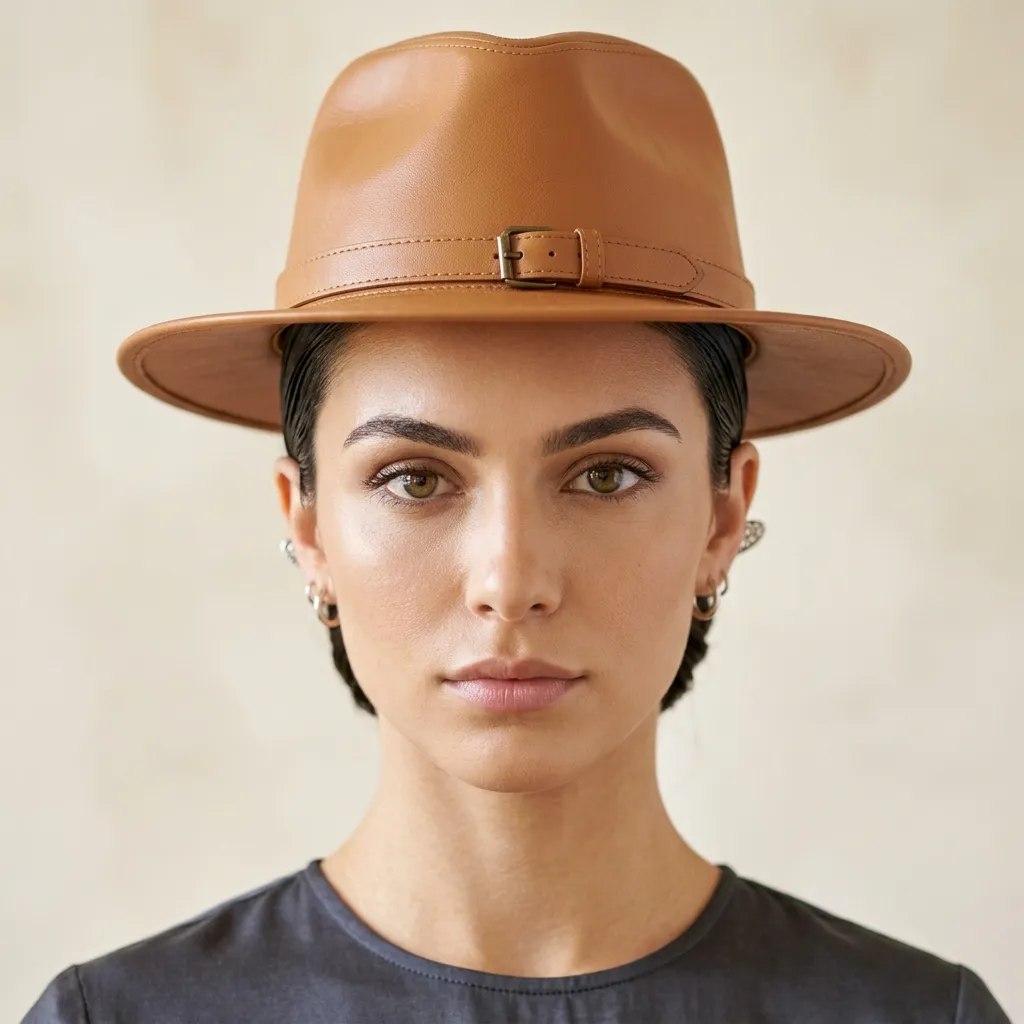
Vibe: Sharp and unshakeable.
Why it works: Leather-lined hats have the lowest interior friction of any material in this list, which sounds like an advantage but actually works against loosely styled hair, without wool’s grip or straw’s texture to hold hair in place, styles with any looseness slide and shift noticeably faster over the course of a day. A fully slicked, gel-set bun compensates by removing loose strands from the equation entirely, using product-based hold rather than material friction to keep everything in place, which is why this pairing is specifically recommended for leather rather than knit or wool hats.
How to get it: Apply a strong-hold gel (Bumble and bumble’s Sumogel or a firm-hold option like L’Ange’s Le Duo Gel Serum) with a fine-tooth comb from roots to ends, twist into a tight bun at the nape, and set the hairline with a boar-bristle brush pressed flat before pinning with two crossed pins. Because leather has so little grip, add one extra pin at the base of the bun beyond what feels necessary. The slide risk under this hat type is real enough to warrant the redundancy.
Shop The Look
- Tan leather panama hat, wide brim
- Strong-hold styling gel, clear
- Boar-bristle edge brush, small
- Silver metal hair pins, set
- Silk bonnet for evening touch-up storage
7. Side-Swept Low Ponytail Under a Herringbone Newsboy Cap

Vibe: Relaxed but pulled together.
Why it works: The newsboy cap (originally working-class British and American headwear from the early 20th century, later adopted into smart-casual office wardrobes) has a soft, gathered crown built from paneled fabric rather than a single rigid shape, so it doesn’t demand the flat, sealed base a fedora or panama does. This gives the style room to lean into ease rather than precision: a side-swept ponytail balances the cap’s asymmetrical peak visually, echoing its off-center construction instead of fighting it with perfect symmetry.
How to get it: Smooth hair back using your palms rather than a brush, which preserves some natural texture instead of flattening it completely, gather hair into a low ponytail positioned just behind one ear, and finish with a small tortoiseshell claw clip at the base rather than a standard elastic for a slightly more finished look. This is one of the few styles in the list where deliberately imperfect smoothing reads as intentional rather than undone.
💡 Quick Win: Twist the ponytail once around itself before clipping to add subtle shape and hold without committing to a full braid.
Shop The Look
- Herringbone newsboy cap, grey wool
- Tortoiseshell hair claw clip, small
- Lightweight texturizing spray
- Clear silicone hair elastics
- Small round travel hairbrush
8. The Twisted Updo for Humid Days Under a Structured Wide-Brim
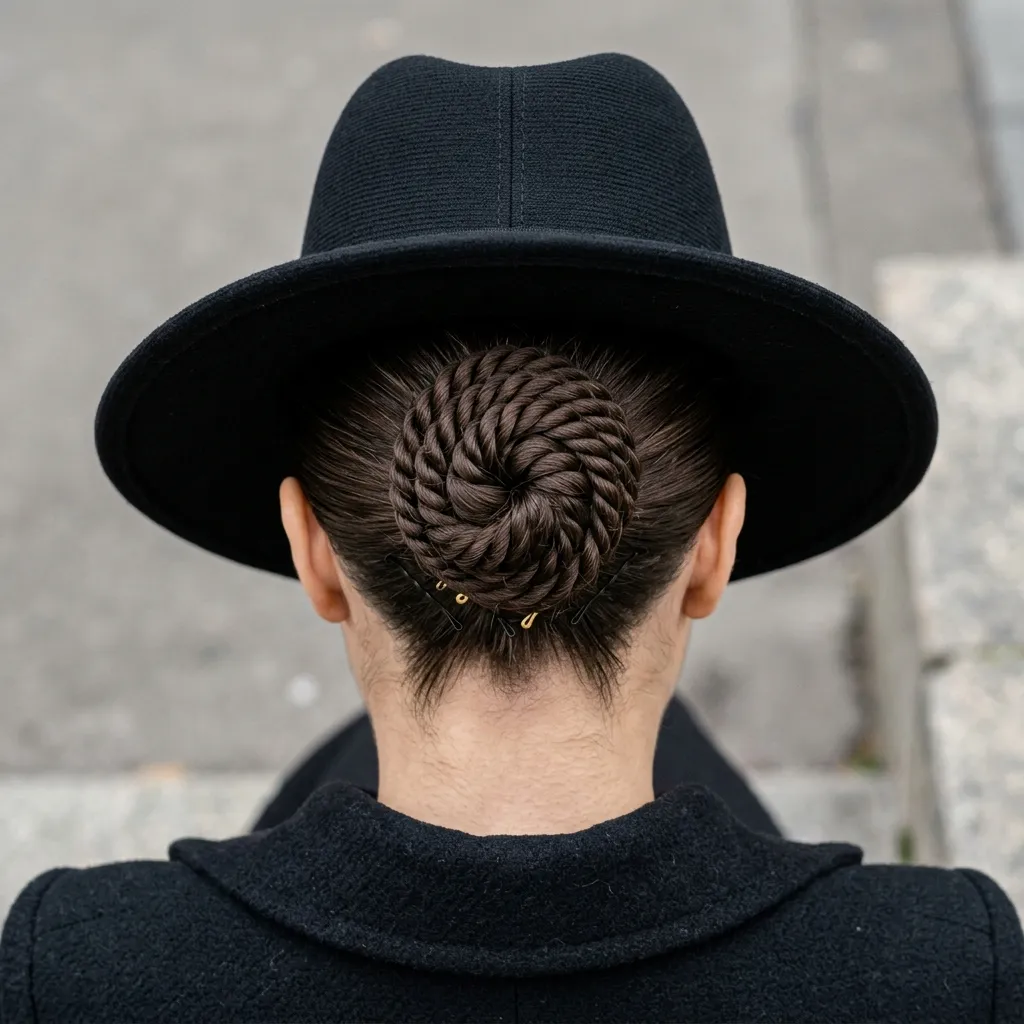
Vibe: Controlled and weatherproof.
Why it works: Twists sit flatter against the scalp than braids or buns and trap noticeably less humidity underneath them, which makes this the single most reliable option for wide-brim wool hats worn on rainy or humid commute days, when frizz, not pressure, is the real threat to the style’s survival. The tight, spiraled construction also means there’s very little surface area for ambient moisture to reach individual strands, unlike a looser braid or bun where hair is more exposed at the edges.
How to get it: Section hair into two or three parts, twist each tightly toward the scalp, and pin flat in a spiral pattern working from the nape upward. Apply an anti-humidity serum (Moroccanoil’s Frizz Control or Living Proof’s No Frizz Humidity Shield) before twisting rather than after. The serum needs to coat the strand from the inside of the twist outward, not sit on top of an already-set style, to actually block moisture penetration through the full humid day.
Shop The Look
- Structured wide-brim wool hat, black
- Anti-humidity hair serum
- Black metal hair pins, bulk pack
- Rat-tail comb for sectioning
- Matte-finish light-hold hairspray
9. The Sleek Bob Tuck Under a Fitted Beret
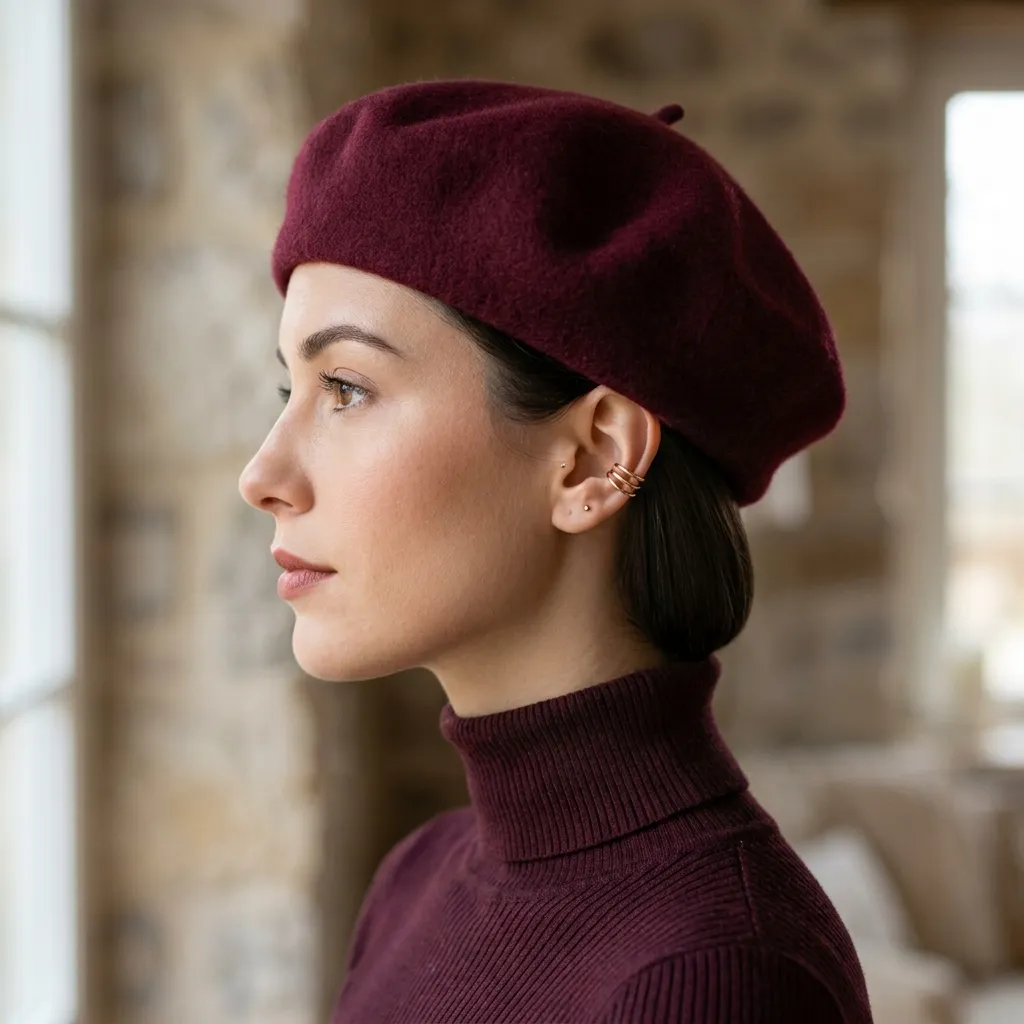
Vibe: Neat and self-contained.
Why it works: Short hair has fundamentally fewer hat-styling options than longer hair, since there isn’t enough length to gather into a bun or braid, which shifts the entire technique toward tucking and containment rather than construction. This pairing works because a fitted beret has just enough give at its rolled edge to hold tucked strands in place through friction alone, without pins. A rigid hat like a fedora or panama doesn’t have that same soft edge, which is why the bob tuck is specifically a beret technique rather than a universal short-hair solution.
How to get it: Smooth a small amount of pomade (a light-hold option like Oribe’s Cote d’Azur Beach Reflection Spray used sparingly, or a dedicated pomade like Baxter of California’s Clay Pomade in a light amount) through the ends, then physically tuck the bob’s edges under the beret’s rim in small sections, working evenly around the head so the tucked line sits at a consistent height rather than dipping unevenly.
💡 Quick Win: Mist ends with a light hairspray before applying pomade so the product has texture to grip rather than sliding loose from the tuck by midday.
Shop The Look
- Burgundy fitted wool beret
- Light-hold pomade, small tin
- Gold ear cuff, minimalist
- Flexible-hold hairspray, travel size
- Boar-bristle smoothing brush
10. Double Space Buns Under a Canvas Bucket Hat

Vibe: Playful but efficient.
Why it works: The bucket hat, originally functional rain and fishing gear before its adoption into casual and now smart-casual office wardrobes, has a rounded, all-around brim and a low, shallow crown with almost no internal clearance at the top, unlike a boater or fedora that leaves room above the head. This means buns positioned at the typical high-crown height will collide directly with the hat’s curved fabric, so the buns need to sit noticeably lower, around ear level, to clear the shape entirely.
How to get it: Part hair down the middle, gather each side low near the ear rather than at the crown, and twist into a small, neat bun secured with a snag-free elastic on each side. Avoid buns higher than eyebrow level, which is the specific height where they’ll begin pressing uncomfortably into the bucket hat’s rounded curve rather than sitting cleanly beneath it.
Shop The Look
- Olive canvas bucket hat, unisex
- Snag-free hair ties, black, pack
- Small mini claw clips, set
- Detangling brush for partings
- Light-hold texture cream
11. The Braided Half-Up Under a Raffia Wide-Brim Sun Hat

Vibe: Airy and sun-warmed.
Why it works: Wide-brim raffia sun hats are typically worn for genuinely outdoor stretches of a workday (site visits, garden centers, open-air markets, event setup) where wind, not hat pressure, is the primary threat to a hairstyle’s survival. A fishtail braid at the crown solves specifically for wind rather than for pressure, locking hair down against gusts while leaving the lower portion loose and soft, which is a meaningfully different engineering problem than the pressure-and-friction styles built for indoor office hats.
How to get it: Fishtail braid a two-inch section starting at the crown and working back to the nape, pin it flat with a bobby pin at the end, and leave the rest of the hair down. The braid functions as a physical windbreak, redirecting airflow around the crown rather than letting the entire head of hair whip loose under the brim, a technique borrowed directly from beach and outdoor-event hairstyling.
💡 Quick Win: A small carved wooden hairpin through the braid adds hold without the metallic shine that visually clashes with raffia’s natural, matte texture.
Shop The Look
- Raffia wide-brim sun hat, natural
- Carved wooden hair pins, set
- Sea salt texturizing spray
- Small clear elastic for fishtail braids
- Lightweight leave-in conditioner spray
12. The Compact French Twist for Small Bags and Tight Schedules
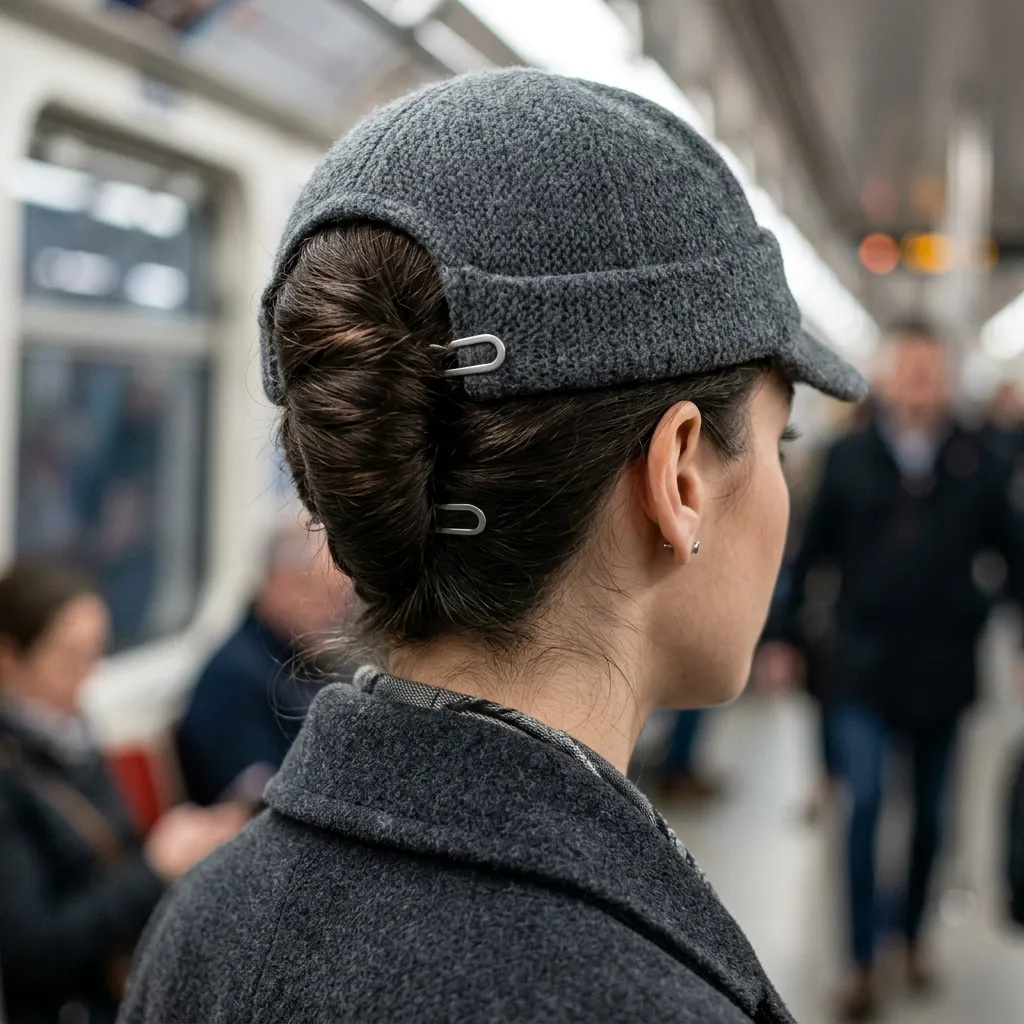
Vibe: Efficient and unfussy.
Why it works: The French twist has one of the longest histories of any style in this list. It was a staple of mid-20th-century office dressing precisely because it required no elastic, no bulk, and could be executed by feel in under two minutes, which made it the default hairstyle for women who wore structured hats to work as a daily requirement rather than a styling choice. That same efficiency makes it the best option here for anyone commuting with a small bag or no room for a full styling kit, since the entire technique relies on two pins rather than brushes, elastics, or heat tools.
How to get it: Gather hair to one side, twist upward firmly against the scalp, fold the loose ends under and tuck them into the twist, then secure vertically with two crossed pins near the top. This style depends more on muscle memory than the others on this list: practice it seated at home in front of a mirror a few times before attempting it on a moving train or in a car, since the fold-and-tuck step is difficult to execute by feel without prior repetition.
Shop The Look
- Grey wool fitted cap, unisex
- Long French twist hair pins
- Compact travel hairbrush
- Mini flexible-hold hairspray, travel size
- Small hairpin case for bags
How to Start Your Hat Hairstyle Routine
Your single first move should be switching your everyday brush to a genuine boar-bristle brush, a Mason Pearson Pocket Bristle or a more affordable equivalent like the Denman D81, used on dry, product-free hair every morning before any hat goes on. Boar bristle distributes the scalp’s natural oils evenly down the hair shaft, which is the single biggest factor in reducing the static and frizz that hats specifically cause, more than any spray or serum applied afterward. This one change alone makes nearly every style on this list hold noticeably better without adding a single new product to your routine.
The most common mistake is styling hair for volume first and putting the hat on second, which crushes that volume within the first twenty minutes and leaves a visible dent line at the exact spot where the hat’s sweatband sat. The fix is to reverse the order of priorities entirely: style flat and close to the head from the very start, as though the hat is already accounted for in the plan, and save any volume, teasing, or loose waves for after the hat comes off at your desk, not before it goes on.
Three items under $50 that create an immediate, noticeable difference: a matte-finish, flexible-hold hairspray such as Bumble and bumble’s Does It All Styling Spray (around $32), a set of long, sturdy metal U-pins made specifically for updos rather than standard bobby pins (around $8 for a set of 20), and a small tin of light-hold pomade for tucking short ends, such as a travel-size Baxter of California Clay Pomade (around $15).
Most people find their go-to hat hairstyle within their first two or three attempts rather than needing weeks of trial and error, since these are fundamentally simple, low-tool techniques rather than complex updos. A complete starter kit (a boar-bristle brush, a pack of long pins, and one flexible-hold styling product) runs $40–$60 total, and once the technique clicks for your specific hat and hair type, the whole style takes five minutes or less each morning, with no ongoing cost beyond replacing the styling product every few months.
Frequently Asked Questions About Hat Hairstyles for Work
What’s the difference between hat hairstyles and regular work hairstyles?
Regular work hairstyles are built around volume and shape meant to look best without anything covering it, relying on round-brush blowouts, teasing at the crown, and hold products designed to resist gravity, not pressure. Hat hairstyles invert that priority entirely. They’re built around a flat, low, tension-based base designed to survive six or more hours of direct pressure and friction, which is why a high, voluminous bun works beautifully without a hat but collapses into a flat, dented mess within an hour underneath one. The techniques that solve this (French twists, flat braids, tight low buns) trade height for durability, which is a genuinely different design goal than everyday office hairstyling.
Do certain hair colors or textures affect how hat hairstyles look?
Hair color doesn’t affect how well a style holds, but it does affect how visible dent lines and static become: very dark, glossy, straight hair shows a crease line from a hat’s sweatband far more obviously than textured, curly, or lighter hair does, since the smooth surface reflects light unevenly at the crease point. For that reason, darker, straighter hair types tend to benefit more from braided or twisted styles, which distribute pressure and avoid a single hard line, over sleek buns or ponytails, which concentrate pressure at one visible point. Curlier and coarser textures generally hold hat hairstyles longer overall, since the natural texture already provides grip that smooth hair has to get from product instead.
How much does it cost to build a full hat-hairstyling kit?
A functional starter kit covering the basics (a boar-bristle brush, a pack of long U-pins, and one flexible-hold styling product) runs $40–$60 total, and that’s genuinely enough to execute most of the styles in this list. A more complete kit that adds a quality curling iron for the wave-based styles (a T3 SinglePass Curl runs around $200), a travel-size anti-humidity serum, and a second hat-specific hold product for humid or leather-lined styles brings the total closer to $250–$300, which covers essentially every hat and hair-type combination described above.
Do these hairstyles work with clip-in extensions or wigs?
Yes, with one adjustment worth knowing in advance. Synthetic and human-hair clip-in extensions hold braided and twisted styles just as well as natural hair, since the technique relies on tension rather than root grip, but they tend to slip loose from buns specifically faster than natural hair does, since the clip base doesn’t move with the rest of the twist. Adding one or two extra bobby pins directly through the clip base before building the bun on top solves this reliably. Full wigs generally hold any of these styles well, though very slippery synthetic fibers benefit from a firmer-hold product than natural hair would need.
What’s the most-requested hat hairstyle for short hair specifically?
The sleek bob tuck under a fitted beret, described as idea seven above, is consistently the most-searched option for short hair, since it’s one of the only techniques in this list that doesn’t require enough length to gather into a bun or braid. It relies entirely on smoothing and physically tucking the ends beneath the hat’s rolled edge. It’s also the fastest style on this list to execute for anyone with a chin-length bob or shorter, typically taking under two minutes with practice.
Ready to Build Your Hat Hairstyle Routine?
These 12 ideas cover a genuinely wide range of what a hat hairstyle can be from the low sleek bun that solves specifically for wool felt’s static and grip, to the compact French twist built for anyone commuting with nothing more than two pins and a spare minute, to the fishtail braid engineered against wind rather than pressure for genuinely outdoor workdays. None of this needs to happen all at once, and picking just one technique that matches the hat you already reach for most often is enough of a starting point.
Today’s specific action: switch tomorrow morning’s brush to a boar-bristle one before any hat goes on, and notice by mid-afternoon how much less static and dent you’re dealing with compared to your usual routine. Once one style clicks for your hair and your go-to hat, wearing a hat stops being a trade-off against your hairstyle and becomes one less decision in an already busy morning. Save the ideas that match the hats already hanging by your door the low sleek bun and the braided crown are the two most worth pinning first.